Friday, July 13, 2012

Refreshing...

It is officially the mid-summer doldrums, where the heat, humidity and drought dominate the local's conversation.  Summer weather and politics, the two things we feel we suffer through- and can't do much about.

Morning Dew
 Yesterday morning I captured a "refreshing" photo of early morning dew on Purple Coneflower and grass.  Just looking at it makes me feel a little bit better, like there is something right with the world.  


It is the same feeling I get when I join my friends at Mid-West Native Plant Conference.  If you haven't signed up yet (beg them to let you come if it is past the date...) go here and download the registration.  It is the weekend of July 27-29 and I hope to see you there.  It is a refreshing time of sharing about native plants and the things right with the world.


Beautiful  Blues.  A Red Admiral, about to become crab spider food. 
And butterflies.  We love to look at butterflies. 

So join me for the Friday program on Home Sweet Habitat to learn more about inviting nature into your yard, and a walk (with Jim Davidson, no-less) to follow.   Jim and I will also be leading the Sunday trip to the Cemetery Prairies, and I hope you will join us to see Ohio's most historical landscapes: Native prairie.

Wednesday, July 11, 2012

King of the Prairie and Butterfly Eco-tourism

Eco-tourism is big business.  It can improve a local economy and entice communities to protect nature- once they realize its economic value. Consider the Monarch trips to Mexico, birding trips to Costa Rica or locally, the Biggest Week in American Birding and Flora-Quest are are good examples of how nature travels are economic boosters for small communities in Ohio.


IF you have an interest in butterflies- THIS is the program you need to support.  The Regal Fritially Tours  are offered 4 DAYS only each year at Fort Indiantown Gap, Pennsylvania.  They are held by PA Wildlife in conjunction with the National Guard.

The people come in droves!  After signing a few papers to remind you that you are on an active base, with active ordinance (live ammunition), we carpool out into the field where the flutterbys await!

 Wildlife program Manager, Joe Hovis  gave us an excellent run-down of the life history of the Regal Fritillary and the land management at this base designed to enhance the frit population.  They have something very special here, and they are working hard to preserve and protect it.

 A mega-bonus: in your face views of the bugs.  Since we are not allowed to enter the fields (KaBoom!) the staff has scouted ahead to procure an up-close sample for us.  This was an expected benefit of this tour, and no butterflies were harmed.  It was strictly an educational presentation and release.


There were plenty of opportunities to photograph butterflies
(at least 17 species!) from the safety and comfort of the road.  Expert lepidopterists and local families blended together on this tour.  There was something for everyone!

Nick, a land manager for the Fort, discusses the grassland management with Ohio's Guy Denny.  We learned much about the regal Fritillary and the role disturbance plays in the preservation of this endangered (in Ohio) butterfly.
" Regals love ranges," say their promotional materials.  In fact, violets love ranges and the Regals love violets.  Disturbance, ie.  fire (historically caused here by live ammo) and big military equipment (like tanks and half-tracks) running around, tears up the grasses- creating habitat for violets.  Without disturbance the grasses soon close in on the violets and crowd them out.


Now these areas are managed with a series of techniques to enhance Regal's habitat, and  Regal larva are being raised to repatriate other landscapes in Pennsylvania- like the Gettysburg battlefield, a National landmark.   Regals were once common there, but the populations died off- as fire has not been a component of the landscape management at that park.  We need to look at the big picture for these butterflies, to understand how to protect and preserve some pockets of their populations for the future.

The winner: the Regal Fritillary and the people who come to visit.  Help protect this rare butterfly by planning your 2013 trip to Pennsylvania to see this majestic King of the Prairie.  You will be impressed with the excellence of this program and the knowledge of your guides.

Monday, July 9, 2012

Regal Fritillary Reigns in Grasslands

Perhaps more majestic than even the Monarch butterfly, the Regal Fritillary was once king of the grasslands in Ohio.  At one time, it was said to be found in all 88 of Ohio's counties.  No more.  There has not been a single sighting in Ohio since 1991. (J. Daniels (2004) Butterflies of Ohio) 

Regal Fritillary nectaring on Butterfly Weed, Asclepias tuberosa

 The only remaining population in the east is found in Indiantown Gap, PA at the Fort Indiantown Gap National Guard Training Center.  These butterflies are constantly monitored, and their habitat is under strict study and management.  We'll have more of that story in the next post.

Honeybee startles a female Regal Frit
First we need to understand the intricate timing of the two sexes of fritillaries.  Regal Frits are univoltine (meaning one brooded), and the males emerge a week or two earlier than the females.  Often the males are rather tired looking by the time these fresh young females arrive on the scene.  It is all but impossible to tell the two apart, until they spread their wings.  Females have two rows of white dots at the lower wing margin.

Once the ladies are on the scene the males have only one thing on their mind.  Males patrol around the open grass and any outlying shrubbery;  they are searching for the ladies.  We watched one dive under this bush, where he sat waiting- nearly undetectable.
"You can't see me."

Regal Fritillary, Male

He briefly opens his wings, just long enough to capture this shot of the hindwings which bear his signature- two colors on the black margin.  The bottom row of dots are orange and the upper markings are white.

Once the pair have mated, the female will lay up to 2,000 eggs.  Apparently she randomly distributes them throughout the grass, regardless of the presence of their host plant, violets.

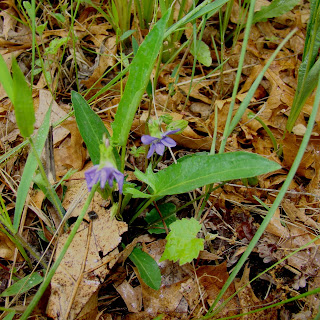
The Regal's preferred violet is the Arrow-leaved Violet, Viola sagittata. 

Once the larva hatch, they must find their way to clumps of little bluestem, where they will winter beneath the ground, in the  larval stage. They re-emerge in the spring to feed on their host plants- violets.


Many species of fritillaries have similarly unusual life cycles, so this alone cannot account for the Regal's rarity. It is thought that loss of habitat is the main reason for their decline.  In Ohio we have lost over 99 % of our native grasslands.  Is it any wonder that we might have lost this Regal butterfly as well?

Sunday, July 8, 2012

Fritillary Trifecta

 Having just returned from a quick trip to Pennsylvania,  here are a few quick photos from a fabulous day of butterflying.   The trip's focus was Fritillaries, the Speyeria genuis of butterflies; now the trifecta for your viewing pleasure.

Aphrodite Fritillary,  Speyria aphrodite

The Aphrodite Frit was a pleasant surprise on this trip. Having only once photographed this species in the Oak Openings in Ohio, it was the bonus butterfly of the day!  These are somewhat rare in Ohio, or at least rarely reported as they are difficult for the novice to separate from the more common Great Spangled Fritillary.  Note: the hindwings have little color contrast in the brown field.

Great Spangled Fritillary, Speyeria cybele

One would be expect to see this butterfly on most outings in the mid-west or north-eastern states.  It is commonly found nectaring at any of the milkweeds and like all frits, its host plants are members of the violet family. Note the hindwings have a golden band of color contrast between those "great" silver spangles.

Regal Fritillary,  Speyeria idalia

All hail the KING!  The Regal Fritillary.  Once known  in most counties, it is extirpated (no longer found) from Ohio; it has not been reported since the late 1980's.  The prairie/meadow loving species is a breath-taking standout among the frits and worth the trip to see this glorious creature.

Stay tuned for some life-history and facts about this orange and black stunner.  Just give me a day to collect my thoughts-  the 'Picker.

Sunday, July 1, 2012

The "Polka Dot Forest"

Deep into West Virginia, in a quiet valley within a pristine gorge, lies a puzzling sight.  The locals call it the "Polka Dot Forest."   It makes the uninformed wonder a bit, and speaks of a worrisome future to those "in the know."

 What are those "dots" on the Hemlock trees?

In late April, just before Flora-Quest, I had traveled to the New River Gorge in West Virginia with Greg Miller, to see what would become my life Swainson's Warbler.  Needless to say the scenery is beyond gorgeous and I would recommend the New River Birding Festival to any of you inclined toward natural things.

 Greg and I enjoyed a day at the Endless Wall Trail at Fern Creek, which I highly recommend for many reasons, including great looks at Swainson's Warblers!  The views of the gorge and the hemlock lined trails create a stunning effect, that you'll not want to miss.

As we walked along, Greg commented to me about the "dots" on the trees.  "What do you suppose they are?"

Realizing the trees were Hemlocks, and fairly up-to-date on the plight of  our natives Hemlocks under siege, I suggested  they might be a scientific study.

 As if a timely apparition, out of the forest (and into our lives) stepped Layne Strickler, a fascinating young lady working for none other than the National Parks Service, treating Hemlock Woolly Adelgid. 

Hemlock Wooley Adelgid infestation on the underside of Hemlock
 Layne told us all about the long term treatment and studies going on at Fern Creek.  She was treating infested hemlocks with the systemic insecticide imidacloprid, and marking the treated trees.  In the past they used a different color spot each year, but the study has gone on long enough, now each tree is tagged and dated each treatment year.  They have also released some biological controls - ie. beetles that feast upon the adelgids.

These studies are very important to those of us in Ohio that understand the significance of our native Hemlock.  It is a keystone species and an integral part of of our ecology at Mohican which we cannot afford to lose.

Since Ohio has recently had it's first occurrences of hemlock woolly adelgid, we are being vigilant against this devastating pest which has forever scarred the face of much of the Great Smokies' forest.
To read more about the work with hemlock woolly adelgid in West Virginia, go here.

 Just past the "polka-dot" part of Fern Creek Forest you'll come to the giant Rhododendron stands.  Beware the Swainson's Warbler in this location... they are mighty plain to look at, but my do they sing sweetly!


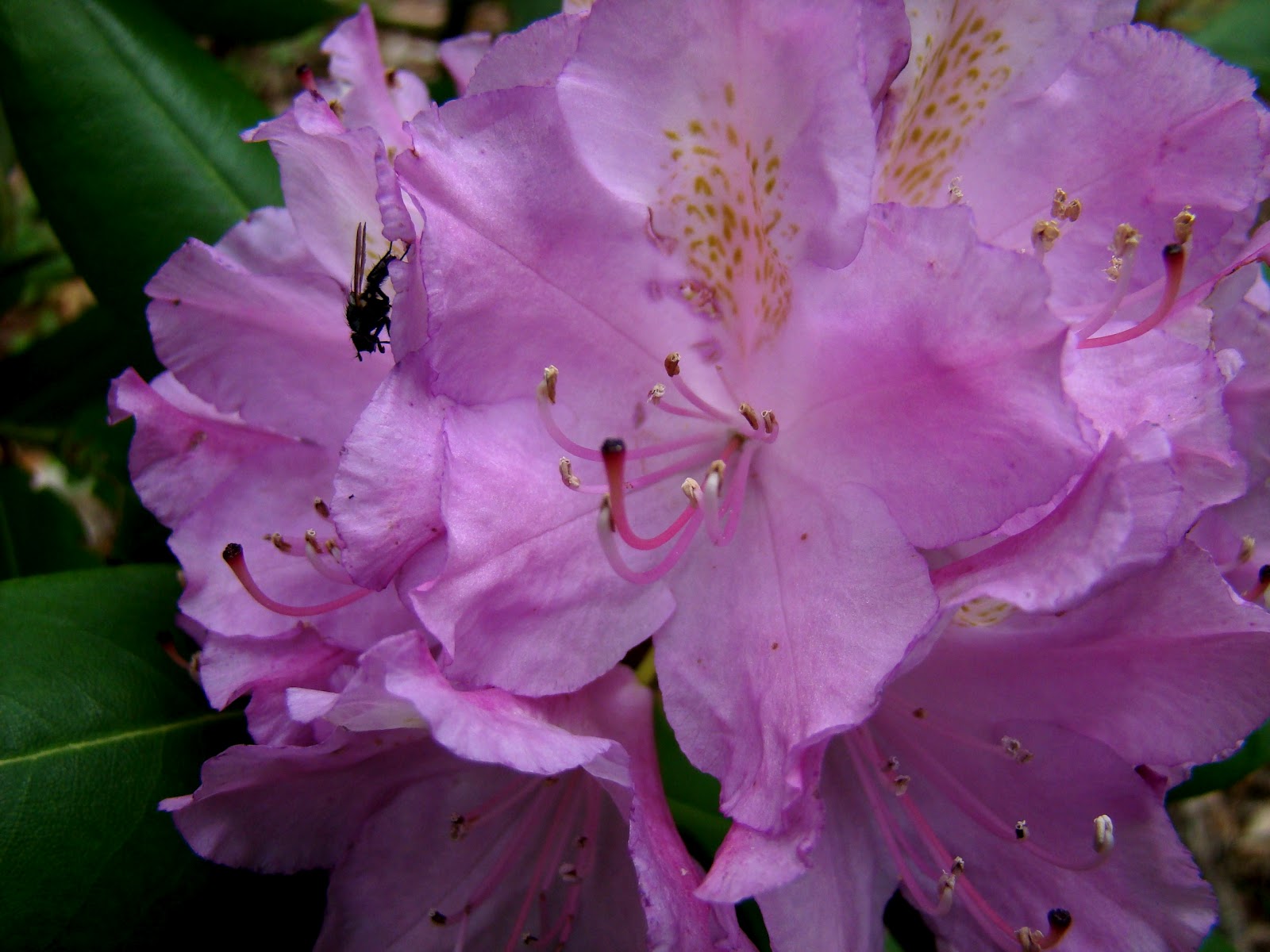
Allow a little extra time to admire the Rhododendron as well. This understory specialist relies on the Hemlock and will surely be impacted if we lose the battle with hemlock woolly adelgid.

My money is on Layne.