Showing posts with label West Virginia. Show all posts

Wednesday, May 22, 2013

Glade tidings of great news...

 Not a half day's travel from Ohio, but an ice age removed from the rest of West Virginia lies a botanical location that has fed my imagination for numerous years.  Being long overdue for some pleasure travel, this is the place I chose to spend some time.

 The Cranberry Glades Botanical Area in Pocahontas County West, Virginia is well known to birders and botanists alike.

 Sure it has all my wetland favorites, like Skunk Cabbage, Symplocarpus foetidus (as in fetid smelling) and the always lovely Marsh Marigolds, Caltha palustris.  Both are common enough in my favorite Ohio woodlots.

 The Glade also offers up a carnivorous vegetable- the Pitcher Plant, Sarracenia purpurea. Woe to the insect who checks into this hotel.  But, this plant too can be found in Ohio, although not in my own county.


These unfurling leaves were something altogether new to me: False Hellebore, Veratrum virde.  It has several other common names (which is why we try to post the Latin bi-nomenclature as well)  like American White Hellebore, Bear-corn, or Duck-retten.  What the heck is a "Duck-retten"?  I know not, but I do know this plant is in the Lily family. Wouldn't it be grand to see it in bloom?


 A bit up the road from the bog, or glade as it is called, there is the very attractive Cranberry Glade Nature Center.  It has many excellent displays inside and some very active bird feeders on the outside.  It is popular with all the visitors to the area, especially birders and reptile-ophiles.


Around back of the building is a nature trail with an excellent display of native flowers.  This Large-flowered Trillium, Trillium grandiflorum in a shade of petal pink was a real show-stopper.

The Painted Trillium, Trillium undulatum blooms a bit later and is found predominately in the glade, but a few scattered samples grow along the nature trail as well. This stunner was an unexpected pleasure, which I have not seen since childhood.  Hello, old friend!


As luck would have it, I stumbled upon a life sedge!  This rarity, Frazier's Sedge (or Lily-leaf Sedge) is not even known from Ohio; it is strictly a southern and central  Appalachian endemic.  The Latin name has bounced around a bit, but an animated conversation on Facebook's Ohio Sedges group has it pegged as Carex fraseriana. Only a fellow Sedge-head might understand what it means to find this unusual plant, and to know intuitively that it was going to be something good.   

This alone made the trip worth while, and we haven't even gotten to the birds!


Sunday, July 1, 2012

The "Polka Dot Forest"

Deep into West Virginia, in a quiet valley within a pristine gorge, lies a puzzling sight.  The locals call it the "Polka Dot Forest."   It makes the uninformed wonder a bit, and speaks of a worrisome future to those "in the know."

 What are those "dots" on the Hemlock trees?

In late April, just before Flora-Quest, I had traveled to the New River Gorge in West Virginia with Greg Miller, to see what would become my life Swainson's Warbler.  Needless to say the scenery is beyond gorgeous and I would recommend the New River Birding Festival to any of you inclined toward natural things.

 Greg and I enjoyed a day at the Endless Wall Trail at Fern Creek, which I highly recommend for many reasons, including great looks at Swainson's Warblers!  The views of the gorge and the hemlock lined trails create a stunning effect, that you'll not want to miss.

As we walked along, Greg commented to me about the "dots" on the trees.  "What do you suppose they are?"

Realizing the trees were Hemlocks, and fairly up-to-date on the plight of  our natives Hemlocks under siege, I suggested  they might be a scientific study.

 As if a timely apparition, out of the forest (and into our lives) stepped Layne Strickler, a fascinating young lady working for none other than the National Parks Service, treating Hemlock Woolly Adelgid. 

Hemlock Wooley Adelgid infestation on the underside of Hemlock
 Layne told us all about the long term treatment and studies going on at Fern Creek.  She was treating infested hemlocks with the systemic insecticide imidacloprid, and marking the treated trees.  In the past they used a different color spot each year, but the study has gone on long enough, now each tree is tagged and dated each treatment year.  They have also released some biological controls - ie. beetles that feast upon the adelgids.

These studies are very important to those of us in Ohio that understand the significance of our native Hemlock.  It is a keystone species and an integral part of of our ecology at Mohican which we cannot afford to lose.

Since Ohio has recently had it's first occurrences of hemlock woolly adelgid, we are being vigilant against this devastating pest which has forever scarred the face of much of the Great Smokies' forest.
To read more about the work with hemlock woolly adelgid in West Virginia, go here.

 Just past the "polka-dot" part of Fern Creek Forest you'll come to the giant Rhododendron stands.  Beware the Swainson's Warbler in this location... they are mighty plain to look at, but my do they sing sweetly!


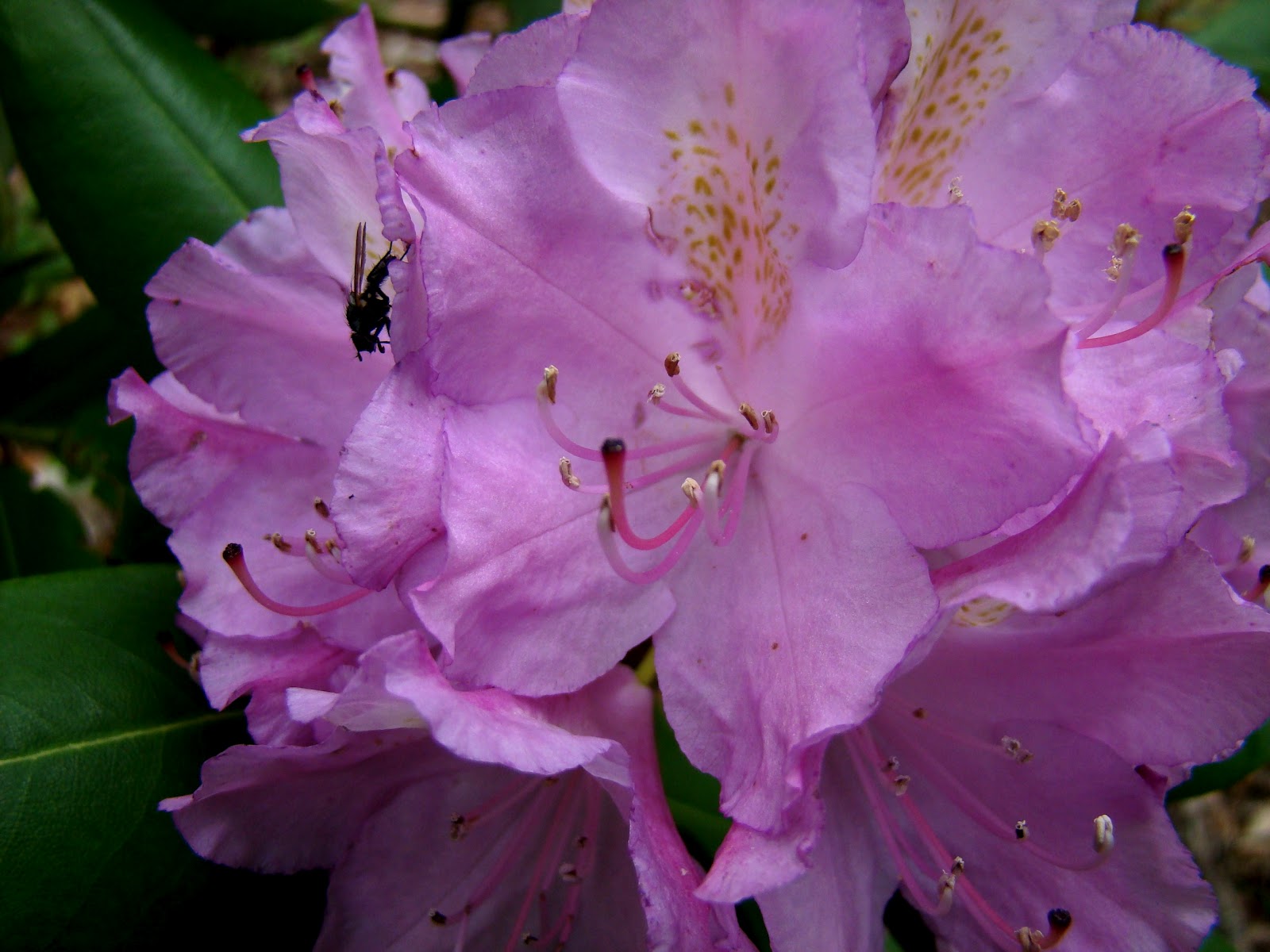
Allow a little extra time to admire the Rhododendron as well. This understory specialist relies on the Hemlock and will surely be impacted if we lose the battle with hemlock woolly adelgid.

My money is on Layne.