Showing posts with label Killdeer Plains. Show all posts

Tuesday, December 10, 2013

Bad Weather = Good Birds

If one is into balmy weather, Ohio has been less than ideal this last week.  However, if you are into winter birding, Ohio has been "Oh-wow-oh" so far this December.

Snowy Owl at Burke Airport. 
Snowy Owls have been the headliners.  This photo was taken off the backside of the City of Cleveland's Burke Airport lakefront, a couple of years past.  It is a good stand in for any one of the nine Snowy Owls now appearing in Cleveland. Most of the owls are at the airport or on a lakefront break wall, so take your binoculars.  You don't often get to see them up-close.

If you would like to read a bit about this irruption of  owls in Ohio (and states beyond) go here  to read a news article written by Todd Hill.

Northern Shrike at Killdeer Plains
If you are willing to risk the back roads in some pretty lousy weather, Killdeer Plains Wildlife Area is a good place to see yet another winter rarity, the Northern Shrike.  This "butcher bird" arrives in early winter to stake out a territory and add small birds and mice to its larder.  This one seems to have set up housekeeping in a hawthorn tree.  The thorns of the hawthorn become a food "holder" the shrike.  It is the shrike's habit to store food items by piercing them upon a thorn.  Later it returns to feed at this cache.  Having a powerful bill, the ripping and shredding of game proves to be no problem, however its undersized talons are better for perching than gripping prey items.  Hence the need to make a shish-kabob with the haw's-thorns.

Michael Godfrey at work on the back roads of Killdeer Plains
This last week it was my privilege to play hostess a videographer at work.  My photos were not the best, as I stand back and attempt to stay out of the way while he works.  But it was a joy to see so many fabulous winter birds all across Ohio, especially in naturalized areas. Other than providing for the occasional Snowy Owl or Snow Buntings, farmed lands of corn and bean stubble does not provide much habitat.


Northern Shrike at Killdeer Plains.

These northern visitors to Ohio, the Northern Shrikes, Rough-legged Hawks, Short-eared, Long-eared and Saw-whet Owls all need mice or other live prey available to winter through.  You'll find them near grasslands and pastures, the exception being the Snowy who is habituated to the vast open expanses of arctic tundra. A wide open field suits him just fine.

So get out your long-johns and snow-suits.  Bad weather can mean good birds!


Sunday, February 10, 2013

Killdeer Plains... unraveled

What good is a love of nature, if we do not share it?   People want to see "good birds", and that is fine as long as we also teach them to become advocates for protection of habitats and species.


It is all about education,  and no one does bird research and education better than Black Swamp Bird Observatory in Ohio.  

This weekend they rounded up tons of  Young Birders and a good number of adults (about 60 people in all) for this well organized trip at Killdeer Plains. Killdeer Plains Wildlife Area has long been noted for its "owl grove." 

It is posted on the ODNR web pages, and Jim McCormac refered to Killdeer Plains in his  Columbus Dispatch article. 
        
Since its location is no secret, isn't it best to offer these supervised trips?

 The main owl grove had a Saw-whet Owl peacefully sleeping in the pine boughs.

 Our group was enthralled- in a quiet and respectful way.  THIS is good education.  No stomping around or hollering here.  Just good birds and quiet birders.
 
Another grove offered distant, but acceptable views of  Long-eared Owls. I have a lot of zoom on my little camera, but you can see, I don't push the shot.  Here is a sleeping, plumped up owl.

If you see the bird stretched-out with ears standing (called "sleeking") you are too close.  Back off!
Enjoy the bird, but respect the bird.  I am the "Queen of Bad Bird Photography."  I don't have the patience to wait forever for a shot, nor will I hang around all day stressing a bird.

You can quietly take a shot and move on.  This is birding at its best.  We collected an owl pellet and explained to the beginners the process of  coughing up the bones and fur from those "mice" meals the owls enjoy.


Yes, kids are kids. They do get restless and goofy.  But these kids were well away from the birds and were waiting their turn to sneak quietly into the grove for their peak.  

All the book learning in the world, all the talk cannot add up to experience.  We each want to experience a Long-eared Owl in the wild.  Blessings to BSBO for endeavoring to create a "controlled" opportunity for learning.  If we left these kids on their own, I guarantee mayhem would ensue!  After all, they are still kids.  

But now they are kids with a new life experience under their belt, and a little more understanding and love for nature.  That will go farther to protect these species than a million games of "Angry Birds."


 Sunset at Killdeer Plains.  

Owls are wonderful, but nothing says "wet plains" like tall grass and the call of wild geese. 

It was my honor and privilege to share this location with young minds- and the potential future leaders.  To tease apart the layers of nature and to welcome another into the fold of responsible birders is a gift we must share to receive.

Killdeer Plains... unraveled to reveal the mystery of nature and shared with youth-  both blessings.

Thursday, August 30, 2012

The Duke

The Weedpicker is out of town today- but I thought you might enjoy this post from July of 2009.  The info is still good-


Well Pilgrims, Killdeer Plains is a great location for lots of wildlife, and some manly stuff too. Not just a bunch of katydids dressed up in pink. Don't even think about putting pink on this skipper, cause it is named for John Wayne, THE DUKE.

Duke's Skipper photo by Warren Uxley

These skippers are are a real man's butterfly. OK, maybe they were not named for John Wayne, but they are very special. Don't look for them in your abreviated field guides either, because they are not there. This insect is a rarity in Ohio's butterfly world, for 2 reasons. It has a very short flight period, and it is wetland related. Since wetlands are on the decline, Ohio has lost 90% of its wetlands- this is a great reason to purchase a "Duck" Stamp.

Here is the host plant for the Duke Skipper, Lake sedge, Carex lacustris. It doesn't always need a lake, as it grows in wet areas and roadside ditches at Killdeer Plains. It is well past fruiting in mid-July, but here is a shot from earlier in the year, when you can see the manly fruiting bodies on this 2-3 foot tall sedge. Don't get yer knickers in a bunch over a fistful of flowers. Real men like sedges.
And here is the flower the Duke Skippers were nectaring on- Winged Loosestrife, Lythrum alatum. This is NOT the bad loosestrife eating up our wetlands, this is a much rarer Ohio native. Well behaved and a joy to see in a wet-scape, look for the much narrower leaves to key it out from the miserable invader, Purple loosestrife, Lythrum salicaria.
Killdeer Plains isn't big enough for 2 kinds of loosestrife, so that purple stuff better head on out of town. The Duke is running this section of ranch.

Sunday, August 5, 2012

No Place like Harpster.

If you are interested in shorebirds, or butterflies or native plants- Killdeer Plains is a spot you are likely to visit in Ohio.  But have you ever considered stopping in nearby Harpster?

Picturesque Harpster, Ohio
This is classic Americana, folks.  And it is going fast.  

 Some of the buildings may have reached the point of no-return.  However, it was this lovely antique- festooned in flowers- which first caught my eye.  Then it captured my heart.  With some time to kill, I set out to photo document this lovely relic of a time gone by

Trumpet-Creeper, Campsis radicans
The Trumpet-Creeper has fully ensconced the building, completely obscuring the front door.  This building may no longer attend to "people" business.. but "nature's " business was brisk. 
.  
Pollinators and hummingbirds visit the vines.  These deep orange flowers are a magnet for wildlife, even in the city.


 This gianormous wasp caught my attention.  I watched intently as it searched among the seed pods.  It might have been looking for some protein-filled caterpillar to predate. He posed no threat to me.

 A train whistle blew, and my attention turned back to the street.  Not much traffic in this scenic old town.

The granary stands as the center of town, just as it should.  It is likely this town grew up with those tracks hauling grain and goods away and bringing the daily mail.  It was the heart-beat of progress in mid-Ohio.

Those times are passing folks and we are losing the best parts of our county.  If you like to meet small town people and see local communities thrive, then stop off at the local "Backwoods" store and by your lunch.  Purchase gas from the small town operators in the villages you pass through.

McDonalds and Marathon have enough people buying their goods, and if you want to keep these remaining holds on our past, we need to support them with our dollars.  Invest in local communities.

There is a good life in Harpster,Ohio.  I hope you don't blink and let it pass you by.

Thursday, August 2, 2012

Killdeer Plains

Today  we visited another prairie of sorts, in Wyandot County.  Killdeer Plains is part of the Sandusky Plains, which once encompassed much of the Marion and Upper Sandusky regions.

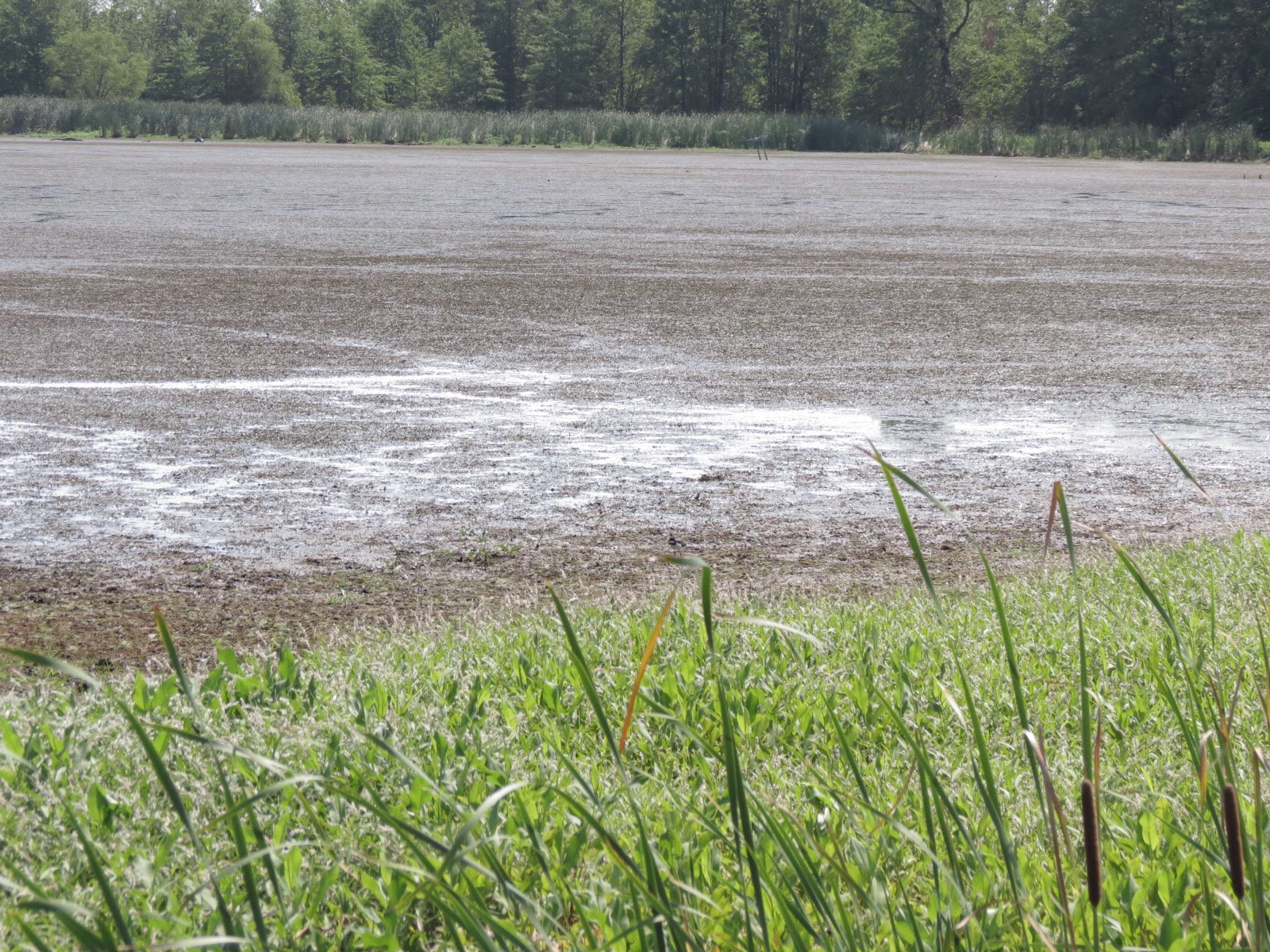
 Killdeer Plains is a designated Wildlife Area.  Not only does it offer vast expanses of grass and prairie forbs, it has a good bit of wetlands.  This makes it great for bird watching, with occasional sighting of Golden Eagles, to routine Short and Long-eared  Owls in the winter time. Now is the time to look for water fowl.

Dainty Sulphur,  Nathalis iole  
But today we were after butterflies!  Rare butterflies that are smaller than a dime, a southern species rarely seen in Ohio.  This year the Dainty Sulphurs are having a boom in their population.  One or two were seen a month ago, and now we have 20 or more flitting about the parking lot at the Sportsmen's Center.

Carpetweed,  Mollugo verticillata
This diminutive plant is the source of the "outbreak."  It is being used as host pant by the Dainty Sulphurs.  How did they ever find it?


This tiny Carpetweed, well... carpets the parking lot near the horse barn.  It would hardly catch the eye of a plant lover, but our friend Jim Davidson (butterflier extraordinaire) knew the plant was there. It has hosted Dainty Sulphurs in the past.

Dainty Sulpurs in tandem
Our Dainty Sulphurs were there all right. And they were doing what Dainty little boy and girl butterflies do.  They will soon be laying eggs in the Carpetweed, but it is doubtful they will "winter" through.  These species are southern beasties, after all.  We probably won't see them in Ohio until we have another record warm year- like next year perhaps?


And if you visit Killdeer for the butterflies, stop by the mudflats too.  Shorebird migration is in full swing and you might see some interesting species!

If you are looking for a quick sandwich and a drink, stop by Harpster, Ohio.  It is a short distance from Killdeer and my new "favorite" Ohio town.  We'll talk more of that soon.

Wednesday, December 7, 2011

Report from Killdeer Plains

Early December in Ohio can be quite picturesque -

Golden grasses on windswept plains

  Snow laden clouds hung above pools of waterfowl.
  
 Killdeer Plain's famous owl woods; we are searching for Long-eared Owls. 

 
 The best we could find was a sleepy Barred ( Bard?) Owl, perhaps with nom de plume Shakespeare, resting from his nightly work.


We had great company - Greg, Leslie Cornett and I ( not pictured) met up with Nina (the now near-famous salamander photographer and author) Harfmann and Tim Daniels, Division of Wildlife photographer.


The wet, open grass lands are excellent for Northern Harriers, once known as Marsh Hawks. 


We didn't stay late enough today to see the Short-eared Owls, but they are back.  This is one I photographed mid-day,  a few years back.

Killdeer Plains Wildlife Area lies south of Upper Sandusky, Ohio.  It is excellent for winter raptures, owls and migrating waterfowl.  For more information click- here.

Sunday, March 7, 2010

Just Golden: a Golden Eagle at Killdeer Plains!

On a march trip to Killdeer Plains, waterfowl is the main event. The warming trends and a crack of open water at pond #27 is all it took to entertain the scope-happy folks from The Wilderness Center, Crawford County Parks, Firelands and Greater Mohican Audubon Societies during our March 6th joint trip to Killdeer.


Both Tundra and Trumpeter Swans were present, and a good number of early migrant ducks.


Thanks to our volunteers, several life-birds were seen on the pond and from the back roads of Killdeer Plains.Our group of seven regaled in some excellent looks at both Horned Larks and Lapland Longspurs on Washburn Rd.
After a little life-bird dancing, we headed west just in time to spot an eagle cruising in our direction. A bit of commentary about the unusual "tilt" of the wings brought our cars to a halt. It was time for a better look...

And look.. we did. And gawk...and stare. With jaw dropping views of a juvenile Golden Eagle circling our heads, I decided it was time to run for the camera. Pardon the poor shots, but after all... I am only a Weedpicker.


As it flew away, the white tail band and white "window panels" on the wings were easy enough to note, but still hard to believe. We were feeling blessed and rich indeed, as we had shared a golden moment.

And here is your blogger, sporting the new Ohio Wildlife Legacy stamp in a handy clip on tag. I was proud to be wearing it when that Golden Eagle added me to his "life-birder" list! I hope you'll buy one too, and support Ohio's wildlife areas and the biodiversity found within.

Special thanks to Brad Phillips, Mary Warren and Su Snyder for helping to compile the day's list, and to everyone who attended our event at Killdeer Plains.


Sunday, July 19, 2009

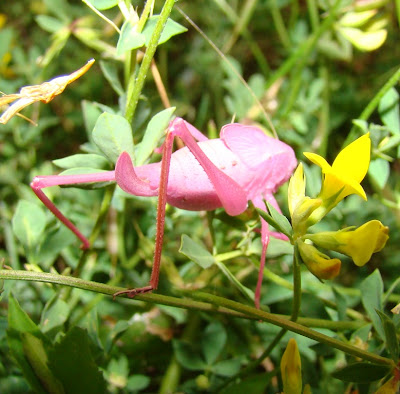
Shocking Pink Katydid

Here's the first of the "Pretty in Pink" Katydid photos that are about to surface on the blog circuits! Jan Kennedy found this unbelievable sight on one of our Ohio Certified Volunteer Naturalist programs at Killdeer Plains. Here is our guy in nature, before we scooped him up in my net to share with others, and he became the most photographed Katydid in Ohio History. I'll leave the full story to Jim McCormac, because no one spins a tale like Jim!


Pink color morph on a Round-wing Rattler Katydid- found at Killdeer Plains. The bright yellow botany? Birdfoot trefoil, Lotus corniculatus, a lovely non-native invader of wasteland and road edges.
Jim McCormac, taught the botany portion of the mini event, and here he describes the Michigan Lily, Lilium michiganense. Not only a great botanist, Jim does it all with birds, as the Division of Wildlife's Avian Educator and OOS president.


Gary Kennedy, displays a Blue Dasher dragonfly that became rather fond of Gary. With leaders the likes of Bob Glotzhober, Jim Davidson, Dave Horn, Bob Scott Placier, and Jim McCormac all the botany, butterflies, dragonflies and birds were well covered. Thanks to Rae Johnson and Jim for organizing this adventure!