Monday, September 16, 2013

Ugly Baby

Yesterday, while on a Sunday hike in Mohican State Forest, we stumbled upon a rather unusual discovery: a juvenile Turkey Vulture. We were surprised to find this "baby" bird so late into the year.

 A quick text from my vulture-mentor, Scott Pendleton, suggested the adult vultures probably failed at their first nest, and this bird was likely the product of their second attempt for 2013.

Juvenile Turkey Vulture,  feathered but yet flightless.
The bird first made its presence known by its wild failing. It was his version of the Fosbury-flop.  Nothing pretty about it.

The youngster had launched from the ground and while unable to become airborne, it had gained enough altitude to grab onto a low hanging branch of a hemlock. From there it clawed its way -still wildly failing- to a resting spot about 15 feet off the ground.

I took a couple photos and moved back, to let the little guy regain his composure.
A section of dimly lit forest floor, within Mohican.
Thanks to the excellent program Scott Pendleton gave to the Greater Mohican Audubon Society last year, I was already on the alert when we arrived in this habitat that seemed “vulture-ish” to me.   We walked around investigating possible old nesting sites, in hollow logs and trees.


 We suspected the bird had been raised in the hollowed out base of this tree.  Several white fuzzy-fluffs of feathers were lying in the ground in the general area.  It looked though the bird had been loitering about, possibly dreaming of his future career as a free-flying recycler.

Once spooked out of its daydreaming, it obviously wanted to fly but was not quite in control of its lifting abilities.

This side view of the youngster shows the white neck-ruff and under-shot of more white juvenile fluff.

A face only a mother could love, juvenile Turkey Vulture.
Mom was probably out gathering some food for the youngster, and will be surprised to find him up here when she returns!  She shouldn't be too surprised. After all, he is getting to be a "big boy" now.  Most of his fluff has been replaced with flight feathers, and he will soon be joining the flock of his friends and family on a roadside near you.

It is a testament to Turkey Vultures that a bird species so common is rarely seen at this stage of growth.  The adults pick nesting sites in the most remote woods and rock crevices, far away from the public eye.

Those vulture parents just didn't count on cross-county hikers with an unusual interest in ugly babies. 


Saturday, September 14, 2013

Hiking the A.T.

One might have noticed I have been missing from the blog-o-sphere for about a week.  It was a week of traveling and camping with my daughter throughout West Virginia, Virginia, and Maryland.  The highlights of the trip seem endless. Several dreams were attained, starting with a day hike on the Appalachian Trail.


Sign post for the A.T. located within the city limits of Harper's Ferry Virginia.
Smack-dab in the middle of the Appalachian Trail is Harper's Ferry.  It was once a sleepy little Virginian town, known as the crossing point where the Potomac and Shenandoah Rivers meet.  It was a small city of bustling commerce and a little-bitty arsenal. (This portion of Virginia became a West Virginia, just before the Civil War.)

Your blogger, Cheryl Harner and daughter, Michelle Goodman standing in front of Harper's Ferry's most famous building.
 A feller named John Brown thought this town would make a good place to stage a slavery insurrection. He chose this very building to make his stand.  The history books can tell you the rest of the story, but I encourage you to visit and decide for yourself if ole bearded-John was just a crazy-coot or a principled man who thought it past time to make a real stand for justice.

The Appalachian Trail's most hospitable stretch.

Just across the river the Appalachian Trail is wide and hospitable, even accommodating bicycles in this location.  We hiked along in the mid morning, taking a side trip up the famous Maryland Heights trail.

The Maryland Heights portion of the hike is not for sissies.  It was steep and rocky terrain at the top and had been key as a strategic Civil War site.

The view of Harper's Ferry from Maryland Heights
The view is breath-taking. Of course, the hike to the top already had me winded.  It is no surprise that whomever held the "Heights" was strategically in control of the city. 

If you have not visited Harper's Ferry, I recommend you make plans to go. It is a well-run National Park.
School House Battle Field, Harper's Ferry, VA
 The surrounding farm lands are scenic and also available to hikers and day trippers.  My only regret of this visit was that we did not allow more time for discovery.

Monarch Caterpillar shares its milkweed with milkweed bugs.
Of course, we checked the local milkweed on the field edges and were happy to find some friends, in the form of caterpillars, in Virginia.


My favorite fall flower quickly became Elm-leaved Goldenrod, Solidago ulmifolia.  We often found it growing in the shade of campgrounds and woodlots.  The sprays of florets reaching for the sun took on the look of woodland fire-crackers. The effect was altogether charming.

Hope you are also enjoying  fall, and taking a bit of time to discover the different Goldenrods in your area.


Wednesday, September 4, 2013

Where have all the Monarchs gone?

As the summer of 2013 winds down, a few things have become fairly obvious in the Midwest.  Monarchs have been nearly non-existent.  Ohio Lepidopterists have a strong core of citizen scientists tallying weekly butterfly counts.  None of my friends were reporting Monarchs in the early summer months.  I have seen only six Monarchs in all of Ohio this summer, and two of those were raised on my own property.

Easily the most recognizable  butterfly in the United States, our population of migratory Monarch butterflies is in deep decline. Not only are they suffering dramatic losses on their wintering ground in Mexico, our farm practices are decimating their chances for reproduction in the mid-west. 

Monarchs must have milkweed plants, and modern farming with herbicides, pesticides and fungicides have nearly wiped out Ohio's milkweeds, thereby striking a death-blow to Ohio's Monarchs.

Regal Fritillary nectars on Butterfly-weed milkweed (Pennsylvania.)
 Will Monarchs go the the way of Regal Fritillaries?  The most colorful members of the Fritillary family were extirpated from Ohio about 30 years ago; now one must travel to prairie remnants in Pennsylvania, Indiana, or much farther west to view this regal butterfly.


Prairies, filled with native grasses and flowering plants -including milkweed-  were once abundant in Ohio. However, we have lost 99.9 percent of Ohio's prairies to "progress", just as agriculture and urbanization have claimed most prairies elsewhere in the mid-west and west.

If we have lost 99.9 percent of our prairies, is it any wonder that we are losing our "prairie butterflies" as well?


Prairie soils are perfectly suited for crops of another grass: maize, or our modern day corn.  Unfortunately modern chemicals "weed" out the milkweed, unlike the corn fields* of my childhood Ohio.  Milkweed used to readily grow along the field edges and in the ditches along the road.  Now, it is only found in abandoned lots and butterfly gardens.

*The corn in my neighborhood is also terrifyingly silent this year.  Where are the crickets, grasshoppers, katydids and bees of my youth?  Monarchs may only be the first blow to the eco-systems in our region. 


Monarch caterpillar feeds on Common Milkweed in Richland County, Ohio.

There a several varieties of milkweeds, the host plant for Monarchs.  Their caterpillars thrive on milkweed in spite of the "milky" white toxic sap the plant produces to ward off other herbivores.

 No milkweed- no Monarchs. 

Bon voyage!  Safe journey to Mexico!
Most years in the past, many, many Monarchs have fed upon the nectar of milkweeds and laid eggs on my pesticide-free milkweeds.  This year, I have seen only two caterpillars.  I raised both of them indoors, away from predators.  Normally, I let nature take care of her own, but this year the Monarchs seem to need every break we can possibly give them, if we hope to have migrating monarch for future generations.  We may feel helpless to change the way farmers manage their lands, but we can still make a difference if we all do two very simple things.

1. Plant more milkweed in our yards and gardens. 

2. Stop using pesticides, fungicides and herbicides on your lawn and landscape.  It can be done, and you and the butterflies will be healthier for it.

Changing your own yard is the first step to changing the world.

Tuesday, September 3, 2013

200 years later... still sailing Lake Erie.

This weekend offered a wonderful mix of family, friends and history.  The history: a two-hundred year anniversary of the Battle of Lake Erie (from the War of 1812.)


Everywhere the battle cry, "Don't give up the ship!" was evident in the Lake Erie Islands.  This photo of a flag adorning a Lakeside waterfront home was taken from my kayak on Saturday morning.  However, it seems to me Oliver Hazard Perry may have won that battle, but he DID have to give up his ship to move his command center to the US Brig Niagara .


I also managed a long-shot of one of the Tall Ships cruising the Kelleys Island coast-line.  History abounded this weekend!

Perry's Monument at Put-in-Bay was also visible from the Lakeside dock.  I would say this photo-shot was a good six-miles out.  Visibility was excellent Saturday morning, before gun-powder filled the air.


The night skies were filled with fireworks.  Port Clinton and Lakeside had displays on Saturday and Put-in-Bay offered a mind-blowing gun-powder-fest on Sunday night. No shortage of smoke and ka-booms in the west basin of Lake Erie this weekend.

Some of my favorite people we  here as well.  My daughter, Michelle, my father- John Boyd- and J.J. the shark-rider (my youngest daughter.) Both girls grew up in Lakeside, so sailing and good music are favorite offerings.  We all attended the afternoon program of the Navy Band Great Lakes.

Historic cottage 345 Sycamore Ave. in Lakeside is known as Toad Hall.
In fact, a whole bunch of my family members arrived to celebrate our annual Labor Day in Lakeside. We are a pretty amicable bunch, and the only war going on here was at sea. 


This is my favorite time of year to go sailing .  Shelly was teaching her friend Joe "the ropes," so to speak.


Captain Shelly (Michelle Soski Goodman) is quite capable in her Sunfish sailboat.  She bought her first boat when she was a very young teen growing up in Lakeside.  As much as I like kayaking, there is something even more exciting about sailing these mini-boats on our Great Lake.

So, very little natural  history going on here, but it was a wonderful family vacation.  I always feel blessed to spend time with my children, and am especially fortunate that they are my best of friends as well.


Monday, August 26, 2013

Fall flowers for butterflies

The insects' song tell me fall is on its way.  Cicadas, katy-dids and snowy tree crickets dominate the chorus around here.  My yard is filled with insect calls, because my yard is also filled with native plants.  Insects thrive on native plants and in pesticide free lawns and gardens.  One might imagine a "locust plague" here at Harnerville, but nothing could be further from the truth. 
.  

There is a balance. A balance of colors, shapes, and foliage forms.  A balance of scents, a hum of pollinators and the fluttering of wings.  Butterflies, moths, bees, even beetles have a place here.  And the bird population keeps them in check.  

Our common yard birds include House Wren, Eastern Bluebird, Catbird, White-breasted Nuthatch, and Eastern Phoebe.  Right now, the goldfinches are in their glory.  My Tall Ironweed is about to go to seed; it is the perfect finch food and will save me a bundle by replacing the store-bought thistle-seed.  

                                         
Here is a close-up of the Tall Ironweed, Vernonia gigantea which towers above the other plants in my yard.  I've always had a thing for "tall, dark and handsome."  Take a closer look at the florets and you will recognize this as a member of the aster family.

Clearwing Snowberry Moth (a bumblebee mimic) is a day-flying moth.
Any member of the Phlox family is also welcome in my yard!  This is the non-native garden phlox, which thrives and attracts all my favorite insects. Phlox is a great nectar plant and I have added several varieties of smaller natives varieties as well.

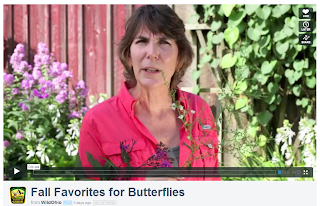
If you would like to hear about some of the plants which attract the bees, butterflies and moths that live in my yard, Wild Ohio has produced a video for you.   http://vimeo.com/72815102

Here is your Blogger, Cheryl Harner, with my spiel on fall flowers.

Special thanks to Ohio Division of Wildlife's Tim Daniels and Nina Harfman for producing this program about fall flowers.  They do wonderful work, and let me blather away about some of my favorite fall plants. I hope you will consider adding these favorites to your yard as well.

PLEASE PLANT MILKWEED!!!   The Monarchs are counting on you!