Showing posts with label Wetlands. Show all posts

Sunday, June 5, 2016

The Holy Grail of Ohio Rails

Birds in the family Rallidae, or rails, are notoriously secretive. They live and breed in wetlands, a habitat which is difficult to bird.  Scientists and hunters who frequent the marshes during fall migration tell me they are numerous.  So why are they so hard for birders to see?

King Rail at Glacier Ridge, photo by Bruce Miller.
Birders are willing to travel many miles and stand for hours for an opportunity to see a King Rail in Ohio.  Are King Rails that rare, or are they just difficult for the novice to find?  Since rails are generally limited to wetlands, and Ohio has lost 90-93% of our wetlands, would it be surprising if rail populations are also limited?

BSBO's Mark Shieldcastle with King and Virginia Rails in hand.
 Photo by Hugh Rose.
The best way for a birder to see more rails, is to support the scientific endeavors to study them. Black Swamp Bird Observatory has been conducting studies on rails in the Lake Erie Marsh for many years.  Biologist Mark Shieldcastle will be telling the story of BSBO's study during the Fall "Rally for Rails" being held in Lakeside.

King Rail outfitted with transponder. Photo courtesy of Winous Point.

 A very large King Rail study has been going on at Winous Point Marsh Conservancy.  Transmitters have been attached to King Rails to help scientists better understand their migratory movements, life history- and possibly shed light on the sheer numbers of their population.

This Virginia Rail was a re-capture, already outfitted with a transmitter.
 The Soras and Virginia Rails are outfitted with a much less expensive transmitter that helps to track their localized movements within the marsh.  This helps the team understand preferred habitats and life history while present in Ohio's marshes.

John Simpson examines a recently captured Sora.
 These scientists at Winous Point take their jobs very seriously.  The birds are treated with the utmost care while being weighed, measured and fitted with tracking devices. Good information is reliant upon healthy and normally functioning birds.  The primary goal is to gather information with the least disturbance to the population.

A closer look at the Sora.
 Soras are one of Ohio's more abundant rails.  Other better known Rallidae, or at least one more frequently seen by birders, are coots and gallinules.  Because King and Virginia Rails are difficult to monitor visually, the tracking devices are providing needed information about those populations.

Oliver Cornet and Brendan Shirkey gently fit a harness on the Sora.
 The transmitters are attached to a harness, much like a micro-backpack.  The biologists gently work the harness onto the bird and double check to assure the bird's wing movement is not restricted.  The bird's feathers settle back around the harness.  The actions and walking gait of a recently "harnessed" bird appear normal and unencumbered.

Brendan adjusts the harness for comfort.
Brendan Shirkey will be sharing more details about the work of Winous Point and the Marsh Conservancy at the Ohio Ornithological Society's "Rally for Rails."  It will be held in conjunction with our fall Annual Meeting in Lakeside, Ohio.  Registration is now on line at http://ohiobirds.org/category/rails/#

Special funds generated by this program for the conservation and study of rails will be directly applied to programs designed to conserve these wonderfully secretive birds.

Tuesday, May 24, 2016

Wetlands at work.

If you love plants, birds and mammals  -biodiversity in general-  you should seek out wetlands. Often called the "cradle of biodiversity," these places are crawling with life!

One of Ottawa N.W. R. newer projects
 A few years back, during the Midwest Birding Symposium held in Lakeside, Ohio, we collected donations for Carbon Offset Birding Project.  The Ohio Ornithological Society also kicked in funds to seed some efforts on a wetland restoration in Ottawa county. This previously wet county was part of the Great Black Swamp. It had been mostly drained for farming, but now a few of those fields are being re-purposed back in to wetlands for wildlife.
Dottie McDowell enjoys the boardwalk and viewing platform.
 The area was enhanced with a viewing platform and parking area, as well as native plantings- both forbs and trees.

This reconstructed wetlands is attracting loads of migratory birds this spring.  It has been educational to watch the tranformation from corn field to natural looking wildlife habitat in just a few short years.

Mystery plant!
Certainly of the  Ranunculus family.
The mystery plant has been solved!  Check the comment below- by Helen.  It certainly is in the buttercup family, and commonly called Cursed Buttercup or Cursed Crowsfoot, Ranunculus sceleratus.  It is reported to cause blistering - especially in the mouth- when eaten by mammals. Hence the "cursed" part. BUt then again, most of the buttercups are rather toxic when eaten.

This is exactly why Flora-Quest 2016 is undertaking wetland plants as the topic for 2016.  Too often we learn the Spring ephemerals and never learn about the amazing botany driving the wetlands in Ohio!  Time to broaden your plant horizons.  Sign up now, as quests are filling!

Just a few of the birds being sighted here!
Wetland birds and mammals need wetlands.  Ohio has lost over 90% of our wetlands to development and agriculture.  Our federal dollars and the massive work of conservation minded hunters has protected the few significant wetland remaining in Ohio.  If you have not yet visited Ohio's Ottawa National Wildlife Refuge, sign up for the Flora-Quest which offers a bus ride to normally off-limit sectors.

Working together for conservation.
Conservation leaders in Ohio, like Friends of Ottawa, Black Swamp Bird Observatory, Ohio Ornithological Society and Toledo Naturalist Association all pitched in for this project.  Flora-Quest is partnering with many of these organizations for our fall workshop in Lakeside. We want to help people understand some of the major plant players in these exciting and dynamic wetlands.  So go ahead, dive in and join us on Sept. 30, 2016.

Thursday, March 15, 2012

Wetland 101

Not all wetlands are created equal; a pond is not a vernal pool.

To better understand the reason not all "ponds" are the same, one must look at the life cycle of a frog.  Sure, why not?  Who knows more about wet places than a frog?

 A recent walk at Byers Woods, an Ashland County Park District property south of Ashland, made the difference abundantly clear. 
This is a pond.  It was silent. 
Fishermen gather here for a little catch-and-release sportsmanship. (You wouldn't really want to eat fish caught at a landfill's drainage pond, would you?)  It is a great place to watch Tree Swallows and dragonflies in the summer time.  But, it is quiet.

 This is a vernal pool; the mid-morning  frog chorus was at a deafening roar.

The very definition of  vernal pool is a "springtime" pool.  It is short lived, or ephemeral.  In other words, it drys up in the summertime and has NO FISH population.  Frogs don't like to lay their eggs where fish live.  Fish eat tadpoles, the larval stage of a frog.  Simple.  Vernal pools are where frogs gather to lay eggs, and tadpoles grow quickly into baby frogs, before the pond drys.


 Northern Spring Peeper is no bigger than the first joint of your thumb.  This tiny denizen of the swamp shrieks a high pitched, "Peep-peep-peep."  You'll know him in a heart beat. If you hear one calling, you'll probably hear many more.

The scientific name is Pseudacris crucifer crucifer.  Think of crucifer, as in "cross".  This tiny frog has a cross on its back.                                    X- marks the spot for Spring Peeper!
Western Chorus Frog, Pseudacris triseriata

Western Chorus frog is known by the stripes running down its back.  The photo (by Warren Uxley)  shows those markings on this regularly occuring Ohio frog.  Chorus Frog's call is commonly described as someone running their thumb against the teeth of a comb.

Get out there and enjoy this warmer spring weather and the call of the spring frogs.  They don't mind if it is rainy, and neither should you!  In fact, warm rainy nights are the best time to visit these vernal pools. 

Special thanks to Warren Uxley for use of the last two frog photos, which portray them in full song.

Sunday, August 21, 2011

Ottawa N.W.R. Auto Tour

There are all sorts of drive-thru opportunities in this fast paced world: hamburgers, banking and pharmacies are just a few. My favorite takes a bit longer, but is well worth the trip.

Crane Creek, as seen from the Ottawa National Wildlife Refuge auto tour.

In a short hour and a half (or longer if you choose) birders can get their birding "fix" on the go. Zoom, zoom. Common Gallinule, Red-necked Phalarope, Greater and Lesser Yellowlegs and a host of birds in between can be seen from the comfort of your car. OK, I admit we had to get out and really look for the phalarope, but it was so worth it!

And it is not only birds! A short walk along these dikes provides ample opportunity for excellent botanizing.
Whorled Milkweed, Asclepias verticillata


Looking rather bland and unassuming to the untrained eye, this plant was one of the highlights of my trip. It is not everyday we find this milkweed, in fact- I am not sure I can name one other place I could consistently find it closer than Adams County.


The narrow leaves might not indicate "milkweed" to most people, but a close-up look at the flower tells the tale. Besides, the monarch butterfly caterpillars can use it as a host plant, and you can't fool the monarchs!


Another huge surprise we found on today's tour, a brightly colored plover. Holy Mackeral!!! It is a Rose-breasted Plover!? What rarity can this be? Some folks were getting pretty excited.


But a few of us remembered a recent post on the Ohio Birding network List-serv. These folded nets also reminded us of the important banding work that goes on at Ottawa NWR. I have attached the notice below. It is a pretty good explanation of the rose-breasted plover.


SPECIAL THANKS: To the Ottawa National Wildlife Refuge for allowing birders some additional days to tour the refuge. It is wonderful to have the opportunity to learn more about the birds, plants and even the insects that are found in our Lake Erie marshes. Thank you again, from of all Ohio's nature lovers.


PS: Birders, don't forget to buy your "Duck Stamp" which helps support the purchase and maintenance of wetland habitats.


Wednesday, November 17, 2010

Marshes and Migration

Lake Erie and the surrounding marshes are magic- and just like magic- they are disappearing before our very eyes.


Think of the incredible pressure development has put on these natural bird and wildlife sanctuaries. Cedar Point Amusement Park- home of the Blue Streak was once home of the Great Blue Heron. Condos, marinas, restaurants- all concentrated on the lake shore- have certainly made a tremendous negative impact on our wildlife.


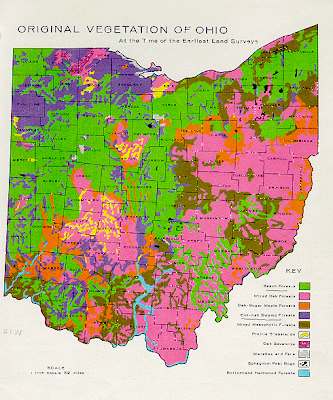
Here is the original vegetation map of Ohio- purple indicates wetlands. See the purple stuff in the Northwest corner? That was the Great Black Swamp; now only 5% of that area remains wetland. Perhaps it is due for a name change: The Little Black Swamp. Were it not for Ottawa National Wildlife and the State of Ohio's holdings, I fear our migrating birds would have no place to "fall out" during migration.

Here is a "bird's -eye-view" of the Marblehead Peninsula from the sky- (shot out of the airplane window as we were headed west on vacation)
...
Spring and fall each year, a miracle goes on above our heads. Birds migrate to and from their breeding grounds in Canada and beyond. Their only hope for continued survival is to cross that lake in hope of successful nesting. Each year hundreds of thousands of birds need to make a critical "re-fueling" stop at the wetlands along Lake Erie: Metzger Marsh, Ottawa National Wildlife Refuge, Magee Marsh, Sheldon's Marsh, and Old Woman Creek.
...
These are all critical habitats for our avian species.


And now, these birds are being handed an obstacle course to maneuver on take-offs and landing. Radio towers, buildings and a new danger- wind power.
...
The thought of greener, cleaner energy is music to any environmentalist's ears. But if wind turbines are placed at the intersection of two major migratory flyways, it is hard to believe it won't become a massive slaughter. This is not something that could happen in the future- this is happening NOW. The Black Swamp Bird Observatory needs our help to put the brakes on this wholesale disaster- before it happens.
...
  • Please sign their petition for a 3 year moritorium to study the effects on wind turbines on the birds passing through the Great Lakes. Please go here.
  • If you really want to make an impact- Send a check to BSBO to help them protect these birds.

For more information- go to the BSBO website or read Kenn Kaufman's blog post.

....

IF we do not act now, who will speak up for the birds? An ounce of prevention is worth a pound of cure- and once wind power comes- it will be too late to stop it.

* I would be ALL FOR WIND POWER as long as it is properly sited. A migratory path is NOT a proper site.

Thursday, October 21, 2010

Wetland Research


Take it from those of us who spend an inordinate amount of time in wetlands: wetlands are a beautiful thing. Not only filled with lovely flora and extremely high in biodiversity, we know they are "good for you" too. Wetlands are the "kidneys" of our land, filtering water, draining off nitrates and sequestering carbon as well.


And whether they are a native wetland, or a created wetland, studies show both are effective in providing many of the benefits and habitat requirements for many species. And while man-made wetlands are not quite on a par with native wetlands in amphibian (especially salamanders) diversity, they can provide effective water overflow management, and are well worth the investment for developers and homeowners alike.

...

Here is a recent study from Ohio State featured in Science Daily that show some of a man-made wetlands merits. That is great, as long as we first protect natural wetlands, and do not promote the idea that destroying wetlands is OK - if you just replace it.


Man made wetlands certainly work well for many plant species and insects that can colonize "new" wetlands- like this Slaty Skimmer.
...
However, the delicate balance of a Cedar Bog or the Sheldon Marshes didn't happen in a decade or two. While we have many benefits from creating "new" wetlands, remember some of the rarest species in Ohio - both flora and fauna - are only found in the ancient gatherings of water.


Sunday, February 28, 2010

Wetlands, Conservation and Waterfowl

Wetlands-
as vital to our ecosystems' health as kidneys are to a human's. You may not dwell on their importance, until they are compromised or cease to function.

The keynote speaker at OOS/Columbus Audubon's excellent Waterfowl Symposium illuminated the point with a photo presentation on the century's worst man-made ecological disaster. Quite a claim to fame, achieved by the one and only Saddam Hussein of Iraq.


Dr Alwash has been involved in engineering the re-flooding of the southern Iraq marshes, the cradle of mankind and the likely location of Eden. The marsh people of Iraq have thrived here for centuries, co-existing with the land and utilizing the marsh reeds for most of their needs, from fuel to building supplies, until Saddam intentionally left them high and dry. In order to punish the marsh people for rebelling against his power, Saddam drained the marshes- destroying their lives and livelihood.
Today efforts are being made to reintroduce water to this region, once again allowing the marsh reeds to grow and thrive. For the full story, you can go to National Geographic on line and read Iraq's Eden: Reviving the Legendary Marshes.
..
.......... Photo from Wiki
And while Americans tend to dismiss all reed grasses as undesirable invasives, even the worst of these harbor an abundance of species, from insects, to frogs and birds. And with proper management some very desirable diversity will thrive along the edges of these areas, i.e. Cleveland Museum's Wakerobin Trail.
...
If you are interested in learning more about wetlands diversity be certain to follow this link to the FOWL organizations link where you will find a registration for an upcoming Managing Wetlands for Biodiversity. Greg Lipps will cover the fauna, while Dr Jim Bissell and John Mack will handily address the flora.
...
And while you are thinking about wetland conservation... don't forget to purchase your Federal Migratory Bird Hunting and Conservation Stamp to help purchase wetlands. They are not just for "Ducks!" And to support biodiversity in Ohio, look for this Ohio Wildlife Legacy Stamp. We will be selling them on the upcoming GMAS trip to Killdeer Plains. So click on our website for details, and plan to meet us there March 6th, 2010. Hope to see you there!