Showing posts with label Flora-Quest. Show all posts

Thursday, September 1, 2016

More Meadowbrook

 It is no secret, one of my favorite places in Marblehead, Ohio is Meadowbrook Marsh. It is a park opperated by the Danbury Township Trustees.  It has turned out to be a birding hotspot and a nature fix for those in need of a little natural TLC.

A young Bald Eagle circles over head with a full white-headed adult.
Today's surprise was found overhead. Two Bald Eagles circled above and conducted a series of dives and aerial flip flops.  The recovery story of Bald Eagles on our North Coast never ceases to make me smile.  How lucky are we to see these magnificent birds high in our skies!

Red-Spotted Purple butterfly
 Butterflies were numerous today as well.  Red-spotted Purples have been in short supply this year, but we saw numerous warming up in this morning's sun.

Under wing of Red-spotted Purple
 People always seem puzzled when we announce a blue butterfly as a "Red-spotted Purple." It is the under wing that tells the true story, Ah, red spots on a field of purple, now it makes sense

Hackberry Emperor, 
One of my favorite trees at Meadowbrook is the Northern Hackberry.  But why am I talking trees when this obviously a butterfly photo?  The Hackberry tree is the ONLY host plant for the Hackberry Emperor.  Three types of butterflies feed on Hackberry in their larva stage: Tawney Emperor, Hackberry Emperor,  and the American Snout.  This particular Emperor was resting on a Common Milkweed plant.  

Milkweed does not play a role in the life cycle of the Tawney Emperor, but it is the host plant of the Monarch butterfly. When you think of butterflies- remember it is not just the Monarch at needs a host plant to survive.  Hackberry trees are important, too.

Wetland species Swamp Milkweed and American Lotus
Meadowbrook is known for its marsh and Swamp Milkweed is right at home in a marsh. These beautiful pink flowers are perfect for young Monarch butterfly larva.  Just beyond the water edge, those large circular leaves belong to the American Lotus.  One of our most beautiful native aquatic plants is just finishing its bloom cycle.  (To see more on American Lotus http://aquaplant.tamu.edu/plant-identification/alphabetical-index/american-lotus/)

American Lotus seed head.
The stunning white lotus flowers have given way to the seed heads, which famously look like shower heads!  Some believe the seed pods are as striking as the flowers.

Come on out to Flora-Quest 2016 and you can choose your own trip to see aquatic specialties in the marshes and wetlands on the North Coast.

Registration has been extended to Sept. 15, 2016.  Sign up now for an eco-tourism adventure!

Monday, May 30, 2016

The Point of Conservation.

They call it Winous.  Winous Point.

It may well be the best kept secret in Ottawa County.  It had its origins as a shooting club in 1856. That makes it the oldest continuously operating hunt club in America. Impressive, to be sure, but it may seem an odd place for a Weedpicker and her fellow conservation enthusiasts to visit.

The main Clubhouse at Winous Point,
complete with Canada Goose weather-vane.
Winous Point Shooting Club is a repository of history of hunting. Through limited use, it protected the shores from development along the Sandusky Bay near the Sandusky River and Muddy creek. Winous Point conserves about 5,000 acres of wetlands and shorelines, providing some of the last remaining places for the massive water fowl and shorebirds migrations, as well as year round habitat for all forms of wildlife.

Historically, Winous Point is a Shooting Club, but in 1999 the Winous Point Marsh Conservancy was formed to study the marsh and the inhabitants therein. We will particularly focus on their on-going rail study. 

Rail habitat- is the edge habitat. 
Winous Point is key to the educational experience Flora-Quest and the Ohio Ornithological Society have planned for birders and plant lovers this fall. Several members of our OOS Conservation Committee visited the Winous Point conservancy experts to see their rail study in action. We ventured out to the sedge meadows and edge habitats where lures were set to attract these secretive birds.

Oliver Cornet discusses the plant life at Winous Point.

One of our guides for the morning, Oliver Cornet, specializes in the management of invasive plants. It was fascinating to learn more about the efforts to improve vegetation and create viable habitats for various shorebirds birds, rails and waterfowl. 

Brendan Shirkey demonstrates the rail trap.
 Brendan Shirkey will be one of our guest speakers at the OOS Rally for Rails in October 1 and 2nd.  You will not want to miss the details of their humane live trapping and data tracking of Ohio's most secretive birds.  We are just starting to peek into the lives of these marsh inhabitants, and the Winous Point study (partially funded by Ohio Division of Wildlife) is providing much of the critical data.

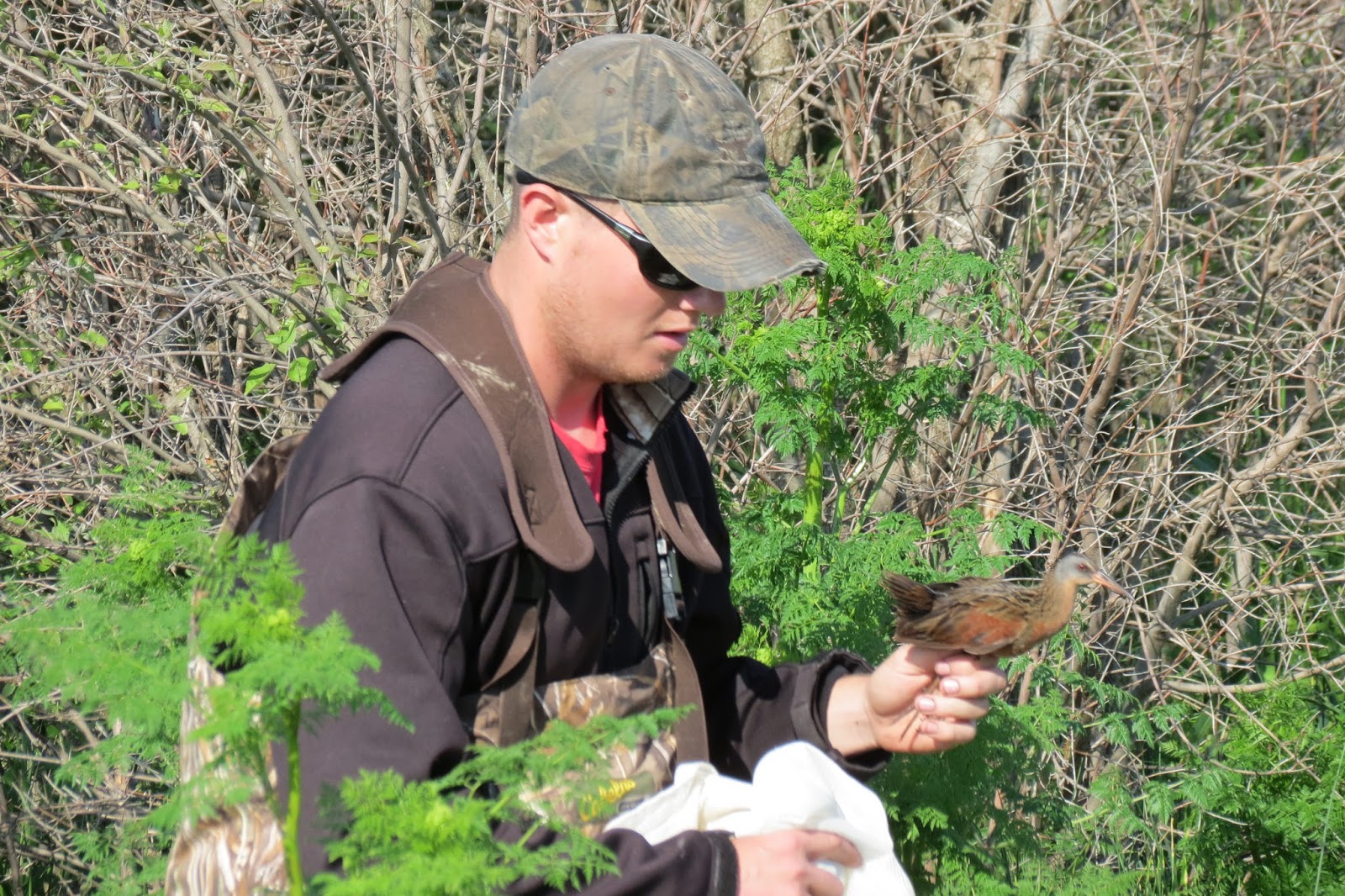
Brendan retrieves a Virginia rail unharmed.
 The third trap of the day held a surprise: a Virginia rail which was already outfitted with a radio transmitter!  This bird was a recapture.  Brendan returns to the awaiting trucks with the unharmed bird.
Virginia rail seeking companionship.
As Brendan said, "This guy must be looking for love in all the wrong places."

After the rail was gently bagged we returned to the station to take its general health updates for the study.  We learned this bird has been found in the trap three times! After gathering their data, the birds are returned back to the area in which they were originally found.  Apparently, the experience must not be too traumatic or this Virginia rail would have likely avoided the trap the second time.

- To be continued.

Tuesday, May 24, 2016

Wetlands at work.

If you love plants, birds and mammals  -biodiversity in general-  you should seek out wetlands. Often called the "cradle of biodiversity," these places are crawling with life!

One of Ottawa N.W. R. newer projects
 A few years back, during the Midwest Birding Symposium held in Lakeside, Ohio, we collected donations for Carbon Offset Birding Project.  The Ohio Ornithological Society also kicked in funds to seed some efforts on a wetland restoration in Ottawa county. This previously wet county was part of the Great Black Swamp. It had been mostly drained for farming, but now a few of those fields are being re-purposed back in to wetlands for wildlife.
Dottie McDowell enjoys the boardwalk and viewing platform.
 The area was enhanced with a viewing platform and parking area, as well as native plantings- both forbs and trees.

This reconstructed wetlands is attracting loads of migratory birds this spring.  It has been educational to watch the tranformation from corn field to natural looking wildlife habitat in just a few short years.

Mystery plant!
Certainly of the  Ranunculus family.
The mystery plant has been solved!  Check the comment below- by Helen.  It certainly is in the buttercup family, and commonly called Cursed Buttercup or Cursed Crowsfoot, Ranunculus sceleratus.  It is reported to cause blistering - especially in the mouth- when eaten by mammals. Hence the "cursed" part. BUt then again, most of the buttercups are rather toxic when eaten.

This is exactly why Flora-Quest 2016 is undertaking wetland plants as the topic for 2016.  Too often we learn the Spring ephemerals and never learn about the amazing botany driving the wetlands in Ohio!  Time to broaden your plant horizons.  Sign up now, as quests are filling!

Just a few of the birds being sighted here!
Wetland birds and mammals need wetlands.  Ohio has lost over 90% of our wetlands to development and agriculture.  Our federal dollars and the massive work of conservation minded hunters has protected the few significant wetland remaining in Ohio.  If you have not yet visited Ohio's Ottawa National Wildlife Refuge, sign up for the Flora-Quest which offers a bus ride to normally off-limit sectors.

Working together for conservation.
Conservation leaders in Ohio, like Friends of Ottawa, Black Swamp Bird Observatory, Ohio Ornithological Society and Toledo Naturalist Association all pitched in for this project.  Flora-Quest is partnering with many of these organizations for our fall workshop in Lakeside. We want to help people understand some of the major plant players in these exciting and dynamic wetlands.  So go ahead, dive in and join us on Sept. 30, 2016.

Saturday, March 26, 2016

Flora-Quest is All Wet in 2016

Swamp, marsh and bog are seldom epithets for locations considered travel worthy.  However, there are a myriad of interesting and little-known plants in these habitats.  Wetlands provide important filtering eco-services to our state’s water, not unlike the way kidneys function in a human body.  Much of that filtration is provided by emergent wetland flora, grasses and those little-known aquatic plants.  Flora-Quest is bringing the botanical experts to Lake Erie to provide a crash course workshop on “Wetlands.”

 Marblehead's Meadowbrook Marsh awash with fall color.
Lakeside, Ohio will be the hub for this adventure to be held Friday, September 30, 2016.  Featured speakers will include experts Jim McCormac from Ohio Division of Wildlife and Mark Dilley of M.A.D. Scientists.  They will help us learn some favorite wetland species and better understand the biological richness of life in our wetlands.

Field trips to botanical hot-spots and general flora tours of local wetlands are available.  Our forays are varied to meet every level of interest and ability.  Whether you are hoping for those gorgeous Fringed Gentians and Nodding Ladies’-tresses orchids, or rarities like Inland Sea-rocket our guides know the way.  Featured locations will include Meadowbrook Marsh, Lakeside Daisy Preserve, Ottawa National Wildlife Refuge, East Harbor State Park, and trips further afield for rarities at Sheldon Marsh or Castalia Rest Haven Wildlife Area.


Fringed Gentian is a "must-see" fall bloomer. 
Evening offerings will be a friendly meal, loads of comradery and special guest speaker, Jason Lewis.  As Manager at the Ottawa National WildlifeRefuge, Jason will help us understand the importance of Ohio’s only National Wildlife Refuge and the conservation and economic benefits it provides to us.

For those interested in extending the fun to a second day, Ohio Ornithological Society will be hosting their “Rally for Rails” on Saturday Oct 1st.  This not-to-be-missed event will bring in bird experts from across Ohio and beyond to peak into the secretive lives of these wetland specific birds.

To learn more about our Flora-Quest Wetland Workshop
                                                                          www.flora-quest.com

Registration opening soon!

Sunday, September 20, 2015

Hellbenders and Hemlocks- Flora-Quest 2015

Flora-Quest is still a major topic in my conversations... mostly folks asking, "How did it go?"

Honestly, all the Flora-Quests in the last 9 years have been amazing, informative and fun, but this year's was almost magical.  Whether the  good fairy of ecology put us under a spell or we just had the precisely the right combination of people, presenters and places to go, the results were superlative.

Greg Lipps studies a "first capture" Hellbender. Photo by Jeff Belth
Seriously, it is a no brainer that getting Greg Lipps involved in any program means it will be informative and fun.  He is Ohio's #1 cheerleader and head scientist for all things amphibian (and reptilian.) He said he couldn't promise he would find Hellbenders, but instead he found two.

The aquatic team returns victorious. Photo by Jeff Belth.
Both aquatic teams had a session in the field with Lipps and Josh Dyer and a second session with Semroc and Rosche, the dragonflies experts from the Cleveland Museum of Natural History. Needless to say these folks couldn't have been flying any higher with their successes in the field.  The guides' ultimate goal was to convey an understanding of how Hellbenders and dragonfly larva are bio indicators,  creatures which monitor water quality in our rivers and streams.

The Clear Fork State Nature Preserve hike. Photo Michelle Goodman.
It is the flora of Mohican that makes all the difference: trees protect watersheds. The giant old-growth trees (some of them 300 year old!) in the Clear Fork Nature Preserve survived all those "bad old days" of deforestation and erosion.  Those were the days before the 1940's and the Civil Conservation Corps,  a government program set people to work during the depression, restoring the lands denuded by poor farming and forestry practices.

Cheryl Vargas, Chris Riley and Mary Lee Minor study the forest floor. Photo Michelle Goodman.
Steve McKee opened Flora-Quest with a program that discussed the uniqueness of the Mohican forest and its history of development, deforestation, reclamation and the ongoing efforts to protect Mohican from poor industrial practices and timbering.  Much of the story can be found in the excellent short video (15 minutes)featured during Steve's progam:  Mohican: The Long View.  

Mohican still has much to offer for nature lovers, and should be preserved for the Hemlock Forests, pine plantations, unusual breeding bird populations, mammals and all of the biota which occurs here.

Mohican's Little Lyons Fall of the Appalachia to Canada tour.  Photo by Mark Dilley
The best waterfalls in the area were featured on two tours: Appalachia to Canada and The Waterfall Tour.  The Little Lyons Falls is likely the most hiked trail in all of Mohican.  People love to see this well-known site, but our guides were able to show the lesser known botany and bugs on the trip in and out.

The Barn at Malabar served us well. Photo by Ed Lux
The second day of Flora-Quest convened at Malabar Farm State Park.  We gathered in the barn and split into groups for tours of the Big House, the Farm, the Doris Duke Woods and the wetlands at Junglebrook Trail.
Jim Berry speaks of the Bromfield family in the cemetery at Malabar. Photo by Ed Lux
We had the good fortune to have Bromfield historian and past Malabar Farm manager Jim Berry as a Flora-Quest guide.  Jim is recently retired from the Roger Tory Peterson Institute in New York. He is  an expert birder and excellent botanist and his love for the workings of Malabar Farm is well-known.
Steve McKee orients his Doris Duke Woods group on the steps to the Big House.  Photo Ed Lux
The Doris Duke connection to Malabar is a lesser-known story, but one of great interest.  In fact, Steve McKee's brother, Tim McKee, made a lovely short video about the woods and Bromfield.  You can find that story here:  The Woods at Malabar.
The Junglebrook wetlands in bloom. Photo by Mark Dilley
The little known Junglebrook wetlands at Malabar was one of our attendees' favorite sites. It was an explosion of floristic color and featured a wealth of Ohio's wetland experts and naturalists: Mark Dilley, Jim McCormac, Lisa Rainsong, Larry Rosche and Judy Semroc!  Everyone found something of interest on this trip.  I even learned later that a few individuals sneaked back for a second tour!

Thank you again to all the fabulous Flora-Quest guides and our patrons.  YOU made it magical by your attendance and participation.  Thank you, too, for all the wonderful photos provided to me by our talented attendees! It is said a picture is worth a thousand words- and what a story that first photo tells.

Let me leave you with one important thought: our watersheds matter.  Let us not be doomed to repeat past mistakes of poor farming practices and short-sighted forest management.  Let us cherish the surviving natural areas we have and reclaim more areas for nature, for the health of our watersheds and for future generations.

To learn more about the Hellbender- click on this link below to see an incredible video by the US Forest Service on their efforts to protect this prehistoric animal. It was the one featured by Greg Lipps in his program for Flora-Quest 2015.


Wednesday, September 2, 2015

Flora-Quest 2015 finale

For those who know me, the fact that I devote a good part of my year organizing Flora-Quest comes as no surprise.  Flora-Quest was the brain-child of Jim McCormac, and Paula Harper and I provided the first "boots on the ground" so to speak.  From 2007-2015 it has been a good run, many of those years were held in Shawnee State Park and Forest.  This year it was time for something new, and Flora-Quest 2015 moved to Mohican Forest and Malabar Farm State Park.

Maidenhair Spleenwort, photo by Steve McKee

With a name like Flora-Quest one might expect flowers.  Most of our Quests have been flora-centric, however this year we focused more on eco-systems. We wanted to convey a better understanding why the hemlock trees and hellbenders are as important as rare ferns, like this Maidenhair Spleenwort, and Roundleaf Orchids.

Mohican's own Steve McKee,  photo by Jennifer Kubicki
But a long time ago I learned what was really important at Flora-Quest: the people.  The incredible guides who share their knowledge.  The fascinating attendees - often guides, authors, conservationists and professional naturalists- who bring so much collective intelligence to our programs.  Many of them are old friends and even more of them have become our new friends.


Long-time guide, Bob Scott Placier and friends. Photo  by Mark Dilley
Bird Banding, photo Zach Pocock

Many of our guides have dedicated their lives to environmental and outdoor education.  Bob Scott Placier recently retired from a long career teaching Dendrology and Ornithology at Hocking College. He is Flora-Quest lifer,  and a guide I can always count on to pitch in and help out in the wee hours of the morning.  There is nothing in the world to capture one's heart like seeing a tiny wild bird, up-close and personal. Bob makes that happen.


Judy Semroc, photo by Jennifer Kubicki
One of our sponsors, The Cleveland Museum of Natural History sends people to our event.  Guides Judy Semroc and Larry Rosche are experts in the field.  They literally wrote the book on Northeast Ohio's Dragonflies. Their combined abilities identifying birds, bugs and plants is legendary.

Greg Lipps and Hellbender, photo by Jeff  Belth.
This year we went to -hellbender- in a basket, or rather a plastic tube. Greg Lipps, Ohio's foremost expert on these endangered, prehistoric aquatic creatures brought some fauna to our flora program. The health of our watersheds matter and the flora we love filters the run-off to our rivers.  Eco-systems are important and we must protect entire ecosystems to protect individual charismatic species, like hellbenders.
Lousie Warner, Chis Riley, Clyde Gosnell 
 For me, the addition of interns or Flora-Fellows took the entire event to a whole new level.  We provide students and young professionals the opportunity to meet the movers and shakers in the world of conservation.  Pictured here, Chris was sponsored by The Stratford Ecological Center (represented by Louise and Clyde.)

Tim McNiven, intern Nicole Hoekstra and Greg Blum
 Nicole Hoekstra brought her many talents to us as an intern, and she was funded by two wonderful individuals who have attended past Flora-Quests.  Greg and Tim wanted to provide this educational opportunity to someone who would not be able to attend without a scholarship.

These are the people of Flora-Quest: intelligent folks who want to share their knowledge and love for nature. People who care.

Mark and Michelle Goodman-  photo selfie
Especially nice for me, my daughter and son-in-law helped by coordinating the efforts of those interns. They also remind me why bringing people closer to nature and learning about our environment really matters.  We do this, not only for our own enjoyment, but rather for future generations.  We are growing a constituency for our parks and forests.

Sure, we all feel better when we breath clean air. We are happier when we are trotting down a wooded trail. My friends all want to have a personal encounters with a bird, butterfly or beetle. Flora-Questers are the people who help us ensure these special places are here for the next generations as well.

Special thanks to all those who have sent in photos!  I rarely have time to get decent pictures during the event. This blog is strictly the result of using the photos I have been given to share.  There were 20 fabulous guides, 4 awesome interns, 1 energetic emcee, 4 excellent speakers- and I will hope to share more of their photos in the future.  For now I would like to say thank you to the paying participants; YOU make this event happen.  "Thank You." 


Thursday, June 18, 2015

Aquatic Adventures

If it is flying, flapping or swimming, it is worth chasing, studying and sharing with friends.

Spatterdock Darner
Today we were harassing dragonflies at the Gorman Nature Center in Mansfield, Ohio. For a little pond, the list was amazingly varied!   Eastern Amberwings, Eastern Pondhawks, Dot-tailed White-face, Comet and Green Darners, Slaty and Twelve-spotted Skimmers, and many others- including this amazing Spatterdock Darner! It was a feast for the eyes.

Judy Semroc and Larry Rosche
Two of my favorite guides and dragonfly experts Judy and Larry gave an excellent program and led the field trips.


They do professional outreach for the Cleveland Museum of Natural History. The are also the authors of one of the best dragonfly and damselfly guides written in the Eastern U.S.  If you don't have it, you can buy it on-line: just click here.

The bridge at Gorman Nature Center's pond.
If you are interested in learning about Odonates (dragonflies and damselflies), the pond behind Gorman Nature Center is a well-stocked location. You can spend an afternoon and see up to fifteen species!
Our field trip to the pond.
We did plenty of milling around, catching the adult fliers and netting some aquatic life in the form of immature Odonates, water bugs and frog tadpoles galore!


 Judy waded right out into the water to get the best specimens, while Larry identified all the goodies we brought to him on shore.  If you have never ventured into the field with these exceptional leaders, you have been missing out on a lot of fun!

They will be leading part of the Aquatic Adventures for Flora-Quest, Aug. 27-29, 2015  in the Mohican Area.  For those of you in the Cleveland area, the Cleveland Museum of Natural History  is offering a sign-up on line to drive down in the bus from CMNH. Just go to this link to sign up from the CMNH calendar.


Or go directly to the Flora-Quest website to see all our offerings.  If you are interested in plants or natural history, this is the conference for you.  Hotel rooms are limited, so contact me if you need help finding a room.

Hope to see you there, chasing Dragon Hunter dragonflies and Hellbenders!


Thursday, June 4, 2015

The Report from Kirtland Bird Club

It was my great honor to do a program in Cleveland for  The Kirtland Bird Club last night.


The Kirtland Bird Club is one of Ohio's oldest and most prestigious bird/ science groups.  It was named after the Dr. Jared Kirtland who in 1852 collected and identified the very first specimen of Kirtland's Warbler on his farm near Cleveland, Ohio. It was many years before biologists found the birds nesting in 1903 in northern lower Michigan.  This is a bird of concern which has been long studied, and recently, conservation efforts have possibly prevented its pending extinction. You can read about the bird, here.

The bird club was named in honor of Dr. Kirtland and their website gives the following history:
The Kirtland Bird Club (KBC) was formed on September 28, 1940 and has a long tradition of quality contributions to the Northeast Ohio Birding community. In its early years the club conducted monthly meetings, field trips, breeding bird population studies, Christmas bird counts, and wintering duck population studies. The objectives of the KBC are serious study of ornithology with a view to increase the knowledge of individual members, the exchange of ornithological experiences and records, the compilation and publication of important information on birds, and the promotion of good fellowship among its members. 
Out-going Kirtland Bird Club President Lukas Padegimas 
 It was Lukas Padegimas' last night as President.  This fine young man is busy attending school at Cleveland-Marshall College of Law, but I am certain he will remain active in the birding community as well.

A nice crowd filtered in...
 As always, a nice crowd of 30 or so filtered in and we discussed upcoming meetings, bird trips and  membership (I renewed my membership, you should join too!)

The Talking Head
 Since The Kirtland Bird Club meets at the Cleveland Museum of Natural History, you never know who is going to stop by to make an announcement or two.  Fortunately, I spoke after this guy, so my program was a little more lively than his.

Cheryl Harner and Lukas Padegimas ( Flora-Quest Scholar 2015)
photo by Paula Lozano
It is also my great honor to announce that Lukas has received a scholarship to the 2015 Flora-Quest!  This is super exciting, because Lukas is interested in land conservation and practising law for conservation easements.  We can't wait to have him meet and greet all our botanical and birding friends when we gather at Mohican State Park in August.

Sign up for Flora-Quest and take part in eco-tourism.  This is educational-entertainment!  We hope to see you there; I'll introduce you to Lukas!