Showing posts with label Shawnee State Park. Show all posts

Tuesday, April 28, 2015

OOS Conference in Shawnee

There was no limit to the good times being had in Shawnee State Park and Forest during the Ohio Ornithological Society's 11th Annual Conference.  It was cool and often cloudy, but our spirits were not dampened.

Birding at Picnic Point, with leader Tim Colborn (left, in blue) with conference speaker
Lisa Rainsong next to him. Marilyn and Michael Shade, and Dwayne are warbler watching.
Tim Colborn was the bird leader on our field trip, Birds and Butterflies. Tim expertly led us though the low lands and forest, accruing a decent bird list in spite of some overcast and occasionally downright wet weather.  

Female Purple Finch vocalizing against a gray sky of doom.
We had some great looks at a Worm-eating warbler and this female Purple Finch who was vocalizing from an elm tree.  She was burbling her little heart away and  might have been mistaken for a young male- due to all of that song.  But fortunately for our group, Wil Hershberger was along and knew exactly who we were dealing with.  In fact, he was somewhat impressed by the efforts of this female.

Clusters of Slippery Elm seeds.

Our group was wondering what type of tree that finch was perched in.  Those nearly floral-like seeds were throwing me for a loop.  They looked to be an elm, but quite unlike the American Elms with which I have a familiarity.  

Daniel Boone (yep, he is related to the one-and-only) and Andrew Lane Gibson set me straight. The Slippery Elm, sometimes called Red Elm,  Ulmus rubra has very robust seed grouped in large clusters. Thanks to that Purple Finch, we gained a botany lesson as well!

Wil Hershberger, walking toward us in camo.  Can you see him?
This is a good time to explain that author, Wil Hershberger, was our conference keynote speaker.  He gave an amazing program on the songs of birds and his recordings were a joy to hear. His expertise in the field of sound recording is undeniable and his field knowledge: encyclopedic.

Lisa Rainsong also spoke on bird song during the break out sessions of the conference.  She was amazing as usual, and the other offering was Andrew Gibson's program on Orchids.  Being the weedpicker that I am, it was my privilege to introduce Andrew's program and see his gorgeous orchid photos. 

The late afternoon speaker was the OOS' past-president, Jim McCormac.  He delighted the audience with photos of birds and all other manner of nature.  He taught us quite a few tips, which should improve our photos from the field.

Weedpicker, Cheryl Harner holds a Tiger Swallowtail
We heard and saw a myriad of singing birds, but butterflies were a little harder to produce.  The temperatures were downright unfriendly to them, as lepidoptera are flightless under 50 or so degrees.

However, one sharp eyed member of our group found this Tiger Swallowtail going for a swim in a mud-puddle.  She thought it was dead, until the temperature of her hands warm the poor fellow's body temperature.  Once it started to crawl around a bit it was passed off to me. Our group showed proper admiration for its stamina.  After our close inspection he was safely retired to a nearby hemlock tree.

Using the binoculars to magnify caterpillars.
 Although we were near skunked on butterflies, both days we were able to get good views of Eastern tent caterpillars.  The pre-moth life forms live communally in a white, sticky "tent" and tend to specialize on wild cherry trees.  Viewing them though a reversed binocular allowed our folks to see the stiff hairs which make them unpalatable to most birds.  However, the Baltimore Oriole and both Cuckoo species are known to whack them about to remove the hairs before eating them. So even our lepidopteran studies were placed into a birding context.


The streams of Shawnee were lined with blooming Redbud, Cercis canadensis.
The beauty of Shawnee is startling, with picturesque natural stream-beds where nature abounds.  Yet it is a fragile ecosystem which deserves our concern and protection.  It is subject to invasive plants, insect and even bird species when the canopy of the forest is pried open by man. Subtle changes in road maintenance, forestry practices and mowing have profound results on the land.  Most of those results are negative, like erosion, siltation of streams and reduction of biodiversity.  Our treatment of this very special land should be gentle. We will want to leave something beautiful for our children, and their children to visit as spring unfolds in the decades and centuries to come.

These babbling brooks with flowering banks, the morning song of birds and the flight of colorful butterflies should make us reflect upon the honor endowed to our species.  We were given the ability to care for this land. 

Let us not disappoint.

Thursday, March 21, 2013

Y'all come back!

Eco-tourism is simply: hospitality that pays off.

The little town of Loudonville Ohio knows how it earns a living, or at least the local McDonald's management knows.  It is all about tourism.  

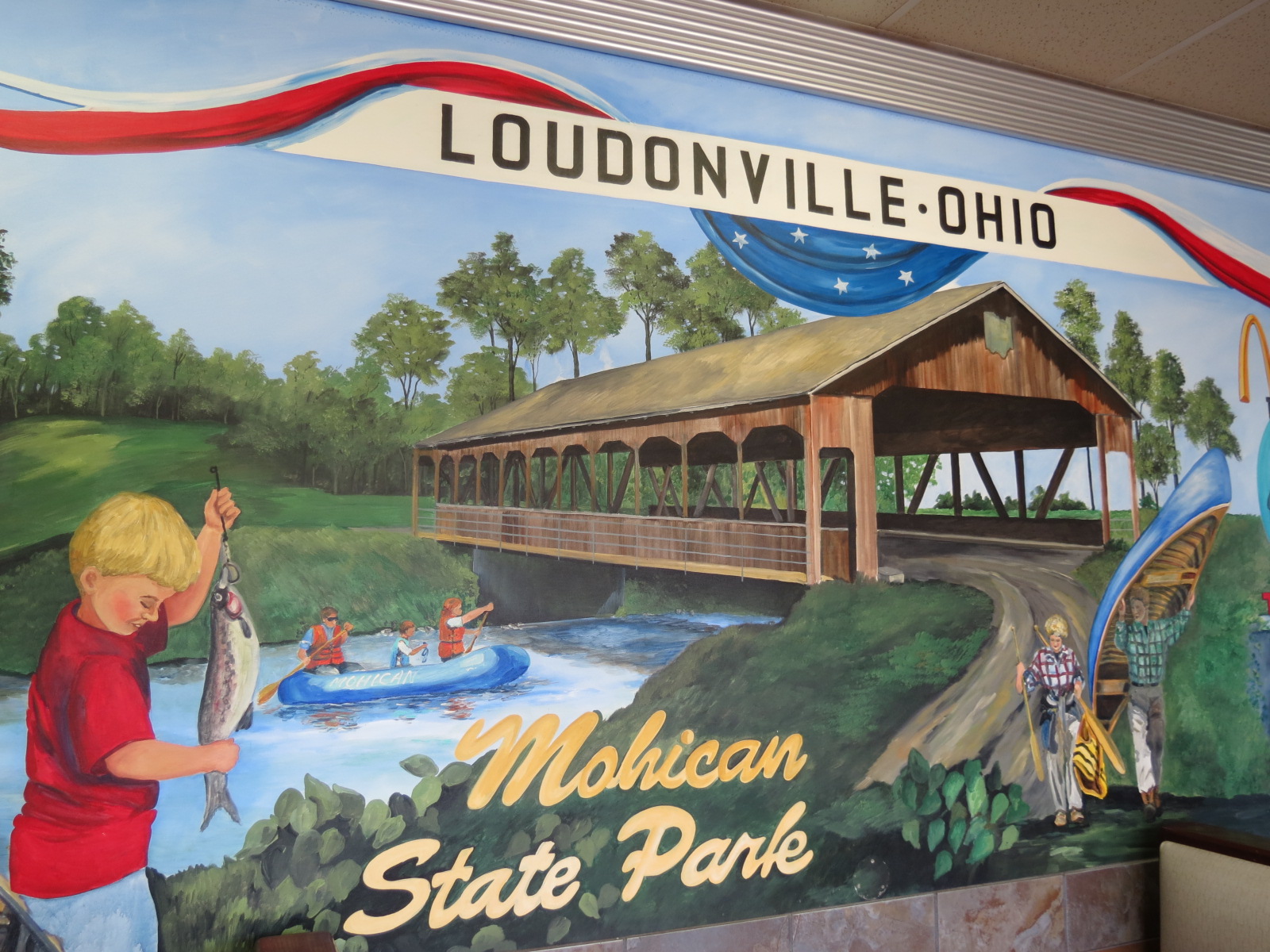
The Loudonville McDonald's displays a beautiful  mural of Mohican State Park.

  These folks are pretty savvy about marketing, and they know from whence their dollars come. Mohican State Park and Malabar Farm are huge economic draws to this area.  That tourism would sharply decline if industry is allowed to operate in our parks.  Who wants to camp or fish next to a logging operation or fracking well?  Ohio State Park land was set aside for the people of Ohio; it should not be "for sale".


The past month has been Maple Sugaring time at Malabar.  The crowds are pouring in, as the demand for homegrown food and natural products are more relevant than ever.  

     The wagon rides make it a memorable day!                                
We love Malabar and want continued protection of the land and farm management by the conservation principles Louis Bromfield promoted.  It is good for the locals and our welcomed guests alike. We are acutely aware that farm run-off is impacting our waterways and lakes.  Conservation "best practices" and conservation education should be Ohio Department of Natural Resources highest goal for this treasured farm.


Flora-Quest was started as an eco-tourism event to enlarge the constituency of the Shawnee Park and Forest. It is no secret people naturally want to protect and conserve the birds, butterflies, plants, and trees, once they understand the basic ecology.  We are now in our 7th year, and have already filled 2013's event.

Eco-tourism works!


The Biggest Week in American Birding is another excellent example of the good that can come from tourism.  People were already coming to Magee Marsh to see the spring Warblers, so why not organize the mayhem?  Now out-of -towners can get up to date information, and a myriad of trip offerings help spread the birders far and wide across Ottawa County. Ottawa County Convention and Visitors Bureau knows BWIAB is a key player in the local economy and local politicians know, too.  

Economic statistics may be the only thing preventing the full scale "bird-beater" landscape on the Erie Shores horizon.  Kim  and Kenn Kaufman have worked tirelessly to get the message  across: Wind power is great- when it is property placed. Wind power should not be placed in a migratory highway.  The science provided by Black Swamp Bird Observatory is conclusive. We know birds are migrating through the western basin of Lake Erie, both spring and fall.  First the ducks and swans,followed by millions of blackbirds, shorebirds and then neo-tropical warblers.  Migration is much more than a two week occurrence in May!  


Reason is one thing, but dollars talk.  Eco-tourism will help save the natural areas we treasure.  Help us keep our rivers clean, our forests pristine and our birds whole.  Make your voice heard about things that matter.   Ohio State Parks were set aside for the people, not for industry. Call your state representatives today.