Showing posts with label CBC. Show all posts

Sunday, December 23, 2012

Birds Count!

 We just can't help it, birders love to have our  "Merry Little Christmas" Bird Counts!

And doggone if we don't see some of the best birds that way.  A couple years back we had heart-stopping views of White-wing Crossbills at the Mohican Gorge Overlook.  You can read a great post about it- over at Jim McCormac's blog.

White-winged Crossbills in Hemlock
 I am no photographer, but here are a couple crossbills scampering around at eye-level.

Roger Troutman compiles both Wooster and Mohican CBC data.
It is a challenge to get a photo of the participants at the Mohican CBC, as our Amish friends prefer not to be photographed. They are a huge part of this count and do much of the leg-work.  They leave the driving to the non-Amish, or "English."

Northern Mockingbird
Historically, Northern Mockingbird is a great bird for the Wooster Count.  This year we had four in my territory alone.  That seems like a significant change.

Keeping consistent data, year after year tells us which birds are rising in number- like the Mockingbird- and which are in decline.  We have over 100 years of information, thanks to "citizen scientists", folks like you and me.

Evening Grosbeak
We'll hope for some Crossbills again, and you can bet we will be trying hard for the Evening Grosbeaks in Mohican as well.  I spotted them this week, and maybe we can find them again for our big day next Saturday.  See the Greater Mohican Audubon website for details.

I hope you'll join a Christmas Bird Count this year.  I do four counts each year, and find them both rewarding and fun.  The best part: this year there is no charge.  Audubon will compile the information and post it on-line.  Since there will be no magazine printed, they have eliminated the fee.

 But I hope you will join me and send them a little cash anyway. Go right HERE, and make a donation to the National Audubon Society today.  This is important work we do each year and helps scientist get a better understanding how bird populations change locally and globally.  Here's what they have to say:
The data gathered by this army of citizen scientists is critical to Audubon’s bird conservation work in the years ahead.  Past counts have shown that many common birds—ones we have grown up with—are rapidly declining in numbers. 
   The Evening Grosbeak has declined by more than 90 percent.

Female Evening  Grosbeak.
 So join our count and if you are really lucky- you'll get to see one of these!

Wednesday, December 28, 2011

Down at the Bog

Oh, the places you will go on a Christmas Bird Count!  My partner Ryan Steiner and I pulled the lucky task of having Brown's Lake Bog in our Wooster CBC route.  This property is owned and managed by The Nature Conservancy and is a dedicated Ohio Division of Natural Areas and Preserves site.

Ryan clued me in to the great birding along this edge line.  It was a happy spot for White-throated Sparrows, Tufted Titmice, Northern Cardinals and a calling Carolina Wren.

But always the weed-picker, I would not be satisfied until we had a quick peek at the bog mat in the center of this preserve.  Growing out on the mats of lime green moss, we found our winter wonders. Pitcher-plants, Sarracenia purpurea are carnivorous plants, a rare find in Ohio due to their habitat requirements.  Mid-Ohio especially, does not offer many kettle hole bogs.

Pitcher-plants, Sarracenia purpurea in winter.  

It is a little easier to understand the Latin name's specific epithet  "purpurea" once you've seen these plants in the winter!  They take on  a reddish-to-purplish hue due to anthocyanins- the same chemicals that make maple leaves change colors in the fall. 

The pitchers weren't catching many flies on this chilly winter morning, but we looked deep into the pots for evidence of previous prey.  Enlarge the photo and note the one-way (down-down-down) hairs that prevent a fly or beetle from crawling away from certain death.   Sarracenia are  exciting plants- anytime of year!

Friday, December 23, 2011

Welcome to the CBCs!

Welcome! The next couple articles are on experiences on some local Christmas Bird Counts.

I am glad you joined me for a tour of our local birding spots, and I invite you to Saturday's Wooster CBC. Details can be found on the GMAS website

Christmas Bird Counts are an important way to gather information on the changing populations of birds.  They are also a lot of fun.  If you were directed here by Jim McCarty's Aerial  View  you will want to roll down to the Dec. 19th Weekend CBC post.  Thanks to Jim for the great reporting he does on our birds and birding community.  I am certain that is the information that he wanted you to enjoy.  The more recent post concerned some environmental issues we have been dealing with in Ohio.  While I cannot turn my head and pretend I don't see these issue going on, I certainly would not use Jim as a platform for my causes.

So if you are new to CBC's and want an uplifting story  GO Here.  But if your are a regular birder, consider this- Ohio is undergoing some serious environmental issues.  Remember to take part in protecting those birds we all love to see.

Best,  Cheryl Harner

Monday, December 19, 2011

A Weekend of CBC

Christmas Bird Counts.

Many of my friends were in the field this weekend, doing our bit for "Citizen Science."  We count birds.  We count all the birds we can find in our section of a count circle. Lest that sound boring to you, I assure you it is a good time and generally we are keeping some pretty good company. Most of the best naturalists in Ohio participate in these counts because they know the long-term collection of this data is truly useful.

 My section of the Mansfield count has several creeks.  This deep, rocky gorge slices right through the property of the Springmill Elementary School and is one of my favorite places to walk.  It is never too birdy, but the scenery is fabulous!  A handful of Black-capped Chickadees and Tufted Titmice sing greetings from the trail's edge.

Sears Woods, Crawford County: Sunday's count
This legendary woods is an excellent spot to tally birds, and I was accompanied by one of Mid-Ohio's legendary birders- Gary Cowell.  Nothing gets past Gary's keen eyes and ears.  He has been one of my birding mentors for over eight years now, as he has led many an Audubon Bird Walk in Mohican Country.  He is always a source of new bird information and with a little coaxing, will share his knowledge.

Gary is a true outdoorsman- totally attuned to nature.  He studies the birds, their behaviors, habitats, and food sources.  In his quiet way, he has done more to promote birding and environmentally sound practices in Richland county than anyone will ever know.  He just quietly goes about doing the right thing, in his own "Gary" way.   

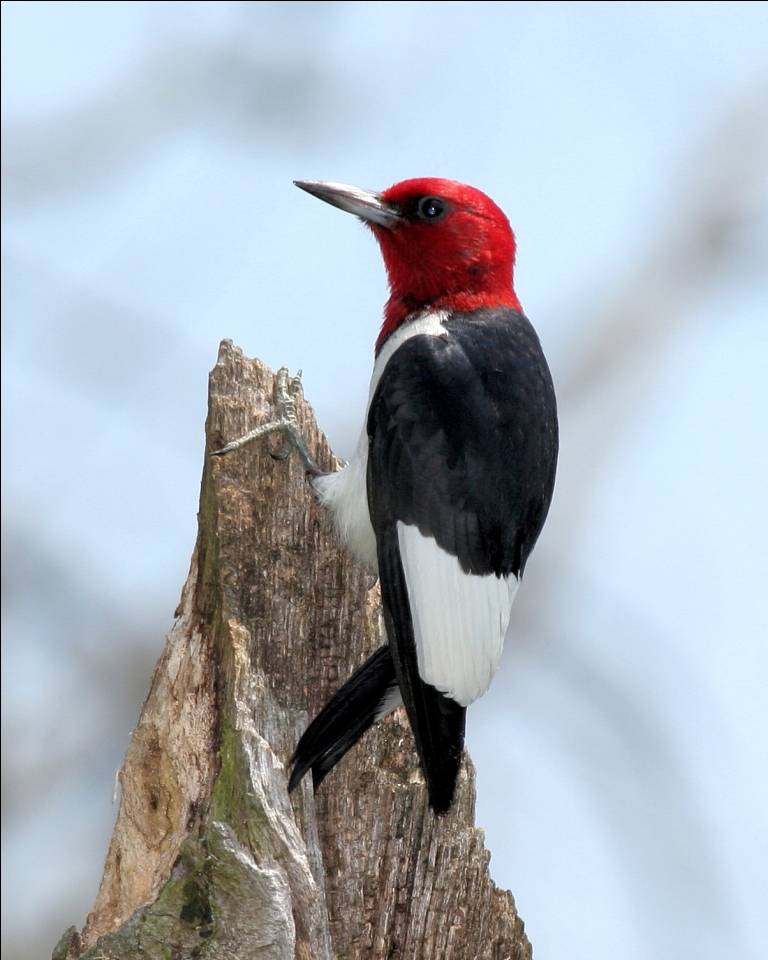
 Red-headed Woodpecker-    photo from Dave Lewis.

Sears Woods is a sweet spot, a State Nature Preserve in Crawford County, and a sure fired location for these magnificent birds.  We found four working the tree snags in the middle of Sears. Always a good day.

American Buffalo (Bison)  or some type of near-related BEEFalo

Lest you think these birds counts are, well- for the birds- we see loads of other interesting things.  One never knows what we will come upon in our our little counties.  I had no idea there was a herd of Bison within 30 miles of my home. 

Beautiful stream side walks, field time with friends and like minded individuals, and important data.  Who knew "Citizen Science" could be so much fun?  If you haven't come out for a CBC, get involved! 

Call a local CBC compiler (found on the Audubon calendar) and offer to join in. They will start you out right- and pair you with an accomplished birder- so there is no reason to miss out on one of winter's best events. 

Monday, December 20, 2010

Mansfield's CBC

Christmas Bird Counts provide a great reason to bird watch, rather than Christmas shop. Enough said, I would far rather endure 17 degree temps on an early morning than endure that pack of wild animals hanging out at Walmart and the mall.
...
My Richland County territory is a mixed bag of industrialized city (250 Rock Pigeons), the OSU Mansfield Branch Campus (Wild Turkeys and Ring-necked Pheasant), and a wet woodland/ residential area generally good for at least one Red-shoulder Hawk.
...
...........................Photo by Dave Lewis
But two species account for the majority of my sightings. It is not unusual to find me circling the ball-fields across the street from MANCI (Mansfield Correctional Institution) counting the 700 plus Canada Geese grazing there- in hopes of a rare Snow Goose or something interesting.


The something interesting this year, was a coyote- (photo "borrowed" from the internet) who was also counting those birds. As he edged along the far end of a grassy field, he created ripples of nervous tension in the flock resting on a frozen water hole. As he crept along, the geese peeled out 20-25 at a time. As they continued to take wing in small groups, it provided a excellent opportunity to inspect each mini-flock for unusual birds and allow for easier counting.

The birds quickly added up to over seven hundred Canada Geese- and Mr. Coyote seemed to think I could certainly spare just one! I doubt that a coyote would try to take on a Canada Goose, unless is was very old or in a weakened condition and left behind from the flock. From what I have seen of geese, several adults make a formidable foe, one this furry fellow best avoid.

...

American Crows- the Mansfield evening roost holds thousands upon thousands now. Early morning and late afternoon an endless stream of crows fly in and out of the city on their daily peregrinations. There is protection and warmth in numbers as they huddle together at night in winter-flocks within the city. In the mornings they disburse like rays of sunshine erupting from the city. Well, most folks would equate them with plumes of smoke, but these intelligent birds are endlessly fascinating to watch and to listen to their calls of encouragement within their family units.
...
A bit of historic scenery from my end of the Mansfield CBC, the old Mansfield Reformatory. Built at the turn of the century, it first provided housing and a hope of reformation for young men. The grounds were dotted with tree lawns and a lovely pond provided an excellent picnic spot for the locals. Follow the link to learn more about its history, and the tours available at this trendy tourist hot-spot.
...
Once again, I encourage you to take part in your local Christmas Bird Count. It is an excellent way to volunteer -and to use your birding skills. Many of my Audubon friends help with this amazing nationwide wide count which provides valuable scientific data provided by "Citizen Scientists."
...
A CBC makes you feel good about spending a day with the birds. Besides, the crows and I enjoy scenery.

Sunday, December 20, 2009

Conservation and CBCs

It was a soft falling snow that covered our county yesterday, and it only enhanced the scenery for our local Christmas Bird Count. CBCs are an annual assessment of birds and their population trends, and those numbers are certainly impacted by human population trends as well.


A sepia colored world.

Think like a bird and find open water in the morning; birds are attracted to water. Just like the rest of us, they gotta drink. On the far north edge of town, this babbling creek was a welcome sight: soothing to both eyes and ears. I stayed to commune with the birds.

Most of my Mansfield CBC route is urban, and becoming more so. The Mansfield Reformatory (home to 12,000 crows and 500 Canada geese), trashed out trailers, run down homes- sometimes it felt like the "Oxycontin Heights" tour.

Woodlots are becoming farther and fewer between in this quadrant. And where construction has not wiped them out, signs indicate it is on the way. Birds in decline? People are making impacts.

Another new gas staion, another housing development- and yet within a mile- houses and stations are already abandoned. Maybe we need to re-think the impact we humans are making?


Two places were highlights on my urban and industrial bird tour, the OSU Campus and a Sportman's Club. The OSU campus has a natural landscape and should be emulated by homeowners. I'll feature some photos in an upcoming blog.


And hurray for the hunters! What can I say? The best piece of habitat I saw all day is a huge hunt club, conserving vast acres of woods, grassland and wetland. Ok, Bambi and the pheasants are living on the edge here, but the benefits to other wildlife was obvious. The raptor count soared!

Birders and hunters- we all basically want the same things. Clean water, natural habitats and healthy animals. Let's do a better job of all just getting along!