Wednesday, July 15, 2015

Lakeside's Botanical Secret

If the cottages of Lakeside could talk, we might hear some intriguing stories.  After all, since the mid 1870's it has been a gathering place for families and the famous alike. You might be surprised to learn the exciting story which came to light during my recent visit to Lakeside.

Dewey Hollister, reknown plantsmen.
While attending the Gardening as Landscape Painting series, Dewey Hollister and I spent a good bit of our free time enjoying the gardens and grounds. We particularly savored the architecture and landscapes which incorporate a century's worth of designs.  We visited elaborately planned gardens and several of the most naturalistic remnants of plant communities on the Marblehead peninsula.
 
Hydrangea arborescens is the oldtime Lakeside garden favorite.
As we walked through town, Dewey noticed the cultivated hydrangeas which seemed to tell the story of Ohio's native plants and their appearance in our gardens. What could say "summer cottage" better than a foundation planting of hydrangeas?

These wild hydrangeas have rather small flower heads and bear more fertile flowers than showy sterile florets. Fertile flowers are the smaller pollen-loaded reproductive portions of the flower.  Today's hybrid hydrangeas boast larger showier flowers which are preferred by many gardeners, but do not provide pollen for our much need pollinators.

A progression of Hydrangeas often surrounded the older cottages.
Some early Wild Hydrangeas, Hydrangea arborescens probably sported a more uniform Hydrangea arborescens var. grandiflora which directly translated from the Latin means: Hydrangea of the woods with grand flowers.  This grandiflora genotype was later developed into the standard and completely sterile "Annabelle" Hydrangea we all know today.

The classic Hydrangeas arborecens is a staple in Lakeside landscapes. 
 Through the years, nurseries and gardeners quit growing the old standard as the much showier "Annabelle" Hydrangea became commonly available. The basic grandiflora form has been all but lost, until Dewey's realization that Lakesiders have shared and preserved this plant for over 100 years!

It takes very little imagination to see how neighbors might have split off a start of their cherished hydrangea to welcome friends and family as their cottages were built in our fair Chautauqua.  What could be more neighborly or Christian than to share your favorite low-maintenance plant?

Hydrangea arborescens var. grandiflora on the left, Hydrangea "Annabelle" on the right.
The difference between "Annabelle's" larger leaves and the showy, fully-sterile flower heads become more obvious with a little practice.  Soon you will notice many cottages with their original Hydrangea arborescens by the door and a nearby line of more recently added hydrangeas from the horticulture industry.

Test your botanical ability on your next Lakeside walk.  Try finding Ohio's missing heritage hydrangea which has been hidden in plain sight all along!  One has to admire the old-time Lakesiders for having the ability to preserve something special through love and friendships.

Tuesday, July 7, 2015

Landscape Gardening and Native Landscape Design

It is no secret that Lakeside on Lake Erie has one of the most beautiful lakefronts in Ohio, if not the entire United States. They have officially declared the one mile stretch of walking paths "Ohio's Most Beautiful Mile." Against the back drop of idyllic lake scenes and sailboats, lie the parks and the shoreline of landscape plantings. It is easy to understand why we love Lakeside and why artists and photographers are compelled to capture its beauty.

Lakeside's Beautiful Mile- Photo provided by Lakeside website.
It is no wonder people came from all across Ohio to the gardening symposium, Painting Ohio in Broad Brush Strokes.  Lakeside was the ideal location to study landscape design and the new movement toward a new Naturalism, as seen in Europe.

Dewey Hollister, Hope Taft and Guy Denny
The program kicked off with three people who have made real strides in adding native plants into the landscape at the Ohio Governors Heritage Garden.

Former Ohio First Lady Hope Taft came up with a marvelous idea to show case the best of Ohio's floristic bounty into sectional gardens at the Governor's residence.  She enlisted landscape designer Dewey Hollister and native plant expert Guy Denny to create a Heritage Garden.  It is open for tour- just tap on this link http://www.governorsresidence.ohio.gov/home.aspx for details.  Hope is an amazing force for nature and still remains active in the development of the landscape gardens at the historic Ohio Governor's Residence.

Amanda Patton Garden designer from the United Kingdom
Lakeside, in conjunction with the Ohio Governors' Residence, hosted a tour which allowed Amanda Patton to travel with this special event.  Amanda gave four educational programs in all, entitled Towards a New Naturalism: All Gardening is Landscape Painting. She described the parallels between art and landscape design.  One should develop a landscape using the principles of good art design and the elements which guide those principles. Art based landscapes have balance and are pleasing to the eye.  The Fibonacci Sequence, the Golden Ratio and focal points matter. Artist Luca Pacioli said, "Without mathematics there is no art."

The second day of lectures focused on creating natural gardens and illustrated many examples of contemporary works in Europe.  It was interesting to see our prairie landscape being utilized in landscape design an ocean away. I highly recommend browsing Amanda's website  for more examples of this exciting trend http://www.amandapatton.co.uk/portfolio/.

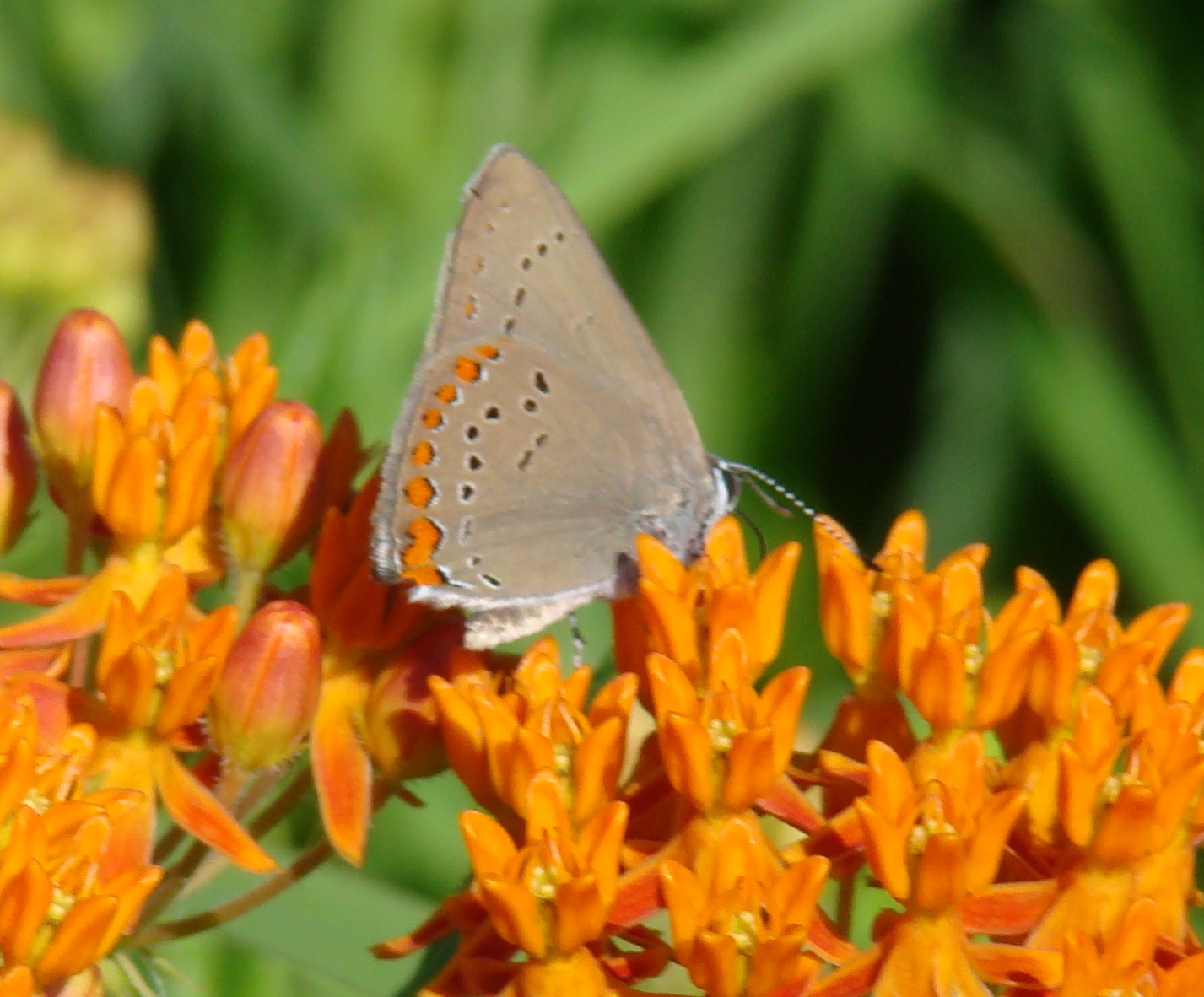
 Coral Hairstreak nectars on Butterfly-weed.
There are many benefits to this new naturalism and native plants in landscape.  Nature make us feel good.  Native plants are more sustainable and they sustain the fauna which we enjoy. They are environmentally beneficial and require less labor to maintain. 

Part of the event include field trips to natural areas like Lakeside Daisy preserve, Castalia's Prairie and Sheldon's Marsh.  These places are all wonderful examples of of Ohio's best Natural Areas and Preserves.

Lakeside boasts of many flowering hydrangeas.
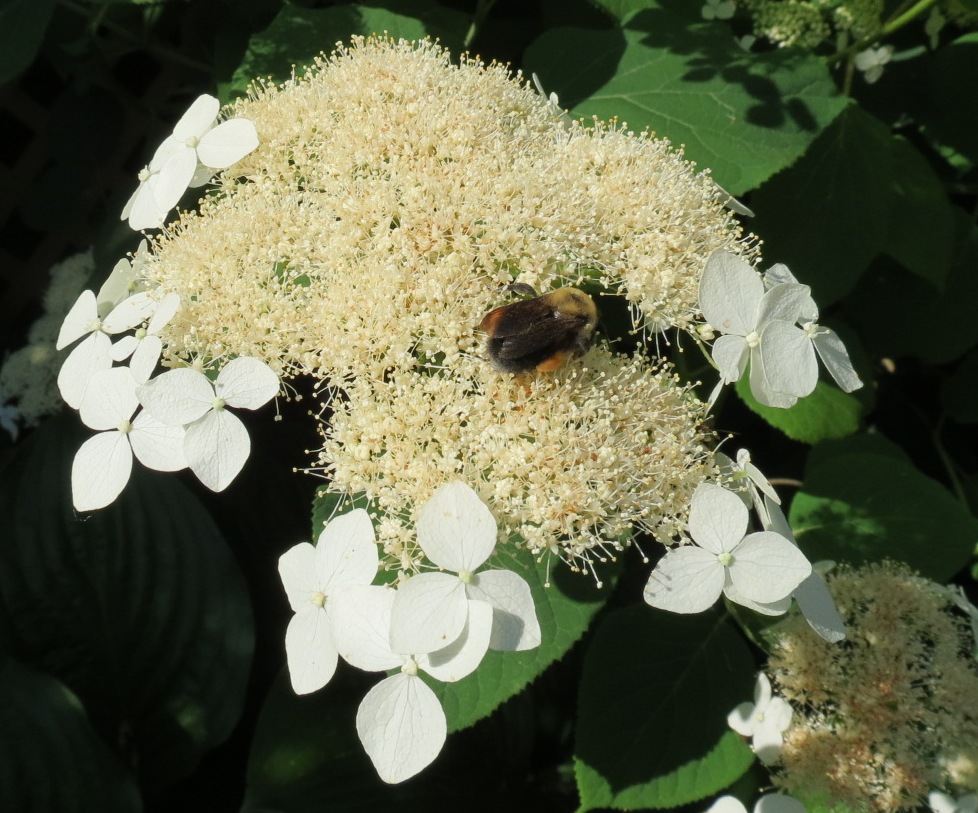
During the course of our many walks we admired the landscapes and plants found within Lakeside. At one point,  Dewey Hollister had a realization about the lovely hydrangea species growing within the gated community, and perhaps unknowingly, how the good people of Lakeside have preserved them for prosperity.  We'll discuss these hydrangeas in a future blog. For now, let's just admire one of the many pollinators that was gathering sustenance at its fertile blooms.


Thursday, June 18, 2015

Aquatic Adventures

If it is flying, flapping or swimming, it is worth chasing, studying and sharing with friends.

Spatterdock Darner
Today we were harassing dragonflies at the Gorman Nature Center in Mansfield, Ohio. For a little pond, the list was amazingly varied!   Eastern Amberwings, Eastern Pondhawks, Dot-tailed White-face, Comet and Green Darners, Slaty and Twelve-spotted Skimmers, and many others- including this amazing Spatterdock Darner! It was a feast for the eyes.

Judy Semroc and Larry Rosche
Two of my favorite guides and dragonfly experts Judy and Larry gave an excellent program and led the field trips.


They do professional outreach for the Cleveland Museum of Natural History. The are also the authors of one of the best dragonfly and damselfly guides written in the Eastern U.S.  If you don't have it, you can buy it on-line: just click here.

The bridge at Gorman Nature Center's pond.
If you are interested in learning about Odonates (dragonflies and damselflies), the pond behind Gorman Nature Center is a well-stocked location. You can spend an afternoon and see up to fifteen species!
Our field trip to the pond.
We did plenty of milling around, catching the adult fliers and netting some aquatic life in the form of immature Odonates, water bugs and frog tadpoles galore!


 Judy waded right out into the water to get the best specimens, while Larry identified all the goodies we brought to him on shore.  If you have never ventured into the field with these exceptional leaders, you have been missing out on a lot of fun!

They will be leading part of the Aquatic Adventures for Flora-Quest, Aug. 27-29, 2015  in the Mohican Area.  For those of you in the Cleveland area, the Cleveland Museum of Natural History  is offering a sign-up on line to drive down in the bus from CMNH. Just go to this link to sign up from the CMNH calendar.


Or go directly to the Flora-Quest website to see all our offerings.  If you are interested in plants or natural history, this is the conference for you.  Hotel rooms are limited, so contact me if you need help finding a room.

Hope to see you there, chasing Dragon Hunter dragonflies and Hellbenders!


Wednesday, June 10, 2015

Swallows? Bank on it in Chagrin.

Ohio has many lovely locations for birding.  Mohican and Shawnee State Forests come to mind, as does the North Coast.  Lake Erie offers countless opportunities to take in a golden sunset and admire a stunning view, all in the name of birding.

The Chagrin River on a lazy day.
Just South-east of Cleveland, the Chagrin River flows north to the lake and meanders through North Chagrin Reservation, one of Cleveland's many parks which make up the The Emerald Necklace.


A river bluff, remains from an earlier geological period.
 The river's water level was down from the previous week when I had visited during a flood stage.  There is no exposed shore when the water was raging over the banks. It was interesting to see the river at both stages.  It is calm in the photos, but just a week before it was an altogether different beast.

Bank Swallow nesting riddles the bluff with holes.
 Scanning the far shore, a cliff rise high above the river.  It is probably a good 120 foot tall, if not more.  Look carefully at the face and you notice the Swiss cheese effect of bank nesting birds.  There is a huge colony present of the highly social Bank Swallows, Riparia riparia.  Special thanks goes out to Dale Gaul for alerting me to this nesting colony.

Bank Swallows tended their nests and socialized along the bluff face.

For video of Bank Swallows go here.  This video shows the interactions of the Bank Swallow colony.  It was a joy to see Bank Swallows in a natural (vs. man-created) habitat.  Watch carefully for the bank swallow hole (mid-screen left)  where excavated sand comes flying out of the nesting cavity!


To read more about Ohio's Bank Swallows- This is from a past blog which features the Bank Swallows utilizing the screenings or tailing piles, the name for the by-product from quarrying operations, at the Marblehead limestone quarry.

The river walk at Chagrin Falls
Chagrin Falls, Ohio is a charming town with lovely shops and cafes. It was fun to visit this nearby city after our birding adventure, knowing the best- kept secret in Ohio.  Bank Swallows rule their nearby river bluffs.

I could hardly contain myself!

Thursday, June 4, 2015

The Report from Kirtland Bird Club

It was my great honor to do a program in Cleveland for  The Kirtland Bird Club last night.


The Kirtland Bird Club is one of Ohio's oldest and most prestigious bird/ science groups.  It was named after the Dr. Jared Kirtland who in 1852 collected and identified the very first specimen of Kirtland's Warbler on his farm near Cleveland, Ohio. It was many years before biologists found the birds nesting in 1903 in northern lower Michigan.  This is a bird of concern which has been long studied, and recently, conservation efforts have possibly prevented its pending extinction. You can read about the bird, here.

The bird club was named in honor of Dr. Kirtland and their website gives the following history:
The Kirtland Bird Club (KBC) was formed on September 28, 1940 and has a long tradition of quality contributions to the Northeast Ohio Birding community. In its early years the club conducted monthly meetings, field trips, breeding bird population studies, Christmas bird counts, and wintering duck population studies. The objectives of the KBC are serious study of ornithology with a view to increase the knowledge of individual members, the exchange of ornithological experiences and records, the compilation and publication of important information on birds, and the promotion of good fellowship among its members. 
Out-going Kirtland Bird Club President Lukas Padegimas 
 It was Lukas Padegimas' last night as President.  This fine young man is busy attending school at Cleveland-Marshall College of Law, but I am certain he will remain active in the birding community as well.

A nice crowd filtered in...
 As always, a nice crowd of 30 or so filtered in and we discussed upcoming meetings, bird trips and  membership (I renewed my membership, you should join too!)

The Talking Head
 Since The Kirtland Bird Club meets at the Cleveland Museum of Natural History, you never know who is going to stop by to make an announcement or two.  Fortunately, I spoke after this guy, so my program was a little more lively than his.

Cheryl Harner and Lukas Padegimas ( Flora-Quest Scholar 2015)
photo by Paula Lozano
It is also my great honor to announce that Lukas has received a scholarship to the 2015 Flora-Quest!  This is super exciting, because Lukas is interested in land conservation and practising law for conservation easements.  We can't wait to have him meet and greet all our botanical and birding friends when we gather at Mohican State Park in August.

Sign up for Flora-Quest and take part in eco-tourism.  This is educational-entertainment!  We hope to see you there; I'll introduce you to Lukas!