Showing posts with label Jim Bissell. Show all posts

Thursday, January 8, 2015

Upcoming Programs

It may be hard to think about getting out these cold winter days, personally, I have been hibernating with some new books I got for Christmas.  But if you are a hardy soul wishing for botany, here are some recommendations:

Three-bird Orchid
 GOT ORCHIDS?

If you like orchids, you will love this program offered by Andrew Lane Gibson.  He is one of Flora-Quest's youngest guides, and an excellent photographer I might add.

You'll want to check our Flora-Quest Facebook page for announcements of up coming events:


Showy Lady Slipper, Cypripedium reginae

Better yet, book mark the webpage of our friends at Cincinnati Wildflower and Preservation Society.

They have excellent programs all year long and free field trips.  This is one more reason I wish I lived nearer to Cincinnati!


Another excellent oportunity:

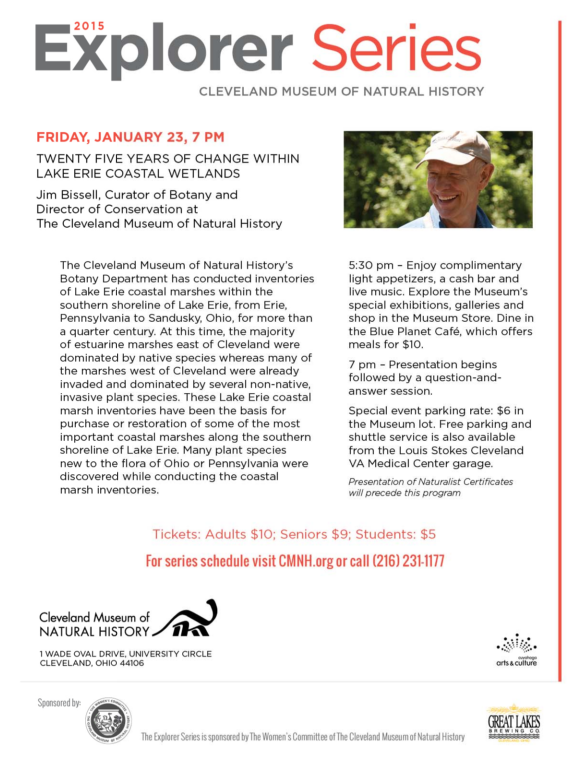
Jim Bissell is Ohio's greatest "un-developer," and my hero. This is certain to be an excellent program and if snow is less than a foot deep in my drive, I plan to be there!  It is always interesting to learn more about Lake Erie wetlands, and Jim is the Sensei of the Swamps.

Hang in there.  Spring has got to be coming and I promise future blogs will be more uplifting. Some of them will be focusing on this year's Flora-Quest! We are formulating some awesome plans.


Wednesday, September 5, 2012

Jim Bissell, the "Un-developer"

One of the finest botanist in the state of Ohio is also Mother Nature's best friend.  Jim Bissell has been quietly going about the work of the Cleveland Museum of Natural History- for as long as anyone can remember.  He was recently described to me as the world's greatest  "un-developer."   

Jim has gone about Ohio, finding the best of natural areas and preserving them for nature and scientific study.  Countless acres that might have become strip-malls and housing tracks are now permanently preserved reservoirs of plants and animals.  And let's face it, these critters need all the help they can get.

Jim Bissell, C.M.N.H.'s  Un-developer
 On a recent Ohio Division of Wildlife Diversity Partners retreat, Jim led a field trip to the nearby Geneva Swamp Preserve.  He told us of the importance of the Flat-topped White Aster, Doellingeria umbellata  and its special relationship with a rare butterfly.  Geneva Swamp is one of the few places left in Ohio that has this aster, and one of the last places this butterfly was seen.

 The caterpillar of the Harris's Checkerspot (I photographed this in Michigan.) The Harris's caterpillar only uses the Flat-topped White Aster as a host plant. This is a plant we need to be searching for, concentrating on wet meadows.

Harris's Checkerspot,  Chelosyne harrisii 
 Harris's Checkerspot has only been found in onesy-twosies in Ohio for the last 10 years.  We are very concerned that this butterfly may no long be present- we know it has not been found in any numbers.  And while it is not much larger than a pearl crescent, the under-wing pattern is uniquely different.

Harris's Checkerspot, (Michigan)
The beautiful Harris's Checkerspot was only known from the northernmost counties in Ohio.  Now it is rarely seen and we should concentrate more effort on finding any remaining pockets of its populations.

And if you like bio-diversity in Ohio, please support it- by purchasing your Ohio Wildlife Legacy Stamp. Jim Bissell and I will thank you!

Friday, May 18, 2012

A Day in the Life...

This post could be named as "A Day in the Life of an environmentalist."  But rather, let's focus on the important things- calling it "A Day in the Life of the Environment."

Dr. Jim Bissell, Cleveland Museum of Natural History, Dept. Botany
The day starts out at a property protected by the North Central Ohio Land Conservancy.  Jim Bissell had already found a rare grass, an Andropogon  (Elliot's Beard Grass) and had moved on to the wetland.  He was scrutinizing the water cress- something just didn't seem right.  Is this a rarity, too?

Jim brought a team of elites: Dave Kriska, Judy Semroc, Larry Rosche and others to comb through the land trust property for a complete documentation, including possible rarities.  It is our job to discover the secrets this land has held in silence as it has remained undeveloped, except for one close-call with a timber company.

Appalachian Azure, in Mid-Ohio?
 As we wandered through the giant Skunk Cabbage a large, or rather largish for a blue, butterfly flitted by.  Dr. Bissell had asked if we ever had Appalachian Azures here, based on the botany.  I had dismissed them as being out of range.  And yet, like a phantom one appears.  Judy Semroc is the butterfly expert of this crowd, and we both feverishly photo document the lep.  This was too good to be true.  And we will see if it is...

Steve McKee Displays a frond of Blunt-lobed Woodsia
 Another find!  A few miles away, while gathering for a press conference, Steve McKee stumbles into the largest and only 3rd population of the Blunt-lobed Woodsia in the county.  Steve has only seen this plant in ones-and-twos prior to today.  Here he discovers a thriving population.

Many life-times of botanists, entomologists and other scientists have made and continue to make new discoveries in Mohican and Malabar.  We are still finding great discoveries, and sadly today we are gathered at this very location for fear of what we might lose.

The press corps roll footage and take notes under the  towering canopy.
 Ohio State Parks, including Mohican and Malabar are currently on the block for fracking and timbering.  In an unprecedented grab for money, the political powers in Ohio believe mining the parks for resources is a way to "save" them.  Who knows what rare fern, butterfly or grass could be forever lost, before it has even been found.

A press conference was held to announce the  Coalition to Protect Ohio Parks.  Please click on this link for more information.  Columbus Dispatch coverage here.

Portrait of a Rough-winged Swallow
The day ended in hush evening bird song, along the Clear Fork River.  Wood Thrush and Veery set the stage for this photo of a Northern Rough-winged Swallow settling in for the night.  I had watched a pair of swallows hawking for insects along the river.  My view from on the old covered bridge afforded this Monnet-esque view with the dappled river as a background.

Day draws to an end, and those of us who commune with nature pray,  It will not the end of days for Mohican, as we know it.

Friday, June 4, 2010

West Woods' Sedge Workshop

This post is strictly for the most avid botany types: the sedge heads. Anyone else is excused now, unless you want to learn a bit more about one of the most fascinating genus in botany- hands down- Carex. Carex is King, and as we say, that sedge is going to bring you to your knees!

There are only a handful of guys in Ohio qualified to lead a sedge workshop- and this is one of them- Dr. Jim Bissell from the Cleveland Museum of Natural History. He knows his stuff, and we were thrilled to be learning from a master, the sedge master.


Buxbaum's Sedge, Carex buxbaumii (don't start sweating Sedge-heads, this in NOT from Geuaga Co. It is an old photo from my file.)
Whats not to like about a sedge? They have great geometry and color, come in all shapes and sizes and are as confusing as heck! Oh, yeah, did I mention they are confusing? We like a good challenge.

And if you have any interest in really learning sedges, you'll need to have a good magnifying lens.

Some folks brought a good book to the class to help them key out sedges. I brought a good botanist: Steve McKee. I was lucky my friend was happy to attend this day of wonderful sedginess.

Interested in learning more? Here is a great guide- until we get one for our own state. Come on Mr. Gardner... we are counting on you!
And of all the places to see this license plate- a sedge workshop.. no real surprise there!