Monday, October 11, 2010

Headlands at Dawn

One of greater Cleveland's most noted hot-spots for birds, Headlands Beach ( Mentor, Ohio) was just one of the locations for OOS field trips last weekend.


Northern Saw-whet Owl- photo by Judy Semroc

Near the main entrance to the beach front trail, a Northern Saw-whet Owl was found resting in a tree. These micro-owls, not much larger than a man's fist, are known for daytime napping in grapevine tangles. They can be extremely difficult to locate- even when you know where to look! But once they are found, they seem tolerate the annoying human presence with aplomb.


After sufficient gawking at the owl, our group proceeded to the grass covered sand dunes just beyond the beach. We were in search of warblers and rare sparrows, but we were not above looking at any common species either. While the rest of the group focused on the Eastern Bluebirds, Swamp Sparrows, and a couple of Nashville Warblers, I became more interested in what they were feeding on.


The predominate grass, with arching, fuzzy seed heads, is the state listed Coastal Little Bluestem, Schizachyrium littorale. Any disturbance of the stems sent up a puff of airborne midges- the perfect migrating warbler fuel. As swirling insects were rising with the sunlight and warming temperatures, birds began feeding mid-air.

Want birds? Find their food source. And while botany does not drive midge production, it was certainly providing habitat for them.


Often called "Muffleheads" due to the feathery antennae on the males, these nearly invisible fliers are fascinating if you take a closer look!


Most species of Chironomid midges should be considered beneficials- and do no harm- other than the annoyance they create for some homeowners. They are often listed as bio-indicators, and a measure of a healthy ecosystem, but most of the interesting reading on the fuzzy headed bird-food is produced by agencies promoting means for killing them. I would think you might use ecological controls, like promoting Eastern Bluebirds as a means to control them. However, most publications promote electrocution (bug zappers), poisoning the aquatic nymphs or spraying the adults without impunity.

Kind of makes it hard for a warbler to eek out a living, doesn't it?


Two of the most amazing field trip leaders, Judy Semroc and Larry Rosche clearly understand the connection between nature's gift of insects and our beloved birds. It is not a matter of taking the good with the bad, but rather understanding nature is many things... and beauty can be found even in the life-cycle of a fuzzy-headed midge.

Saturday, October 9, 2010

OOS Rocks Cleveland

It is my good fortune to be on the board of one of Ohio's largest and most active birding organizations. Each year we gather to hold our annual meeting and conference, and this year we rocked Cleveland, at the beautiful Radisson in Eastlake .


This morning was filled with field trips and a Lake Erie pelagic. Our group met up at Dike 14 - the only undeveloped land within eye-shot of downtown Cleveland. It is the remains of a dredging operation's spoil pile, and now offers some of the best sparrow watching in Cleveland.


Our stellar group of leaders, including Craig Caldwell, Dan Sanders and Jim McCormac helped us sort out the host of fall migrants. We even determined that every birder in Ohio has been on at least one Jim McCormac-led field trip, somewhere, sometime.


It was my honor to present Jim with a gift from the whole society, in honor of his 6 years dedicated to the OOS as the Inaugural President. From its humble beginnings - a letter of interest from Ed Pierce which started a series of small group meeting in Wooster, Ohio- the OOS was "fledged" in 2004. Combined with with Jim's first book release- Birds of Ohio- it was a perfect storm.

Jim relentlessly toured the state giving programs and book signings, all the while promoting OOS. His enthusiasm for birding and conservation was the eye of the OOS hurricane, and in a few short years membership sky-rocketed to nearly 800.


A photo of Jim's award- a Black Scoter.
OOS has given a number of awards in the past-lovely duck decoys- created by Tim and Laura Dornan. Usually we give a Wood Duck, but we knew Jim's heart has been set on adding a Black Scoter to his personal collection of "Dornan Decoys." Special thanks to Tim and Laura for helping us pull this off!


The Keynote Speaker was Drew Wheelan of the ABA, on the Deepwater Disaster.

OOS is donating half of our proceeds to a Gulf Relief effort, and half to the Safe Flight program headed up by Harvey Webster at the Cleveland Museum of Natural History.

There were two awesome days of field trips, and many of us got two see Nelson's and LeConte's Sparrows at Wake Robin Trail. We counted ourselves very lucky. It was a wonderful conference, and the field trips were full of fall migration birds.

Wednesday, October 6, 2010

Looking forward to Headlands

OOS' 6th annual Conference is this weekend and I am so looking forward to returning to Mentor Headlands Beach. This is one of Ohio's most scenic birding locations and too good of an opportunity to pass up!


When the beach is this beautiful...

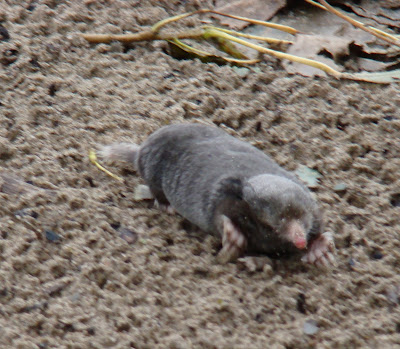
and you are birding beside one of Ohio's historic lighthouses, it is worth the trip. Life is good when you are sharing the day with friends, enjoying some botany and last year- we even saw a "life" mammal!
Harry- the Hairy-tailed mole was skittering around in the beach sand. His fuzzy white tail made for a quick ID. Maybe he just wanted to take in the scenic view as well.


And just a couple miles down the road from the beach you find Wake Robin Trail.
It provides perfect sparrow habitat and Nelson's Sharp-tailed Sparrows were seen in numbers here. We got our binoculars trained for several good looks at the skulkers found here last year. That is when we formulated a little Sparrow logic: if is was perched up- it was a Song Sparrow, if it dove down and tucked into the weeds- that was the likely Nelson's.


And what does a sparrow to eat while migrating? Smartweed seeds. Several species of smartweed, including Pennsylvania Polygonum pensylvanicum, Water-pepper Polygonum hydropiper and Arrow-leaved Tearthumb Polygonum sagittatum grow along the boardwalk, providing seeds for the little skulkers.

Another smartweed aficionado, a Smeared Dagger Moth caterpillar makes good use of the leaves of these same plants.

So whether we get any rare birds this year, or not, it is never a wasted day when we are able to enjoy some of nature's ample offerings. Good birding, and more, to you. Hope to see you at Headlands!


Tuesday, October 5, 2010

6th Annual OOS Conference

The OOS is proud to bring ABA's Drew Wheelan to our conference on October 9th. We hope you will join us for the full conference, but if you are unable to attend the entire weekend's festivities, you can now sign up forDrew's Saturday night presentation.

Drew will present a first-hand account of the effects of the disaster in theGulf on birds and bird habitat, and subsequent efforts to clean it up. He will also examine wildlife response efforts and behind-the-scenes politics, including rehabilitation and recovery efforts. You can read Drew's blog at: http://birding.typepad.com/gulf/

Please visit the OOS website www.ohiobirds.org for further details, or click on the link under the announcement of our 6th Annual Conference in the side bar of this blog.

Friday, October 1, 2010

October Asters

Nothing says "Fall" like the bloom of asters. With a vast array of species represented in Ohio, one can only hope to learn a few new species each year and go for the long term achievement.

Steve McKee (Richland Co. Parks) and Jim Bissell ( Cleveland Museum Nat. History) both give excellent programs which offered keys to Ohio's asters, if you are serious about learning them. Either key is an welcomed resource for sorting this confusing species.


Shale Barren Aster, Symphyotrichum oblongifolium is a major rarity only found in three of Ohio's counties. This one was found on the edge of Lynx Prairie in Adams County. Of all the asters, the Shale Barren could be recognized by site affiliation and the enlarged buds- which have a swollen appearance.

Also known as aromatic aster, this creeping flower is right at home in stone barrens, and would make a likely candidate for a rock garden. There are a surprising number of "on-line" plant nurseries offering this gem.


...
And when is an "Aster" not an aster? When it is Golden Aster (aka Maryland Goldenaster), Chrysopsis mariana. True, this southern species and warm weather friend is in the Asteraceae family, but it is not found in the genus we know as "asters." Not that it would matter to anyone but a botanist. Everyone else seems to enjoy this little yellow aster at face value. What's not to love?
...

And one parting shot of the Stiff Aster, Ionactis linariifolius - seen in yesterday's post. Its stiff needle-like leaves make it a stand-out among the asters. This, too, could make a smashing rock garden plant if sited properly.

Enjoy your fall weekend, and pay particular attention to the many species of asters out there!~