Showing posts with label Native plants. Show all posts

Thursday, March 17, 2016

LEAP into Spring

Spring is bursting forth on Ohio's landscape. 

A vernal wetland provided ample sight and sound.
 Yesterday I enjoyed blue skies and the raucous amphibian calls at several locations, including the Bath Nature Preserve in Bath, Ohio.  This particular frog pond offered a deafening cacophony of croaks, clucks and peeps.

 I had traveled to Bath for a Lake Erie and Allegheny Partnership (LEAP) meeting.  LEAP is a consortium of land trusts, parks, and educational organizations dedicated to protecting and restoring biodiversity.  It is supported by the  Cleveland Museum of Natural History, where there is an active staff who provides leadership for LEAP.  (Thanks Renee!)

Akron U. has a field Study center at  Bath Nature Preserve.
We met at the University of Akron's Field Study and Environmental Education center.  These traveling meetings give LEAP members a excellent opportunity to see other organization's outpost. We have visited numerous park districts in Ohio and even a few in Pennsylvania.

Cornus mas, (Cornelian cherry) in full flower. 
The attractive yellow buds on a nearby tree beckoned to me from across the parking lot.  We now know them to be the four petaled flowers of a tree in the Dogwood family. This is the non-native Cornelian cherry or Cornus mas.

Cornelian cherry trees
 These small trees had me fooled!  I thought they were our native Spicebush, but they are Cornelian Cherry, or Cornus mas.  It would be fairly easy to successfully ID a Spicebuch vs this non-native dogwood, had the leaves been present.  But I am happy to have learned the difference between the two species, by the blossoms' petal count.  (Thanks to Sarah who wrote in to set me on the correct path!)


This brings me to the annual "Native Plants of the Year" cards LEAP produces.  They are an excellent mini-guide to three native Ohio plants you can incorporate into your landscape.  Look for the Flora-Quest display at up coming events, and I will be glad to share these free cards with you.

 The 2016 plants are Spicebush, Swamp Candles and Little Bluestem.  To learn more about our native plants and the pollinators attracted to them, or find local native plant nurseries, you need look no further than the LEAP website. 

Don't you think Ohio otter offer a license like this?

 Native plants also benefit native animals, just like this handsome River Otter pictured on a LEAP member's Pennsylvania license plate.  This special plate promotes the need to  "Conserve Wild Resources."

That is a message we can really get behind.  HONK, HONK!!


Monday, January 26, 2015

LEAP into Landscapes

If your idea of a perfect snow day includes browsing seed catalogs, we must be friends.  Back in the days I ran a greenhouse, Stokes was one of my favorite catalogs.  It offers extremely detailed information on seed germination and is an excellent resource for planting information. If you have ever pondered the terms "scarify" or "stratify," Stokes is for you.

Plant like the professionals!
It is never too early to think about planting.  However, January is too early to actually plant, unless you have access to grow lights or a green house.  Raising your own flowers and vegetables can be very therapeutic. You can even grow them in the same beds, or try adding berry plants in your landscape.  Here at home we have blueberries and strawberries festooning the shrub bed. What could be better than having your landscape and eating it too?

A good variety of potted plants from Native in Harmony nursery.

 Once I became more interested in growing native plants, I found it was harder to find native plants and seeds to purchase.  In the last ten years, this has become much easier.  If you are looking for a place to purchase native plants, plan to attend the Midwest Native Plant Conference in Dayton.   They always offer a great variety of native plant vendors and many plants from which to choose.  You should also continue reading this blog, at the bottom of the page is a link to many native plant sources.

Weedpicker- planting native plants in the Lakeside landscape.
Planting a native plant garden is not very different than planting any other garden.  You should assess the soil, day light and water available to the garden. A native garden is more likely to use plants that will thrive in the local soil, where horticultural gardens often amend soils to nurture plants that would not be native.  For example in  mid-Ohio clay-based soils, we would have to add peat-moss and acid to grow azaleas.  Or, we might add sand to our soil to grow succulents. 

Native plants host native wildlife, like this moth caterpillar.  
Anyone know what moth this will become?

The landscape we planted last fall in Lakeside was comprised of Ohio native plants.  These plants are suitable for the soil along the lakefront and were chosen for their durability and sun tolerance.  The grasses were used to stabilize the lake shore and reduce erosion.  Many were one gallon potted plants, but some were even smaller.  I prefer using younger plant material and allowing it to become established in situ.


The LEAP (Lake Erie Allegheny Partnership) has developed a new interactive map where you can find the location and information about many of Ohio's native plant nurseries.  Just click on this link to visit their website.  It is important to use only reputable vendors who do not wild collect plants. This map will make it easier for you to find those reputable dealers.

Do you know of other nurseries specializing in native plants,which should be included on this map? Or do you know of seed vendors who supply the native plant seeds we might like to grow?

Leave me a note in comment section below and I will be happy to pass the info on to LEAP.

Now, back to my seed catalog...

Friday, January 23, 2015

LEAPing into 2015

Some of the best meetings I attend are at the Cleveland Museum of Natural History.  The have a working group called: Lake Erie and Allegheny Partnership for Biodiversity.  We like to call ourselves LEAP.


 LEAP members are involved in identifying, protecting and restoring ecosystems and habitats.  They also actively try to help educate about native plants.  Each year they come up with these fabulous cards with a tree, shrub and forb you can use in your home landscape.  This project is sponsored by the Cleveland Metroparks.


Pawpaw is the tree of 2015. If you like to see butterflies in your yard, think Zebra Swallowtails! Pawpaw is a host plant for Zebra butterflies and is a deer-resistant plant for your yard and garden. This is one of my all-time favorite plants.

Buttonbush is a shrub that loves wet spaces and would be perfectly suited for you rain garden.  Bees and butterflies love to nectar on Buttonbush. You will be helping our pollinators by planting this shrub.

Stonecrop is an easy-to-care for flowering native that thrives on drier soils and neglect.  It makes a great ground cover. To see past year's selections go to the LEAP website.

Renee Boronka  of CMNH heads up the meetings.

These meetings gather a diverse group of land managers from Cleveland Metroparks, Ohio Department of Natural Resources and many Land Trusts and Conservancies. We struggle with the difficult problems of land management.


                   Like this one....

White-tailed  Deer
White-tail deer, a.k.a.  Bambi, Botany Browsers, and last but not least, Tick Transporters.  Nothing creates a bigger stir in land management.  They are sooo cute but they create so much damage to the land, ecosystems and the other inhabitants in the woods.  A few deer are a wonderful addition to the landscape.  A few too many? Deer are the enemy of biodiversity, and left unchecked, quickly become the scourge of all lower life forms, except ticks.  Ticks love 'em.
.


 These gatherings are the Who's Who of Land Management and attended by some of the finest land managers in the state of Ohio and Pennsylvania.  We look closely at a potential problems and assess them from all angles.

 i.e.: Could birth control be used on deer?  Unfortunately, we know it would have a trickle-down effect on the reproduction of Bald Eagles and other scavengers as well. It is just not that simple.

To learn more about LEAP, the conservation problems we are currently tackling and helpful tips about native plants- http://leapbio.org/   is the link to click.


Wednesday, October 1, 2014

A Sense of Place

Travel is the best way to experience the vast wonders of nature, and I have done my share. The verdant forests of West Virginia, the rocky mountains of Colorado, and the breath-taking vistas from Big Sur California, each are special for their own unique flora and fauna. 

Nothing annoys a plant enthusiast more than golf-course grass in the middle of a dessert or palm trees in Nevada! Seriously, we should travel to experience each unique location, not to visit some homogenization of landscape or the floristic counterpart of McDonald's fast food!

This gorgeous model has not been compensated to appear in this picture.
Yes, she is my daughter.
Experience the beauty of each place.  Breath deeply.  Let the colors penetrate your soul, and you will soon know why so many people migrate to the blue of Lake Erie for their vacations and relaxation.  This particular spot in Lakeside, Ohio is very special to my entire family.  One can visit our history and the natural world simultaneously.  View Perry's Monument on Put-in-Bay and scan little known Mouse Island, just off the point of Catawba Island.


No one enjoys horticulture more than I do.  After all, gardening is my primary hobby and it was once my livelihood. But, I have evolved.  Now I want more than ornamental plants such as hosta and day-lilies.  Subtle grasses and delicate flowers have their place too.

Quite possibly America's rarest flower, the Lakeside Daisy.
Too often we overlook the beauty in front of our very eyes. The Lakeside Daisy was considered unremarkable by locals, until visiting botanists recognized it for the rarity we now know it to be.

Consider the delicate flowers desperately clinging for life on an alvar, battered by waves of water and ice in hostile Lake Erie.

Little Blue Stem grasses line the shore.
Shorelines are given to erosion, by the same forces that batter those lakeshore alvars. So we are planting deep-rooted native grasses along the lake front on the west end of Lakeside. Native Ohio plants will do well growing in our climate and may have the fortitude to stand up to the temperament of the lake.
Butterfly-weed, Asclepias tuberosa is a host plant for Monarchs.
Milkweeds are also being added to the landscape in order to provide nectar and nursery space for Monarch butterflies.  Monarchs pass over these shores twice a year, on their way to and from Canada. Much has been written on the plight of our migration Monarchs, and we hope to give them a little assist.

Zebra-mussels may crowd our shore line, but make attractive slug control in flower beds.
Even alien invaders can be put to use.   Zebra-mussels are unwanted nuisances in our lake, clogging our water intakes and littering or shores with their sharp shells.  But, used as a mulching material, they blend in quite nicely with the existing shoreline and make a natural snail barrier for plants.  This is far better than using a poisonous snail bait which can harm pets.

Irish compost?  Sure, lake-weed is a natural for the garden!

The lake is determined to increase our compost piles with heaps of eelgrass, Vallisneria americana.
Farmers in Ireland have used seaweed to supplement their poor soils through-out the ages. Landscapes on Martha's Vineyard often utilize this bounty from the sea.  Why not? Eelgrass is filed with nutrients, readily adaptable to being used as a mulch and dries to a clean straw-like substance.

Piles of eelgrass on the shoreline.
When left to rot along the shoreline, eelgrass becomes rather rancid and fishy smelling. Pulled from the water and spread out to dry on the shore, it is odor-free and beneficial to shoreline stabilization. So we can clean up our lakeshore and put the material to good use at the same time.  This is just good old Yankee-engineering and common-sense gardening practices.

Planting Hibiscus moscheutos, our native marsh or rose mallows.
So join us where the sky meets the lake and the views of the Lake Erie Islands are unhampered! Lakeside is transforming the shoreline with a tidy little clean up along the lake. Plantings will re-introduce localized native plants and utilize some further afield Ohio natives that will thrive in this location.

We think it is a very progressive way to take a step back in time and witness our lakeshore au natural.


Wednesday, September 17, 2014

September on Lake Erie

Having spanned the country and visited countless parks, forests, natural areas and sea shores, I can assure you, it is nearly impossible to find anyplace more beautiful than Lakeside, Ohio.


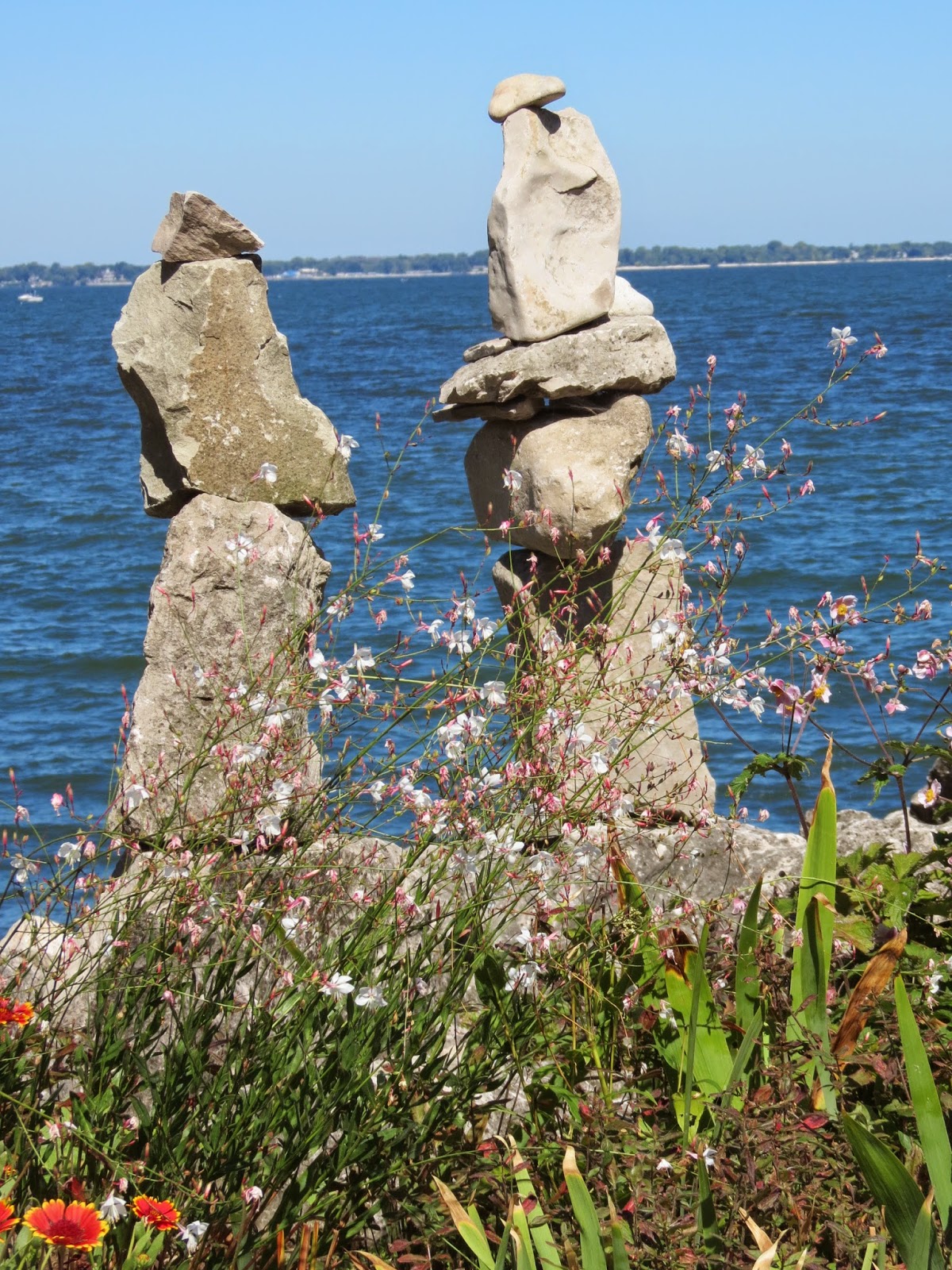
 There is something about this town. First it gets into your heart and then silently creeps into your very soul. The call of shore birds and gentle slapping of the waves speak to me.  The vista of Lake Erie's Islands, floral gardens and these playful stone cairns  delight the eye. They won't last for long against Lake Erie's storms, but they balance the joy of "today" against the "forever" of rock.

Jewel-weed, Impatients capensis  on the rocks.
Lakeside is well known for its history and architecture.  It is a gated community in the summer, where children rule the streets and ice cream is considered the nectar of gods. It is a Chautauqua, and I could probably devote an entire blog to that alone, if I have not already. 

But it has a compelling natural history as well.  For example, these orange flowers growing in wild abandon on the lakefront attract Ruby-throated Hummingbirds which visit them for sustenance on their migration south for the winter.


Lakeside's administration has turned a serious eye to this issue and is promoting native plants and the "natural look" of our great lake, Erie. The fall migration of birds and Monarch butterflies both pass through these historic grounds. Our wildlife will appreciate the consideration we are giving to milkweeds for monarchs and bee-balms for pollinators in general.

Our native plant enthusiasts should be proud of the on-going effort to select Ohio native plants for the restoration of the west end's lakefront.  I hope you will join me for the Ohio Natural Areas and Preserves Association's Annual Banquet and field trips this weekend.  Keynote, Allison Cusick will be speaking about our native Sandusky Flora, and we will be leading tours on this lovely stretch of Ohio's Most Beautiful Mile.


The gales of September on Erie.
 And "weather" it is windy or balmy, Lake Erie and Lakeside is always my favorite place to be each fall. Every moment is to be savored...


especially, during the sun sets.

Friday, October 11, 2013

Invitation to Cincy Zoo

Please join us for a fabulous fall program on native plants: Oct 26th, 2013 

The Cincinnati Zoo has lined up an awesome program and I hope to see you there.  Go to the Cincinnati Zoo website for all the details!


Sunday, October 14, 2012

Screaming Reds

Nothing screams "fall color" like the Sumacs.

 The most brilliant reds of fall are reserved for members of the sumac family.  There are four common species in Ohio, with Smooth (Rhus glabra) and Staghorn (Rhus typhina) Sumacs  commonly occurring along our roadsides and byways throughout the state.


Staghorn Sumac, Rhus typhina is easy enough to identify- even for a novice weedpicker.  Look for those giant, red seed heads.  Sumac tends to colonize in low (5-15 ft.) growing hedges.  It is fabulous for wildlife and yes, you can use it in your CREP or wildlife-landscaping at home.

Who wouldn't want this fall color adorning their property?

Even after the leaves fall, the best is yet to come!


This is bird food, man.   Watch for these seed heads this winter and I guarantee you'll fine Chickadees, Titmice and Bluebirds.  What could be more lovely than a sumac in snow?

Plant some habitat in your back yard and enjoy the year round benefits of Sumac.  

You'll be screaming for these reds.


Wednesday, February 9, 2011

Re-thinking "green" space

Green comes in all forms: grasses, trees, woody and herbaceous plants, both native and/ or ornamental.
...
Who is to say one can't substitute "native" plants into our home landscapes? This fits right in with Tallamy's thoughts in "Bringing Nature Home." That's a great book to curl up in front of the fireplace with on these cold winter days.


Sure, we enjoy the lawn that frames my gardens and natural areas. But I have a rather loose definition of lawn these days, which includes anything green that can be managed with regular mowings. I rarely fertilize - and that alone reduces the mowing! Long ago, I gave up the chemicals that kill everything but grass and beat lawns into a monoculture that can't harbor biodiversity.


..
Look no further than the advertisements of the lawn companies to tell you the truth. They have no respect for nature; they cannot even be bothered to appreciate one of our best known butterflies and replicate it correctly. When did the Monarch grow blue and yellow swallowtails? After a blast of lawn chemicals? This mutant butterfly says it all.
...
Chem-lawn may call themselves Tru-green, but there is nothing environmentally friendly about chemicals that can give your dog cancer, poison butterflies, and run-off into our watersheds. There is a reason they are required to put warning flags on lawns that have been sprayed.

...
Some areas beg for a different treatment. If it is too shady to successfully grow grass, why not try moss instead? Moss gardens are gaining popularity, and there are many varieties of moss that will adapt to your shady areas. Check out this website- www.mossacres.com
...

Consider a patch of prairie plants in your sunny areas!
...
Tall grasses, native sunflowers, flowering mints, and cone flowers will attract hosts of birds and butterflies to your yard. Click on the "Natural Areas" link in the slide bar of this blog to get a complete listing of native Ohio plants.
...
We discussed techniques for planting prairies during a recent Master Gardener class, and Guy Denny will be one of the speakers at Midwest Native Plant Conference (as well as a Flora-Quest guide), if you would like to learn more about Ohio Prairies.
...
Nature's beauty is offered in many forms. And while a little lawn is an asset to your home and yard, there are other options as well. You'll attract more wildlife, and enjoy more butterflies when native plants dominate your landscape.

Sunday, February 6, 2011

Lawns

Lawns may seem like an unusual choice of topic for a flora and nature blog, especially in mid-winter when your lawn is probably blanketed with 6-8" of snow.


Even the most nature attuned home owner can benefit from a bit of lawn. Think of a lawn as the "frame" for your perfect picture. If the woods and mini-prairie/ sedge meadow ran right up to my front door, the panoramic views afforded by a bit of lawn would be lost. And besides, a good lawn makes your neighbors think you are not such a crack-pot after all.
...
I have been thinking a lot about lawns this week, as Monday night I will be teaching the local Master Gardeners interns about Lawns, and of course my favorite- lawn alternatives.
...
..
Having been the Head Groundskeeper for Lakeside, and a bit "lawn obsessed" in a former life, I can relate to the needs of a "green-grass" junkie. Somewhere in the middle lies a compromise; one can have an attractive lawn without spraying a ton of chemicals or spreading toxic grains on the grass where your children, grandchildren or pets play.
...
Relax and smell the clover, or henbit. These "weeds" are just as green and stay green better during droughts. So if you will work with nature, you can reduce your lawn's chemical dependence, and save yourself a ton of time and money. Time that can put to better use watching birds, chasing butterflies, or walking barefoot in that grass.


Lawns at my property are green and beautiful transitions to native (and some remaining non-native) horticultural pursuits. I admit to harboring hosta. ...Catmint runs rampant at my place. Pokeweed and blackberry brambles are respected for their attractiveness to birds, but kept somewhat in check for their aggressiveness. And thanks to the lawn, for the easy access it affords to all of the best views of nature that my property offers.

SO think a bit about your lawn, and how you can reduce the chemical load and maintenance, while still enjoying a bit of barefoot grass and eye-candy green.

Friday, August 13, 2010

Saving the World

Some mornings the news is pretty hard to take. Environmentally, we humans don't have such a hot record for co-existing with nature. Reading about oil spills, global warming, and invasive species is enough to get you down.

If the bad news all becomes a little overwhelming to you too, let me share a few thing you can do to make a difference.

1. Provide Habitat


The last slide from my "Creating an Oz for Butterflies" program pretty much sums it up. Plant native plants (especially native trees) to improve YOUR corner of the world. You might be surprised with the wildlife that will visit... and even come to depend on your oasis or "Oz."

Landscapers and homeowners tend to avoid using tree species that shed fruits or nuts on lawns. So, what do you think our wildlife will live on? Plant a wild cherry, oak or hickory tree if you want to see nature in action.

2. Preseve habitats-

...
Here is a feel-good story about a guy who is hosting the ONLY remaining Swamp Metalmarks in Ohio. He didn't even have to plant natives. He just didn't mess up the habitat that was already there! Follow this link to the story in the Bellefontaine Enquirer to read about my hero.

3. Support a conservation group- or several!

Greater Mohican Audubon Society, OOS, Black Swamp Bird Observatory have all done educational programs and promote conservation. There are many organizations that need your help (or $ if you can't spare the time.)

So, those were three simple, empowering, things you can do.

And if you are most interested in that important link between native plants and nature- I encourage you to check this out:

Here is a book that could change your life. Reading Bringing Nature Home will help you understand how important native plant species are to the survival of birds, butterflies and other natural wonders... including singing insects! The book is also a great resource for lists of "best" trees and shrubs.
...
No one of us can save the world... but we can make a difference, by simply re-thinking our own backyards. As Tallamy wrote in my copy of the book, "Garden as if life depended on it."

Saturday, April 3, 2010

Fernwood: a forest out of balance

The previous post featured the West Virginia White butterfly, a charming and altogether unexpected find at Fernwood State Forest. Unfortunately, an isolated rock dome named Little Round Top may be a last outpost in this "forest". Unlike the Ravens we sought, West Virginia Whites are weak fliers, doomed by habitat disturbance. Forest fragmentation and invasive plants are the primary causes for their decline.


Marginal Woodfern, Dryopteris marginalis was one of the few native species hanging on for dear life. If this was once a "Fernwood," the name has long outlived the reputation.


Many non-native species have taken hold, like Coltsfoot, Tussilago farfara, shown here eking out a living along a creek.

The creek color, tinged with Yellow Boy, tells the whole story: coal mining was here. If you are ever told the tale of "clean coal" you need look no further. Much of southern Ohio bleeds the orange of acid mine runoff. While student teaching in Athens' elementary schools, my daughter noted the children color the creeks orange in their artwork; the only color of water they have ever known.


Fernwood was strip-mined before the days of Federal standards for reclamation (i.e. The Wilds). Left to recover by its own devices, invasive species rule. The Armageddon of nature, Ailantus altissima or Tree-of-heaven, must come straight from hell, as it can endure anything. Honeysuckle, buckthorn, garlic mustard- looking for a noxious weed? Look no further. Once stripped of native soil, the non-natives move in.


And if it wasn't bad enough, the Forestry service helped them along with Russian Olive, another noxious and invasive weed. Too often these invasive plants provide attractive but non-nurturing fruit to birds but do not provide host material for our native insects, including lepidoptera. Caterpillars, the bio-mass most preferred by nesting birds, are a vitally important link in the food chain.
....
So, we Weedpickers go on-and-on about invasive species and non-natives... it is not just a preference for our natural world. It is actually the life-line that holds our natural world together. Botany drives the wildlife, and geology drives botany. And strip-mined areas, become biological deserts filled with invasives. Coal has a long-term cost we haven't begun to measure.