Showing posts with label Ohio. Show all posts

Thursday, March 17, 2016

LEAP into Spring

Spring is bursting forth on Ohio's landscape. 

A vernal wetland provided ample sight and sound.
 Yesterday I enjoyed blue skies and the raucous amphibian calls at several locations, including the Bath Nature Preserve in Bath, Ohio.  This particular frog pond offered a deafening cacophony of croaks, clucks and peeps.

 I had traveled to Bath for a Lake Erie and Allegheny Partnership (LEAP) meeting.  LEAP is a consortium of land trusts, parks, and educational organizations dedicated to protecting and restoring biodiversity.  It is supported by the  Cleveland Museum of Natural History, where there is an active staff who provides leadership for LEAP.  (Thanks Renee!)

Akron U. has a field Study center at  Bath Nature Preserve.
We met at the University of Akron's Field Study and Environmental Education center.  These traveling meetings give LEAP members a excellent opportunity to see other organization's outpost. We have visited numerous park districts in Ohio and even a few in Pennsylvania.

Cornus mas, (Cornelian cherry) in full flower. 
The attractive yellow buds on a nearby tree beckoned to me from across the parking lot.  We now know them to be the four petaled flowers of a tree in the Dogwood family. This is the non-native Cornelian cherry or Cornus mas.

Cornelian cherry trees
 These small trees had me fooled!  I thought they were our native Spicebush, but they are Cornelian Cherry, or Cornus mas.  It would be fairly easy to successfully ID a Spicebuch vs this non-native dogwood, had the leaves been present.  But I am happy to have learned the difference between the two species, by the blossoms' petal count.  (Thanks to Sarah who wrote in to set me on the correct path!)


This brings me to the annual "Native Plants of the Year" cards LEAP produces.  They are an excellent mini-guide to three native Ohio plants you can incorporate into your landscape.  Look for the Flora-Quest display at up coming events, and I will be glad to share these free cards with you.

 The 2016 plants are Spicebush, Swamp Candles and Little Bluestem.  To learn more about our native plants and the pollinators attracted to them, or find local native plant nurseries, you need look no further than the LEAP website. 

Don't you think Ohio otter offer a license like this?

 Native plants also benefit native animals, just like this handsome River Otter pictured on a LEAP member's Pennsylvania license plate.  This special plate promotes the need to  "Conserve Wild Resources."

That is a message we can really get behind.  HONK, HONK!!


Thursday, October 8, 2015

Go take a hike!

October is the perfect time to take a hike in the woods.  The fall temperatures have been favorable, not too hot and not too cold. Fall colors have not peaked yet, but each day the show keeps getting better and better.

Extra parking at the old Clear Fork Ski Resort.
If you like to hike in the fall, here is an event you won't want to miss. The Grand Opening of the Clear Fork Scenic Trail will be held on Saturday Oct. 17th.  Mark your calendar and head towards Butler, Ohio to take advantage of this special opportunity.

This stream bed glistens as the colored leaves fall.
North Central Ohio Land Conservancy is opening up some very special trails that were not previously accessible by the public. These locations are now being decorated in fall's finest colors. The springs are springing and the trees are standing a little taller as Richland Public Health announces this big event.

Chief trail hiker, Eric Miller.
The trail opening is the culmination of 25 years of careful planning and a few fortuitous mistakes. Since the 1990's, North Central Ohio Land Conservancy has been piecing together this trail from Butler (and the B & O Bike Trail) to Malabar Farm.  Our chief trail hiker (and CEO) Eric Miller is inspecting every step and has personally raked and leveled off a lot of those miles. Major props also go to Larry Smith, Michael Woogerd and Zach Pocock for all of their labors and time spent with trail volunteers.

Rattlesnake Plantain, Goodyera pubescens
Special efforts went into siting those trails. One can easily see a huge colony of orchids,  like the pictured Rattlesnake Plantains. Their stunning striped foliage is quite visible in the fall.  You'll have to come back again in the spring to see our colony of hundreds of Showy Orchis,  Gallearis spectabilis (or Orchis spectibilis.) Right now they are more like "Orchis incognito".  Their foliage and flowers are hidden in the fall as they rest under the soil until next year.

Fall asters are abundant.
 Fall is still a great time to see floristic displays.  Many of our Ohio native prairie plants, like the asters and goldenrods, are still putting on quite a show.  The prairie portion of this Clear Fork Scenic Trail was featured during Flora-Quest 2015. Guy Denny and Larry Smith led a group on a hike through the grasslands of NCOLC.

Look for the signs.
 Come on out and look for our signs. The trails are well marked and often tagged with orange streamers.  We only ask that you stay on the trails and enjoy the views. While the trail was 25 years in the making, it took eons to arrange much of this scenery. Now we want to share it with you. Details are in the poster linked below.  

We'll look forward to seeing you there!

Download this poster

Sunday, April 13, 2014

Not all the same...

If this warm weather has you excited for butterflies- you can join my club.  Well, I don't really have a club, but if I did it would be for chasing butterflies!  I first got interested in them when I was a child, and now I like to make road trips to see unusual species.  Basically any excuse for travel is good, so why not "butterfly sight-seeing?"

The Karner Blue
 You'll need to drive towards Toledo, Ohio and the Oak Openings to see the Karner Blue Butterfly. One of the Nature Conservancy's properties call Kitty Todd is ground zero for this blue.  Its host plant is Wild Blue Lupine, so make certain you visit around "Blue Week" when the lupines are blooming and one of Ohio's rarest butterflies fly.

The Common Buckeye
You'll have to wait for summer to see the Buckeye, as it migrates north from southern states.  They cannot winter over here, so this butterfly will arrive in July or August, unless it gets hot early.


A local favorite the Red-Spotted Purple. 
One of our local butterflies is the Red-Spotted Purple.  They are common to wood lots and back yards, their host plants are cherry trees and willows. The little spotted butterfly in the background is a Pearl Crescent. Its host plant is flowering asters!

If you like butterflies, I hope you will take time to follow this link and send a message to Save Ohio Butterflies.  https://secure.sierraclub.org/site/Advocacy?cmd=display&page=UserAction&id=13345

The Sierra Club and I want you to know our government agencies plan to spray for Gypsy moths- and they won't only be killing one moth species.  They will wipe out any and all butterflies in the area as well.
Spraying will begin early this spring and impact caterpillars of all varieties in Ohio. Areas all across Ohio will be impacted with this non-specific aerial spraying, and if we don't act now - there will be a lot less butterflies to enjoy this summer. Other alternatives such as pheromone flakes or Gypchek only affect the gypsy moth and would protect native butterflies. 
There are other better alternatives.  Help us encourage Ohio to do the right thing! Click the link above!

Friday, February 14, 2014

Mid-Ohio HOLA!

Mid-Ohio birding in February can be a bit daunting. But like the postal service, "neither snow nor rain nor heat, nor gloom of night will keep me from making" my appointed rounds. Throw in ridiculous winds, three foot snow drifts, and unplowed roads and you have described the general condition of my neighborhood.

Horned Lark (HOLA in bird bander's code)
HOLA!  What have we here?   Hola = Greetings!  Hola is not just a Spanish salutation, it is also the bird bander's code for HOrned LArk. 

HOLAs, welcome to my winter world!

Horned Lark (left) and Snow Bunting (right)
Much has been made of this winter's appearance of Snow Bunting and Lapland Longspurs.  Both species are birds of the far north, which occasionally winter in small numbers in Ohio. They are often found gleaning for grain and generally fraternize with Horned Larks in open fields.

Large flocks of birds feeding in the open field.
Horned Larks are found year round in Ohio's farm country.  However, their dull brown backs blend with the soil in the fields, making them difficult to see most of the year. Snow cover makes them highly visible. Watch along the edge of country roads during heavy snow events, and you may see flocks of birds feeding along the gravelly road edge where snow plows have cleared down to the grass. 

Horned Lark, Eremophila alpestris  
 Horned Larks are easily overlooked by the novice, and difficult to study once found.  These skittish birds of the field flock together and move in large circular patterns when disturbed. When you see road-side birds take flight at the approach of your car, watch in the rear view mirror after you pass.  Most likely they will be re-forming their ranks on the edge of the road once again.

This winter, with its exceptional periods of snow cover, drove flocks of larks and snow buntings into feeders and fields baited with small grains or cracked corn on the ground.

Horn Lark of a different race- the all-yellow face of the Northern race or E.a. alpestris 
    Much of my last two weeks have been dedicated to watching and photographing Horned Larks in the local "baited" ditches. Face-on views reveal stunning yellow or yellow-and-white faces, both with the distinctive "horns," which are not horns at all. They are feathers that stick up, generally when the bird is excited or alarmed. There are 20 subspecies of Horned Larks which occur regularly in the US and Canada, but only three of those probably occur in Ohio. I have found it interesting to try to sort them, but I have no real confidence in my ability to do so. Therefore, I will bow to the advice of expert birder and friend, Kenn Kaufman:
    "I think for starters you can say, deep yellow face = Northern, bright white face = Prairie, all those others = unidentified. I don't even try to name the intermediate ones, but the extremes are fairly straightforward."
Looks intermediate to me!
 That sounds like a plan to me.  So, Horned Larks by any other name or race considerations are still Horned Larks. They are all immensely enjoyable to watch, when and if the opportunity ever presents.  I'll try not to get too hung up on sorting them out.

Horned Larks, E.a. praticola  "Prairie" male with a very light face and a probable female (right.)

The more I learn about these local "Prairie" birds, and the migrant "Northern" larks which come south to winter, the more I admire their differences.  And note, the various races mix peacefully in the field.  

Apparently, they have that one-up on us humans!  I always knew I liked these birds.

Tuesday, January 28, 2014

Bring on the snow!

Buck-up you whiners and complainers, we live in Ohio! Ohio gets snow, and cold, and cold snow.  So snap-out-of-it and go visit the wonders that may be hiding in your own back yards!

Snow rollers!  the coolest thing to blow into town.
 I have lived in the land of cold and ice all my life and never heard of snow rollers before.  But they are here now, in a big way.  When I decided to go look for some today, I had to go no further than my front door.  Across the street in a local farm field were the grand-daddies of snow rollers.   These partial sno-men are created when wind blows loose, wet snow across sheets of icy snow pack.

Next thing you know, it is a virtual snow-man factory!  Lots of postings in the news and web if you want to know more of the science behind this phenomenon.  Google round a bit, OK? Here is an explanation by my friend, Deb Marsh at  Around the Bend Ohio or Jim McCormac's take on the event at : http://jimmccormac.blogspot.com/2014/01/snow-rollers-snow-rollers.html.  Very cool, indeed.

Corn-fed Snow Buntings the field next door.
This is my local herd of Snow Buntings.  I admit to visiting them daily and leaving offerings of corn and bird seed, just for the privilege of seeing their black-and-white wings against the snowy backdrop of winter fields.

Snow Buntings are birds from the high arctic, and like Snowy Owls, we seem to have more than usual number visiting Ohio this year.  Crawford County is over-run with them! It is a great honor to have them in our neighborhood, keeping company with the local Horned Larks.


If you haven't the chance to experience Snow Buntings in your own backyard, here is a little video for you. Yes, it is windy, and about -3 degrees.  Aren't you glad you can watch this from the comfort of your home?

Bottom line, quit complaining about the cold and get out there and experience winter!   Besides, some of the best things can be experienced from inside your heated car.


Monday, July 9, 2012

Regal Fritillary Reigns in Grasslands

Perhaps more majestic than even the Monarch butterfly, the Regal Fritillary was once king of the grasslands in Ohio.  At one time, it was said to be found in all 88 of Ohio's counties.  No more.  There has not been a single sighting in Ohio since 1991. (J. Daniels (2004) Butterflies of Ohio) 

Regal Fritillary nectaring on Butterfly Weed, Asclepias tuberosa

 The only remaining population in the east is found in Indiantown Gap, PA at the Fort Indiantown Gap National Guard Training Center.  These butterflies are constantly monitored, and their habitat is under strict study and management.  We'll have more of that story in the next post.

Honeybee startles a female Regal Frit
First we need to understand the intricate timing of the two sexes of fritillaries.  Regal Frits are univoltine (meaning one brooded), and the males emerge a week or two earlier than the females.  Often the males are rather tired looking by the time these fresh young females arrive on the scene.  It is all but impossible to tell the two apart, until they spread their wings.  Females have two rows of white dots at the lower wing margin.

Once the ladies are on the scene the males have only one thing on their mind.  Males patrol around the open grass and any outlying shrubbery;  they are searching for the ladies.  We watched one dive under this bush, where he sat waiting- nearly undetectable.
"You can't see me."

Regal Fritillary, Male

He briefly opens his wings, just long enough to capture this shot of the hindwings which bear his signature- two colors on the black margin.  The bottom row of dots are orange and the upper markings are white.

Once the pair have mated, the female will lay up to 2,000 eggs.  Apparently she randomly distributes them throughout the grass, regardless of the presence of their host plant, violets.

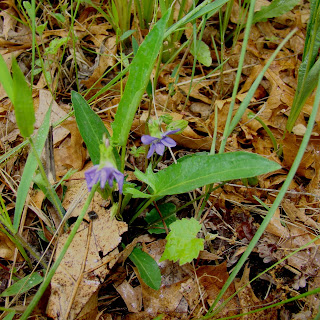
The Regal's preferred violet is the Arrow-leaved Violet, Viola sagittata. 

Once the larva hatch, they must find their way to clumps of little bluestem, where they will winter beneath the ground, in the  larval stage. They re-emerge in the spring to feed on their host plants- violets.


Many species of fritillaries have similarly unusual life cycles, so this alone cannot account for the Regal's rarity. It is thought that loss of habitat is the main reason for their decline.  In Ohio we have lost over 99 % of our native grasslands.  Is it any wonder that we might have lost this Regal butterfly as well?

Sunday, April 29, 2012

Willet fall-out!

Yesterday was partly cloudy, with a scattering of Willets.
Willets alight, photo by Kim Graham
Large numbers of Willets were reported from two separate locations in Ohio, leading one to believe their migration was disrupted by weather conditions. Their colorful wings gave flashes of light to the otherwise gray on gray, birds on weathered board.

The well-known boardwalk at Galena, Ohio juts out into Hoover Reservoir.  We have seen many remarkable birds from this location, but nothing to compete with this phenomenal sighting!  Gulls lined the far end, while 115 Willets gathered on the midsection of the hand-rail.  Once settled in, their plain tones falsely suggest this is an everyday occurrence.  Non-birders were hard pressed to understand our excitement.

E- bird's map of Willet sightings in Ohio is most useful.  Not only does it show the location of previous sightings, more frequently on the shores of lake Erie, it also marks this boardwalk at  Hoover Reservoir.  It is the red flag near the center of the state, slightly north-east of the city of Columbus.

 Several times the birds spooked from the rails, circled overhead and returned again to the rail.

Willet  flock, photo by Kim Graham
After a resting period, the birds would fly out toward the edge of the reservoir, as if searching for mudflats or shore to provide forage. Unfortunately for them, the high water at Hoover has reduced the littoral edge to nil.

Willets in flight, Photo by Kim Graham
 Their misfortune provide an opportunity for a handful of people. We witnessed their return to the rail over and over again: resting, seeking shore, resting.  The birds spent the afternoon and early evening at Hoover- finally flying away for good as the sun was setting.

Willet at St. Mary's Fish Hatchery, Sept. '09, photo Cheryl Harner
 Willets, Tringa semipalmata have ranged from being uncommon in the late 1880's - to very rare.  They were hunted to near extinction, as one of the few sandpipers who bred in the lower forty-eight states.  Other shorebird species which migrate to the arctic were able to breed without human "pressures," while the Willets took the brunt of the abuse.

Their presence in Ohio has been generally noted with sporadic sightings of singles or pairs.  Until now, the largest gathering ever noted in Peterjohn's The Birds of Ohio, was 50 in Cleveland in August of 1976.


 The 115 Willets that toured Hoover in April 2012 will have birders talking for years.

Single Willet in flight, Kim Graham
Several photos in this blog have been graciously provided by Kim Graham of kimgraham.zenfolio.com. (Click on the link to see all of her lovely work.)  He beautifully captured the event for all of prosperity.  Hopefully he will forgive me for cropping out a single image from his work to show you the color of a Willet in flight.

In the past, I have erroneously regarded willets as rather dull birds of gray color. All I have seen heretofore have been foraging on mudflats, and looked rather unspectacular.  To experience 115 Willets on a fly-by was both breath-taking, and eye-opening.  These birds are as stunning as they are vociferous in flight; the dull gray bird becomes a brilliant striped banner of black and white as it takes to the sky.

Willets are considered a conservation success and their population numbers are climbing. Certainly that is good news we can all relish, but even if their numbers sky-rocket on the breeding grounds, chances are, we'll not see another sighting like this in Ohio, ever again.

Monday, January 16, 2012

Going...Wilds!

Each year the Ohio Ornithological Society hosts a winter event that should be called-
"Birders- Gone Wilds!"
We meet up in Muskingham County, 15 or so mile east of Zanesville in the vast acreage of grass lands at the Wilds.  This is a restoration area from the days of strip mining.  The landscape has been drastically changed from the days of hill sides mined for coal to moonscapes replanted in grasses to reduce erosion.  The International Center for the Preservation of Wild Animals, Inc. has become an extension of the Columbus Zoo and a premiere spot for breeding endangered animals. 

 But it is not the endangered animals that attract this crowd.  This is half  of our 100 plus crowd of bird watchers who come each year to see winter grass land birds like Northern Harrier, Rough-legged Hawk, and Short-eared Owls.

 Marc Nolls (above) helps us organize the event each year, while Julie Davis lined up the guides.  We couldn't make this event run without volunteers-  Especially the folks in the field leading trips..

like Kenny Davis!  He takes his job pretty seriously, even working through his lunch hour.


A couple of years ago the OOS Conservation committee worked the Wilds and AEP to install Kestrel boxes and raptor posts throughout the grass land.  It was exciting to see this Rough-legged Hawk teed up just was we had hoped.  There was also a Short-eared Owl perched atop a Kestrel box- barking his little heart out.  But DUH, I missed the shot!

The Wilds event is always a lot of fun and a great opportunity for many birders to see some unusual winter raptors for the first time.  It is one of the many excellent programs OOS has sponsored over the last 8 or so years.  Go to www.ohiobirds.org to learn more about this fine organization and good work we do.

Hope to see you next year at the Wilds!


Tuesday, February 15, 2011

Amish Country Visitor

A few miles down the road from Wooster's Secrest Arboretum, the heart of Ohio Amish country spreads across Wayne and Holmes Counties. It is a favorite place to bird, as the folks are friendly, the birds are numerous and the scenery- is just delightful.


One never tires of this type of scenery, and it is plentiful in Wayne County.


I met up with Greg Miller and Nathan Madison, to try once again for the Harris's Sparrow.

Greg and I have set the record for missing out on this bird- this was our third trip! I would like to show you photos of the home and children, but that would be disrespectful to the family. Amish people do not wish to have their photos taken, so I limit my photography to barns and buggies... and a few good birds. We are grateful for their hospitality, and do not wish to offend.
...
Troyer's farm is a wonderful place to visit, with a warm wood-stove and a clean windows to view the feeder set-ups (this photo shows only one of many.) They attract many species of birds, and not just your average cardinals and jays. Each visit provided good looks at species like Carolina Wren, Pines Siskins, and White-crown sparrows in abundance along with all of the other regular "feeder" birds.


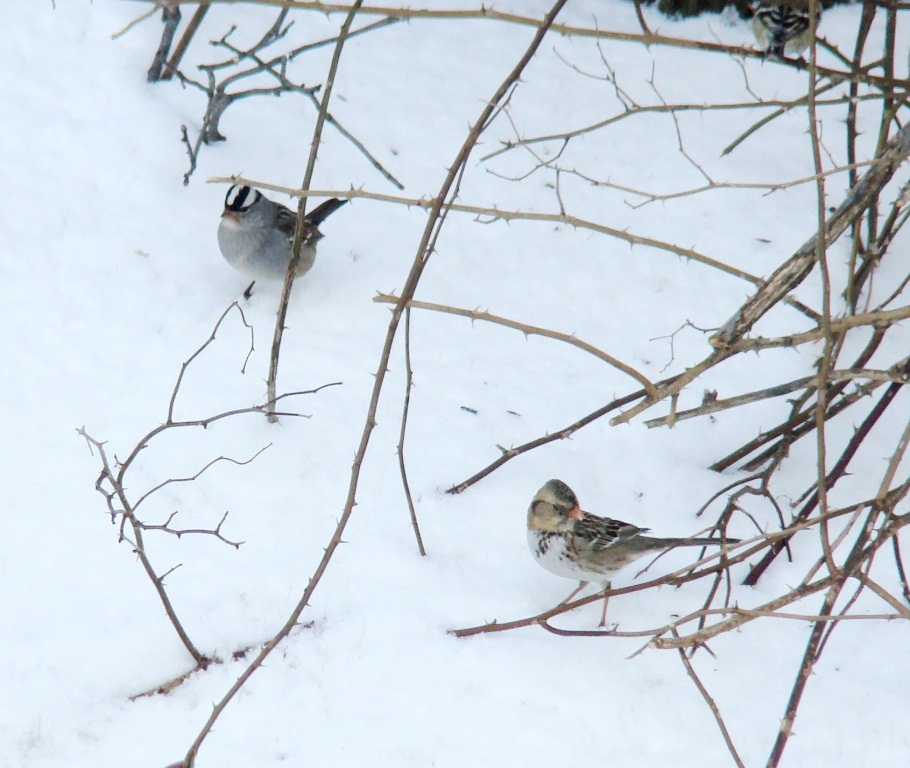
But this winter, their son, Andy found a special visitor at the feeders. A young Harris's Sparrow has been making regular appearances, much to the delight of Ohio's birding community. Of all the sparrow species found in Ohio, the White-crowned sparrow (left) and this Harris's Sparrow (front right) are two of the "lookers," as far as sparrows go!


Handsome youngster, isn't it? Third time was a charm, and so it goes with a "chase bird." There is never a guarantee that the bird will be there when you arrive; our persistence paid off.


So why would we want so desperately to see this sparrow? As the USGS map shows, a Harris's Sparrow's routine migration is well to the west of Ohio. But each winter, we may get one off-course Harris's visiting in Ohio and they generally stay for several months once they arrive. But I have not seen a Harris's Sparrow for several years, and this opportunity was just too good to miss.
...
Besides, the Troyer family's hospitality made this adventure feel like a visit with old friends, or rather- new ones.

...