Showing posts with label Butterflies. Show all posts

Saturday, July 16, 2016

I'll BEE there: Native Plants and Pollinators


Our friends at the Midwest Native Plant Society are hosting a Pollinator Workshop at Caesar Creek on August 13th, 2016.  In my book, this is a not-to-miss event.  There is a tremendous amount of interest in pollinators all across the country and it is not all European honeybees doing the work!

Get ready to "Bumble"!

Bumblebees come in many "flavors."
 There are several types of bumblebees native to Ohio. It would be great to understand their differences!

Tiger Swallowtail and Spicebush Swallowtail!
 Butterflies are pollinators, too! And while we have heard plenty about declining numbers of Monarchs, there is more to the world of Lepidoptera than all gloom and doom.

We can help you sort out the common butterfly species on our  afternoon field trips.

Native bees and pollinating flies abound!
I can't wait to learn more about the unique relationships between native plants and pollinators.

Good thing we have Heather Holm speaking at this Pollinator Workshop at Caesar Creek on August 13th, 2016.  She will have her awesome book for sale too!

Pollinators of Native Plants is "an excellent guide that will help you attract, observe and identify native pollinators! Her presentation is a fascinating journey showcasing the development of different flower types and the presentation of floral resources to pollinators.  Heather will provide many specific examples of how native plants are pollinated and what pollinator is most effective and why."*

Heather Holm and her fabulous book.
"Author of Pollinators of Native Plants, Heather Holm owns a Minnesota-based landscape design and consulting firm specializing in pollinator landscapes and native landscape restorations. She is currently working the University of Minnesota Extension faculty on a three year study to determine the types of native bees that visit cultivated blueberries in Minnesota. The study includes developing customized forage plantings for the native bees identified, and providing additional or enhancing existing nesting sites within the farms. Heather is an environmental educator and frequent presenter at conferences in the Midwest and Northeast. She writes for Houzz, a social media website, about pollinators, beneficial insects and native plants."*


I'll be there leading field trips for this event and I hope to see you there, too!


 Registration at http://www.midwestnativeplants.org/

*Quoted text from Midwest Native Plant's website.

Tuesday, November 4, 2014

VOTE for Monarchs

America is a great nation of democracy.  Since election day is on everyone's mind, it is a good time to stress the importance of voting.  You might think it odd that I would promote having a Monarch.  After all the jib-jabs back and forth, the ultimate insult to a President is to suggest he acts like a monarch or king.  Opposing politicians did it with Kennedy, the Bushs' reign and now Obama.  It cuts both ways.  But we do have one Monarch we should all vote for: Danaus plexippus, the Monarch butterfly. 

Danaus plexippus, Monarch   photo C. Harner
Once the reigning butterfly of America, the most recognized lepidoptera to take to the sky, our Monarch is in a tragic decline.  I wrote about it here  and gave a presentation on the midwest migratory Monarchs at the Cleveland Museum of Natural History's Conservation Symposium about a month ago.  The fact remains: Monarchs are in serious trouble.  


Monarch lifestages, by artist Ann Geise
Monarchs are members of the subfamily Danaus or Milkweed butterflies.  All of these butterflies use a milkweed as a host plant.  The caterpillars ingest toxins from the milkweed- cardiac glycosides. The main study on the host plant and the butterflies' toxicity were conducted by "Browers barfing Blue Jays." I had often wondered what scientist had the job of watching birds vomit and now I know: meet Dr. Lincoln Brower.

Milkweed authority Roger Troutman and Monarch expert Dr. Lincoln Brower
 It turns out, Dr. Brower and I have a mutual friend, Roger Troutman.  Not only an avid birder and excellent naturalist, Roger is an authority on Asclepias, or Milkweed.  Years ago he worked with Dr. Brower when they visited many milkweed patches in Florida and studied the toxicity of the various milkweeds.

Roger and I recently travelled to Indiana to attend the INPAWS (Indiana Native Plant and Wildflower Society) annual conference.  Dr. Brower was a Keynote speaker, who entertained and informed the audience on the current standing of the declining Monarchs. We learned there is currently an effort to list Monarchs as a "Threatened" species.

To VOTE click : http://www.centerforfoodsafety.org/
PLEASE take the time to click on the link above  to add your name to the petition. We simply should not allow the extinction of the greatest gateway insect for budding entomologists. The Monarch is an iconic species of America, you might even say it is the Bald Eagle of the insect world.

We need to pay attention to this dramatic decline, before Monarchs are completely wiped out.  Their population has fallen by 90% in just the last four years!  Scientists believe the problem used to be deforestation in Mexico, but now and even bigger issue is the combination of herbicides and pesticides being used in our farm fields.  It is time to realize the butterflies are bio indicators and Monarchs have become the "Canary in the cornfields."

"Weedpicker" Cheryl Harner and Dr. Lincoln Brower
Think about your yard and neighborhood.  Did you see Monarch butterflies this summer? How about other beneficial pollinators, were they AWOL?  Maybe it is time to plant some Milkweed and nectar plants in your yard. While you are thinking about helping us create a better world for those buzzing and flapping creatures who make our lives possible, remember pesticides kill ALL insects! Pesticides are non-selective; everybody dies!  Life is all about the food chain, kids.  If the insects don't eat, none of the higher life forms eat either.  This is a wonderfully complicated world in which we live.


If you want to know more about butterflies, host plants and nectar sources, please pick up a copy of Jeffrey Belth's book, Butterflies of Indiana.  His excellent book provides the information Ohioans need as well. If you would like to meet Jeff in person, join us at the January 17th, 2015 Ohio Lepidopterist meeting in Columbus, Ohio.

Sunday, April 13, 2014

Not all the same...

If this warm weather has you excited for butterflies- you can join my club.  Well, I don't really have a club, but if I did it would be for chasing butterflies!  I first got interested in them when I was a child, and now I like to make road trips to see unusual species.  Basically any excuse for travel is good, so why not "butterfly sight-seeing?"

The Karner Blue
 You'll need to drive towards Toledo, Ohio and the Oak Openings to see the Karner Blue Butterfly. One of the Nature Conservancy's properties call Kitty Todd is ground zero for this blue.  Its host plant is Wild Blue Lupine, so make certain you visit around "Blue Week" when the lupines are blooming and one of Ohio's rarest butterflies fly.

The Common Buckeye
You'll have to wait for summer to see the Buckeye, as it migrates north from southern states.  They cannot winter over here, so this butterfly will arrive in July or August, unless it gets hot early.


A local favorite the Red-Spotted Purple. 
One of our local butterflies is the Red-Spotted Purple.  They are common to wood lots and back yards, their host plants are cherry trees and willows. The little spotted butterfly in the background is a Pearl Crescent. Its host plant is flowering asters!

If you like butterflies, I hope you will take time to follow this link and send a message to Save Ohio Butterflies.  https://secure.sierraclub.org/site/Advocacy?cmd=display&page=UserAction&id=13345

The Sierra Club and I want you to know our government agencies plan to spray for Gypsy moths- and they won't only be killing one moth species.  They will wipe out any and all butterflies in the area as well.
Spraying will begin early this spring and impact caterpillars of all varieties in Ohio. Areas all across Ohio will be impacted with this non-specific aerial spraying, and if we don't act now - there will be a lot less butterflies to enjoy this summer. Other alternatives such as pheromone flakes or Gypchek only affect the gypsy moth and would protect native butterflies. 
There are other better alternatives.  Help us encourage Ohio to do the right thing! Click the link above!

Wednesday, September 4, 2013

Where have all the Monarchs gone?

As the summer of 2013 winds down, a few things have become fairly obvious in the Midwest.  Monarchs have been nearly non-existent.  Ohio Lepidopterists have a strong core of citizen scientists tallying weekly butterfly counts.  None of my friends were reporting Monarchs in the early summer months.  I have seen only six Monarchs in all of Ohio this summer, and two of those were raised on my own property.

Easily the most recognizable  butterfly in the United States, our population of migratory Monarch butterflies is in deep decline. Not only are they suffering dramatic losses on their wintering ground in Mexico, our farm practices are decimating their chances for reproduction in the mid-west. 

Monarchs must have milkweed plants, and modern farming with herbicides, pesticides and fungicides have nearly wiped out Ohio's milkweeds, thereby striking a death-blow to Ohio's Monarchs.
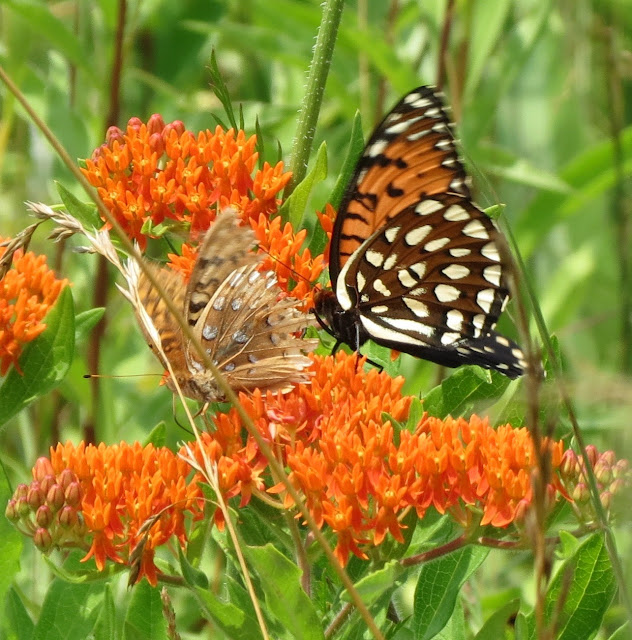
Regal Fritillary nectars on Butterfly-weed milkweed (Pennsylvania.)
 Will Monarchs go the the way of Regal Fritillaries?  The most colorful members of the Fritillary family were extirpated from Ohio about 30 years ago; now one must travel to prairie remnants in Pennsylvania, Indiana, or much farther west to view this regal butterfly.


Prairies, filled with native grasses and flowering plants -including milkweed-  were once abundant in Ohio. However, we have lost 99.9 percent of Ohio's prairies to "progress", just as agriculture and urbanization have claimed most prairies elsewhere in the mid-west and west.

If we have lost 99.9 percent of our prairies, is it any wonder that we are losing our "prairie butterflies" as well?


Prairie soils are perfectly suited for crops of another grass: maize, or our modern day corn.  Unfortunately modern chemicals "weed" out the milkweed, unlike the corn fields* of my childhood Ohio.  Milkweed used to readily grow along the field edges and in the ditches along the road.  Now, it is only found in abandoned lots and butterfly gardens.

*The corn in my neighborhood is also terrifyingly silent this year.  Where are the crickets, grasshoppers, katydids and bees of my youth?  Monarchs may only be the first blow to the eco-systems in our region. 


Monarch caterpillar feeds on Common Milkweed in Richland County, Ohio.

There a several varieties of milkweeds, the host plant for Monarchs.  Their caterpillars thrive on milkweed in spite of the "milky" white toxic sap the plant produces to ward off other herbivores.

 No milkweed- no Monarchs. 

Bon voyage!  Safe journey to Mexico!
Most years in the past, many, many Monarchs have fed upon the nectar of milkweeds and laid eggs on my pesticide-free milkweeds.  This year, I have seen only two caterpillars.  I raised both of them indoors, away from predators.  Normally, I let nature take care of her own, but this year the Monarchs seem to need every break we can possibly give them, if we hope to have migrating monarch for future generations.  We may feel helpless to change the way farmers manage their lands, but we can still make a difference if we all do two very simple things.

1. Plant more milkweed in our yards and gardens. 

2. Stop using pesticides, fungicides and herbicides on your lawn and landscape.  It can be done, and you and the butterflies will be healthier for it.

Changing your own yard is the first step to changing the world.

Wednesday, March 28, 2012

Botany and Butterflying

Jaret Daniels has several fine field guides on the market, and I used his wildflower guide during my recent trip to Florida.  I highly recommend it to the general naturalist who wants to get a "lay of the land." There are so many plant species in Florida that it boggles the mind of this Ohio girl, and I appreciated an idiot-proof guide to help me along.


Jaret also wrote an excellent  field guide to Ohio's butterflies.  He is not only very knowledgeable about the identification of all those hard-to-know skippers and such, he is a marvel in the field.  Jaret is a professional photographer and his artistic eye for detail is obvious.  Nothing gets past this guy.  He can be in a group of 40 and STILL be the one who finds the rarity!


We are so lucky he travels up from Florida each year, just to be a Flora-Quest guide.  It is an incredible opportunity to be in a small group of participants and really have the time and ability to access  Jaret's knowledge.

Click on the photo below to go straight to the Flora-Quest web site to register.  We only have a few spots in Jaret's trip, so you'll not want to delay. 


Tuesday, March 27, 2012

Gulf Butterfly- Florida

Last week the weather was unnaturally warm for Ohio and I wondered why I had booked a flight to Florida. Although Ohio's weather nearly rivaled the balmy climes of the south, Florida has butterflies I will never see here.

Underside of Gulf Fritillary, Dion vanillae  nectaring on Scorpion's Tail, Heliotropium angiospermum

The long-winged member of the fritillary butterflies is quite common in the south; it is a very, very rare occurrence in Ohio.  It was one of  the most common butterflies seen during my visit to Florida.

This "Gulf Frit" had landed on an invasive species of plant, the Water Pennywort, Hydrocotyle vulgaris.  The local tell me this non-native plant "appeared" everywhere after a hurricane and has been a nuisance in the landscape ever since.


 The Gulf Fritillaries use several members of the Passion-flower family as host plants. 
The Gulf Fritillary caterpillars we found were feeding on (presumably) a passion vine.  There was not enough vegetation left intact to identify the plant species!
Unfortunately, it appears a Braconid wasp had, or was laying eggs on this poor caterpillar.  That spells "lights out" for this guy.  The eggs will hatch out and feed on the innards of the caterpillar, allowing it to live long enough until they reach maturity.  A good parasite doesn't kill its host, until it is no longer needed.

Nature is amazing, but at the same time, often horrific.

Friday, July 8, 2011

Woodland butterflies

On a recent butterfly outing, we were fortunate to find a flurry of activity in the understory of Wolf Creek Park in Mt. Vernon, Ohio. There must have been a recent hatch of these woodland butterflies and several were drying their wings in the late morning breeze.

This photo would make a good $100 butterfly quiz. Can you name this species from a top-side view?


Does this help? Two of the same species on one stem. The woods was thick with the beasties!


Northern Pearly Eye, Enodia anthedon. Not so tough from this angle. Pearly Eyes favor damp-to-wet woodlands and use bottlebrush grass (Hystrics patula) for their larva form.


You'll have to look twice to see the differences between Pearly Eyes and a rarer species, the Eyed Brown. Pearly Eyes are more of a woodland species, while Eyed Browns prefer marsh or wetlands. The Eyed Browns are also lighter in general color and their markings are not as vivid.


Jim Davidson just gave an amazing butterfly and host plant program today at the Midwest Native Plant Conference. I am looking forward to some more time in the field and programs by some of Ohio's best botany (and butterfly) experts.


The next quiz question might be how many of these fantastic native plants can I cram in my car? With so many vendors to shops, I may go crazy! Hope you'll stop by to shop for native plant deals on Saturday!

Monday, March 28, 2011

Trees for Butterflies!

Oft loved, but seldom understood- the butterfly is a creature of highly refined tastes. ... ... ... .... The Hackberry butterfly, for example, only lays its eggs on... .. .... .
HACKBERRY trees! Go figure.

...
So, if you want more butterflies, plant more native trees.
I planted both hackberry and spicebush on my property this year to increase the odds of retaining a population of - hackberry and spicebush butterflies.


I ordered "bare rooted" whips through a mail order company in Michigan. If they take well, I will be forthcoming with the company's name. Meanwhile, when you plan to purchase plants- it is best to get them from a region as cold or colder than your home area. Don't be buying South Carolina plants, and then wondering why they failed to thrive in Ohio.


I used a spade to slice a vertical trough in which to place the roots. Don't plant trees too shallow or too deep. Figure out where the 'bulge" is just above the roots- and get that ground level.


The little ones are hard to see at this stage, so I mark them with a stake (makes it easier for the rabbits to find them!) ...

For the few minutes I invested today- I can look forward to many years of enjoying the berries and butterflies!

Monday, September 20, 2010

Butterflying with Bob

Some speakers/ writers weave magic with their words- and we were treated to one of the best this weekend. The butterfly world's most famous citizen dropped down in Black Swamp territory, and not unlike Santa Claus, he left behind a passel of warm feelings and goodwill.


Robert Michael Pyle, watched butterflies before we even had a term for it- Butterflying.

And for the past 40 odd years he has been helping others learn and enjoy these fascinating creatures. His greatest gift might well be his ability to connect with people. From the smallest child to the veteran "skipper and moth" groupies - Bob relates. We thought he would make a great politician, but he is just too dog-gone sincere.
...
It was a little cool and cloudy for our field trip, but once we found a Great Spangled Fritillary, Bob put it through the paces... and education and delight meld into one.


Bob talked skippers and conservation with Jan, one of the Kitty Todd Karner Blue monitors. Note he is using a Kaufman guide in this photo, although he wrote the first butterfly guide for Audubon! Each guide has it own merits- and I use both. Kaufman's side-by-side photos rock, while Pyle's has informative narrative on host plants!


Oh egg-heads gather round. Here are the serious B-fliers lapping up knowledge at a Bob Pyle puddle-party.


Bianca Davis, Greg Miller, Linda Romaine, and Darrick, soaking up some plant and butterfly facts from Ohio's own Jim Davidson.

So, my weekend was filled with friends, butterflies and plants as well. I will be spitting out a few of the adventures over the coming days. Until then, "thanks" to the Kaufmans and Black Swamp Bird Observatory for making this weekend possible!

Wednesday, February 24, 2010

Return of Jaret Daniels

So who is this Jaret Daniels, and where is he returning? If you are an Ohio Butterfly enthusiast, you'll already know that name. Jaret is the author of Butterflies of Ohio, an amazing little book that covers all the colorful butterfly species found flying in the buckeye state.


The most common, the Spring Azure, a delicate blue beauty (magnified here to 4 times its actual size!) found near woodlots and dappled shade is a fast flier who rarely provides an extended look.

Equally appealing are Red-banded Hairstreaks, just one of our many, similar-looking, gossamer winged hairstreaks. They can be a challenge to sort, but how gratifying would it be to find a rare White-M Hairstreak! It would be the same thrill a birder feels when finding a Mississippi Kite or a Kirtland's Warbler, all three are rarities in Ohio.

If you don't have this book, you'll want to go here and order one.
Butterflies are interesting creatures of diverse habits and habitats. Most are highly selective, with specific host plants needed to maintain their larva. There is such an intimate tie between butterflies and their host plants, it is not surprising that Dr. Jaret Daniels is a botany guy too.
What is surprising, is the fact he would trek all the way from Florida for the third year in a row- just to see the Southern Ohio butterflies and lead a Flora-Quest trip!


So if your wildest dreams include Olive (Juniper) Hairstreaks, or...


the subtle shades of Henry's Elfins, you'll want to beat feet to the Flora-Quest website and download a registration form. You'll have to write in "BUTTERFLY TRIP" as this news is so new- we don't even have it listed yet!
Everyone attending Flora-Quest will get a species list of the butterflies found in Shawnee during the spring, and I hope you'll enjoy these little beasties as much as I do.
Maybe some year we will have to offer a "Caterpillar Quest" too!

Photos and Butterfly chart all provided by John Howard

Monday, September 14, 2009

The Butterflies of Claridon Prairie

The Claridon Railroad Prairie is a rare remnant of the Sandusky Plains Prairie, and it was this prairie enthusiast's delight to meet Trella Romine, Gale Martin and other good friends for the grand tour this afternoon. But the butterflies stole the show! After a summer with record low sightings of the flying jewels, I basked in the glory of multiple species, along with a showcase of Prairie plants. And now without further delay:


The most common, yet pleasing Orange Sulphurs were nectaring nearly exclusively on asters. Two common species, yet... how enchanting.


This was the thrill of the day: Common Checkered Skipper (not so common in my book) on Saw- tooth Sunflower, Helianthus grosseserratus


A Monarch utilizing a Boneset or Tall Snakeroot, Eupatorium altissimum as a nectar plant.


The peachy tones of a Painted Lady's underwing are almost more pleasing than the brilliantly colored upperwings. This one favored the Flat-topped (or Grass-leaved) Goldenrod, Euthamia graminifolia .


And the grand finale'- the first Buckeye butterfly I have seen this year, on one of Ohio's most stunning goldenrods: Riddell's Goldenrod, Solidago ridellii. Note the leaves reflexing and arching away from the stem.
Prairie plants and butterflies- the best part of a fall day.