Showing posts with label Monarchs. Show all posts

Sunday, March 13, 2016

Unfortunate Winter Update on our Monarchs

Our migration Monarch are hardly out the woods, so to speak.  Although this year's wintering Monarch count in January showed great improvement over recent years, winter has taken an ugly turn. A late season snow has fallen in Mexico's Butterfly Reserves.  

Weather disruptions brought on by climate change, both winter storms and off-season droughts, have contributed to low population numbers.  Add a shortage of Milkweed for host plants, and the continued bombardment of herbicides and pesticides, and you will see our conservation work is far from done.

Read the full news release from MEXICONEWSDAILY.COM below:

Snow and cold takes toll on monarchs

As many as 11 million butterflies might have died


Mexico News Daily | Saturday, March 12, 2016
The beleaguered monarch butterflies can’t get a break. The numbers that arrived in Mexico for the winter were up, but cold weather has killed as many as 11 million in the last few days, according to one report.
Rosario spokesman Homero Gómez González was able to see the monarch deaths in a positive light. He pointed out that the majority had survived despite snowfall levels that hadn’t been seen in 40 years.At the El Rosario sanctuary in Michoacán, where winter storm No. 11 brought 35 centimeters of snow and temperatures that plunged to -12 C, they say about 1.5 million butterflies have died.
However, the National Protected Areas Commission said its inspection of the monarchs’ reserve revealed that the butterflies had resisted the effects of cold, snow and wind.
Conflicting reports should not be surprising considering the conflicts that evidently exist between the local stewards of the butterfly reserve and government agencies.
Gómez González said government representatives show up to have their photos taken and to justify their salaries, “yet in reality we receive nothing in the way of support. Proof of that is that we ourselves have reforested the areas [affected by logging].”
For government functionaries, he charged, “it’s pure bureaucracy.”
The butterflies, which migrate annually from the United States and Canada, were up in numbers this year after steady declines for several years. Numbers are estimated by the area they cover, which this year is about four hectares, up from 1.13 last year.
But two decades ago they covered as much as 20 hectares.
This year’s coverage of four hectares has been estimated to represent at least 100 million butterflies. Loss of habitat in the U.S. and Mexico has been blamed for the declining population.
Source: El Universal (sp)
- See more at: http://mexiconewsdaily.com/news/snow-and-cold-takes-toll-on-monarchs/#sthash.LBMkr6Tz.dpuf

Thursday, May 28, 2015

What's the Buzz...

Forgive the obvious title. It seems a forgone conclusion to name pollinator programs for the bee.  But bees are not the only pollinators, and many of the sexual surrogates for plant reproduction don't buzz at all.  Take moths and birds for an example.  

If you haven't thought much about this before, I hope you will join us this Saturday at 7:00 pm at Gorman Nature Center in Mansfield, Ohio.  Prepare to have your mind blown.


It is my honor to be the keynote for this first (annual) event, so come out and help me kick this thing off right!  I have just put the final touches on my program and I am happy to share some new information (at least it was news to me!)  I am no neophyte regarding pollinators, so prepare to be edu-tained!  We will talk about all kinds of pollinators!


Our native bees hold a special spot in my heart and these work horses haven't been given the credit they deserve.  They definitely need an Emmy for "Best Supporting Actor."

Sure honeybees are great, but we have a lot of interesting things with wings getting in on the pollination act.


Moths and butterflies are also pollinators.  There is a direct correlation between botanic diversity and pollinator diversity.  Don't believe me?  Ask Darwin.  He suggested the basis of this a very long time ago.


So why all the interest in pollinators?  You might have heard of a little thing called Colony Collapse Disorder.  This is has had a major impact on bees, bee-keepers and farmers all across the country. But it is not only the Honeybees that are having a rough time of it.

Come on out and will discuss some very cool local pollinators and learn more about their preservation and protection.  

Love to mulch your landscape with wood chips?  We'll discuss why that could be bad news for your bees. 

Hope to see you there!


Sunday, September 7, 2014

The Point of No Return

For those of you who were unable to attend the recent Conservation Symposium at the Cleveland Museum of Natural History, here is a little recap.  The line-up was a wonderful selection of people involved in or studying conservation in one form or another. Dr Bridget Stutchbury spoke on Conservation Triage, with an interesting twist.  Let's just say, we can and should make conservation a budget priority.

Dreams of Martha - Painting by Kristina Knowski
This year's topic of extinction plays well, as it is the 100 anniversary of the death of Martha, the last known Passenger Pigeon. Other topics discussed were Mussels, a program by Dr. Thomas Watters, and Conserving Plants by Dr Valerie Pence.

Chad Pregracke shows his photo of the pollution in the mighty Mississippi River.
The afternoon keynote was a real live wire!  Chad Pregracke, the founder of of Living Lands & Waters spoke on the efforts to clean up America's Rivers, from the bottom up. As CCN's Hero of the Year for 2013, there is some pretty awesome footage of this young man and his organizations efforts.  Do yourself a favor- and go HERE to see the CNN story.  It makes you realize one person can make a difference!  We can each be a force for positive change.  It was an honor to meet Chad!

Greg Lipps, one of Ohio's leading herpetologists, spoke on the effort to captive rear and re-introduce Hellbenders in Ohio's waters. Tim Krynack gave an update on the bats imperiled by White-nosed Syndrome, and Harvey Webster told the compelling story Of Mast, Men, and Memory, about the Passenger Pigeon and the lessons we should learn from its extinction.

It was my good fortune to play a role in the program as well:


My program featured the latest information on our Midwest Monarchs, and their flight for life. Generally, migration is a behavior that benefits a species, but now migration is putting our Monarchs in harm's way.  Our "migration Monarchs" are counted each year during their diapause- or rest period- in the central highlands of Mexico.  This well documented data shows a declining trend for the last 20 years.


Generally, the data is reported in hectares but World Wildlife Fund has converted that to acres and reports the population that inhabited nearly 10 acres in 2010 was a down to 1.6 acres in 2013.  In 2014 the surviving population occupied less than 1 acre. 

In a mere four years, we have lost 90% of our Midwest Monarchs.


There is currently a movement to get Monarchs listed as a "Threatened" species.  Because the two populations of Monarch on the coasts (both have very limited migrations) are doing fairly well, the species is not endangered.  It is the Midwestern Migration Phenomenon which is endangered.

We are certainly on the brink of having Monarchs extirpated from Ohio.

There are many factors at play here.  A loss of milkweed (Monarch's host plant) and a rise in the use of herbicides, pesticides and even fungicides are being implicated.  Add in climate change, which has dumped snow on wintering populations, and decimated the spring migration start-up in the drought impacted Texas.  Hopefully, the Monarch will rebound some this year, but only time will tell.

Even if their numbers increase this winter, it is time to look toward serious Monarch conservation. They should be considered the "Bald Eagles of insect conservation".  That which improves the chances for Monarchs would also benefit other insects, especially other pollinators.

So please, plant milkweed, but only if you discontinue the use of chemicals in your yard! Better yet, let's start asking our great State of Ohio to champion the cause of the Monarchs and actively manage milkweeds in Wildlife Areas, State Parks and Forests.

It would be a terrible loss to no longer have Monarchs to be tagged and raised in school programs. They are the best introduction to natural science and basic entomology!

It is far better to start conservation efforts now than to react after they are extirpated.  Please help us help the Monarchs.


Wednesday, September 4, 2013

Where have all the Monarchs gone?

As the summer of 2013 winds down, a few things have become fairly obvious in the Midwest.  Monarchs have been nearly non-existent.  Ohio Lepidopterists have a strong core of citizen scientists tallying weekly butterfly counts.  None of my friends were reporting Monarchs in the early summer months.  I have seen only six Monarchs in all of Ohio this summer, and two of those were raised on my own property.

Easily the most recognizable  butterfly in the United States, our population of migratory Monarch butterflies is in deep decline. Not only are they suffering dramatic losses on their wintering ground in Mexico, our farm practices are decimating their chances for reproduction in the mid-west. 

Monarchs must have milkweed plants, and modern farming with herbicides, pesticides and fungicides have nearly wiped out Ohio's milkweeds, thereby striking a death-blow to Ohio's Monarchs.

Regal Fritillary nectars on Butterfly-weed milkweed (Pennsylvania.)
 Will Monarchs go the the way of Regal Fritillaries?  The most colorful members of the Fritillary family were extirpated from Ohio about 30 years ago; now one must travel to prairie remnants in Pennsylvania, Indiana, or much farther west to view this regal butterfly.


Prairies, filled with native grasses and flowering plants -including milkweed-  were once abundant in Ohio. However, we have lost 99.9 percent of Ohio's prairies to "progress", just as agriculture and urbanization have claimed most prairies elsewhere in the mid-west and west.

If we have lost 99.9 percent of our prairies, is it any wonder that we are losing our "prairie butterflies" as well?


Prairie soils are perfectly suited for crops of another grass: maize, or our modern day corn.  Unfortunately modern chemicals "weed" out the milkweed, unlike the corn fields* of my childhood Ohio.  Milkweed used to readily grow along the field edges and in the ditches along the road.  Now, it is only found in abandoned lots and butterfly gardens.

*The corn in my neighborhood is also terrifyingly silent this year.  Where are the crickets, grasshoppers, katydids and bees of my youth?  Monarchs may only be the first blow to the eco-systems in our region. 


Monarch caterpillar feeds on Common Milkweed in Richland County, Ohio.

There a several varieties of milkweeds, the host plant for Monarchs.  Their caterpillars thrive on milkweed in spite of the "milky" white toxic sap the plant produces to ward off other herbivores.

 No milkweed- no Monarchs. 

Bon voyage!  Safe journey to Mexico!
Most years in the past, many, many Monarchs have fed upon the nectar of milkweeds and laid eggs on my pesticide-free milkweeds.  This year, I have seen only two caterpillars.  I raised both of them indoors, away from predators.  Normally, I let nature take care of her own, but this year the Monarchs seem to need every break we can possibly give them, if we hope to have migrating monarch for future generations.  We may feel helpless to change the way farmers manage their lands, but we can still make a difference if we all do two very simple things.

1. Plant more milkweed in our yards and gardens. 

2. Stop using pesticides, fungicides and herbicides on your lawn and landscape.  It can be done, and you and the butterflies will be healthier for it.

Changing your own yard is the first step to changing the world.

Tuesday, September 7, 2010

Orange-ya Glad!

Do you remember the old joke...

"Knock-knock- "
"Who's there?"
"Apple."
And after repeating this three times the answer becomes-
"Orange you glad I didn't say apple?"

The Weedpicker took a well deserved break from the caterpillar farm today and struck out to Lorain with some "birdy" friends in search for a rare "orange" bird, the Cinnamon Teal.


Here we are, 15 or so avid birders looking for a Cinnamon Teal- without a trace of "cinnamon" on it. We found the little traveller, an Ohio rarity, but it was too far out for my camera's focus. And frankly, it pretty well blended in with the other brown and tan birds in fall-plumage. It was certainly not the showiest bird I have "chased" but it was a great deal of fun to find, none-the-less.


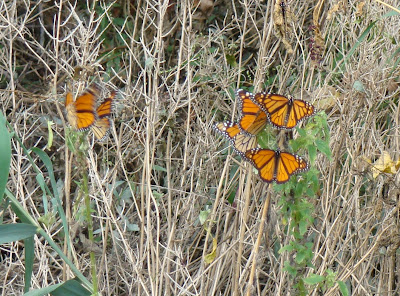
Can you find the Monarchs?
...
While wandering around the impoundment, I noticed Monarch butterflies (another shade of orange) streaming into a shallow area protected from the wind. They must have been drafting-off the north wind for their migration flight across Lake Erie. They gathered, nearly undetectable, in ever-growing groups resting from the flight on dried brush and "weeds".


Each time a new one came into land, a quick flash of wings signaled the location of the "flock". Now scroll back up to the previous photo to see if you can pick out those same closed butterflies on the stems.
...
THE MOST RECENT Audubon Magazine features a Kenn Kaufman review of R.M. Pyles' new book Mariposa Road (see the side bar photo in this blog) about a butterfly "Big Year." In the article he states, "..monarchs are honking big butterflies, tough and adaptable." And once you see these not-so-delicate creatures flying in from their Lake Erie crossing, you'll understand what he means!

And a Rufous Hummingbird (nearly orange in color) was our last stop of the day. This brilliantly plumed fellow has been visiting a hummingbird feeder near Kidron, Ohio for over a month. Normally a western bird, we are not sure why he is here, unless he just has a powerful urge for "Amish essen".
...
So, there was my day full of wonderfully "orange" things. Aren't you glad I shared them with you?