Showing posts with label Florida. Show all posts

Thursday, January 24, 2013

Florida Rarities

 Some things you expect to see in Florida: sand, sunshine, surf.


Other things you hope to see in Florida: Wood Storks. These strange looking birds are somewhat rare and always a thrill to see.

 Bridges, like the one that spans the Sebastian Inlet, are a regular part of our travels, too.  This particular inlet holds great interest for vacationers as it is known for marine life, fishing and very strong currents flowing out to the sea.


We sought out the inlet's calm and deep water, where the most unusual of Florida's visitors has been seen.  

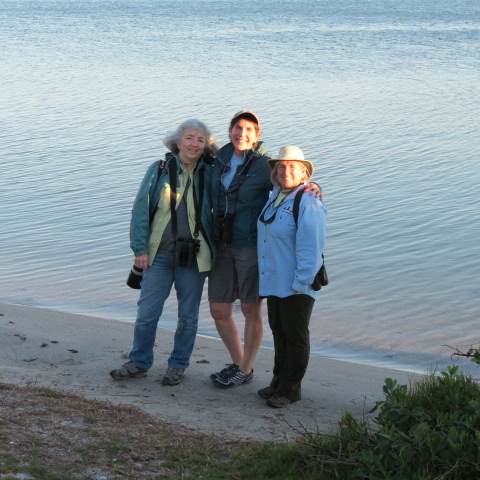
No, I don't mean Canadians.  They seem gather here in good numbers; we met 2 couples on the beach taking in the sights. So, we showed them the sight that brought our group to Sebastian Inlet.
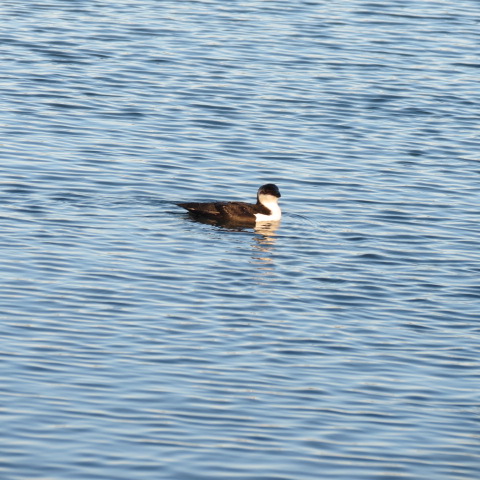
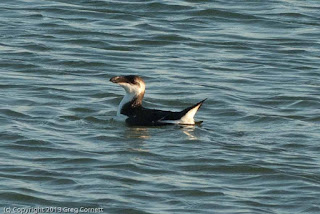
Razorbill at Sebastian Inlet, Florida - photo Cheryl Harner
This is the strangest sight one might hope to see in Florida this year, a Razorbill.   These members of the Alcid family of ocean birds are usually found in the northeastern waters like  Maine or New Brunswick.  Winter of 2012 has dumped flocks of them in Florida waters.  Unfortunately, they are dying off big numbers and generally giving the wildlife rehabbers fits. (Follow that link to a news article.)

The locals can't figure out why they are seeing these "penguin" like birds!  That is a great question.  Some suspect it has to do with Hurricane Sandy.  (We blame that "witch" for everything, don't we?)
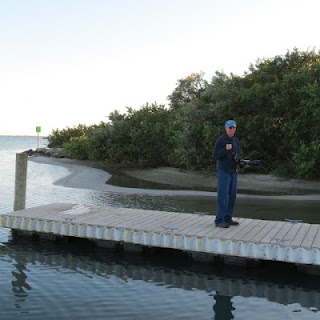

Behold, the paparazzi watching the Razorbill swim past the boat docks.  Greg Cornet (in the photo above) graciously loaned his photo of the bird for your enjoyment, and was our tour guide for the day.  Hats off to Greg.

Jan Auburn, Cheryl Harner and Leslie Cornett at Sebastian Inlet.
What could be better than a little sand and sun among friends? A Razorbill- seen in shirt-sleeve weather!

Tuesday, January 22, 2013

Wings over Cocoa Beach, Florida

Multitudes of "snowbirds" have gathered near Titusville, Florida for the annual Space Coast Birding Festival.  We have great digs just off of Cocoa Beach, with miles of sand and sunshine (apologies to my friends left in Ohio.)
 Tonight we saw the most amazing sight as we were crossing the bridge to the island.  What "wings" were we seeing?


 It is a bird, a plane.. no-  it is a KITE!  (Not a Snail Kite, either.)

There were a handful of intrepid athletes, attached to surf boards, being towed along by kites.  They call this kiteboarding. Go here to see what is is all about.


They start out flat on their back in the water...

 The kite catches wind, and the lift begins.

 Here he is, hanging on for dear life!

What could be more awesome than scooting across the water with the sun setting at your back?

This gal was really cutting the moves...
                                maybe next time, it will be me!

Tuesday, March 27, 2012

Gulf Butterfly- Florida

Last week the weather was unnaturally warm for Ohio and I wondered why I had booked a flight to Florida. Although Ohio's weather nearly rivaled the balmy climes of the south, Florida has butterflies I will never see here.

Underside of Gulf Fritillary, Dion vanillae  nectaring on Scorpion's Tail, Heliotropium angiospermum

The long-winged member of the fritillary butterflies is quite common in the south; it is a very, very rare occurrence in Ohio.  It was one of  the most common butterflies seen during my visit to Florida.

This "Gulf Frit" had landed on an invasive species of plant, the Water Pennywort, Hydrocotyle vulgaris.  The local tell me this non-native plant "appeared" everywhere after a hurricane and has been a nuisance in the landscape ever since.


 The Gulf Fritillaries use several members of the Passion-flower family as host plants. 
The Gulf Fritillary caterpillars we found were feeding on (presumably) a passion vine.  There was not enough vegetation left intact to identify the plant species!
Unfortunately, it appears a Braconid wasp had, or was laying eggs on this poor caterpillar.  That spells "lights out" for this guy.  The eggs will hatch out and feed on the innards of the caterpillar, allowing it to live long enough until they reach maturity.  A good parasite doesn't kill its host, until it is no longer needed.

Nature is amazing, but at the same time, often horrific.

Wednesday, March 21, 2012

The Bag Bills

I admit sometimes I am smitten in the craziest ways.  But it is no less real, perhaps, I am just better able to see the wonderfully unique features that makes this bird- such a personality!  

The "Bag Bill" or Brown Pelican, Pelecanus occidentalis is a beautiful bird!

A large, colorful presence found along the Florida coast, this handsome adult Brown Pelican, which sports a yellow crown and silvery plumage, is a mighty fisherman.  There is a wonderful poem that documents his prowess:
         What a marvelous bird is the pelican
          His beak can hold more than his belly can
          He can store in his beak
          Enough fish for a week
          But don't ask me how the hell-he-can!              (Author unknown)

 Indeed you will find his beak can hold more (water) than his belly can, and he strains the water from his catch.  But the catching is the amazing part!  He cruises along the water, until he seems suddenly rendered with a paralysis which throws him into a head-long dive, deep into the water.  Up he comes to the surface, with a virtual smile on his beak and a fish in writhing within.  He drains the water a bit, throws back his head, and gulp!  Down it goes.


Pelicans seem nearly improbable in flight.  They cruise in small groups, or casual flocks of 20 or so, along the coastline. They look almost prehistoric as they cruise overhead; it boggles my mind that these unwieldy birds even fly!  They look like a squadron of  B-52's.  Sometimes their formation skims so low across the water, wingtips nearly touch the waves.  On they go, for miles and miles...

And if fishing is not so hot, no worries!  There are plenty of Florida fisherman most willing to share the scraps from their fish cleaning process.  All the pelicans have to do is hang out at the local docks 'til the boys come in.  I once heard someone say pelicans were stupid, but that doesn't look so dumb to me.


Wednesday, March 16, 2011

Sky Candy

Just in from my friends in Florida, mouth-watering views of a Swallow-tail Kite.
...
Greg and Leslie were kayaking along the Indian River in Florida (without me!?) when this beauty put on an air show. This is the time of year Swallow-tail Kites return to their summering grounds.
...
According to Sibley they can over shoot that migration by a bit, and make extremely rare appearances in northern states. Most records I find are in mid-April or in the fall. So look sharp for these fellows, and if anyone spots one- don't keep secrets!


Swallow-tail Kite........... photo by Greg Cornett


photo by Greg Cornett
...
Mmm, something good to eat! Probably a tasty cicada or grasshopper! These birds are also known to buzz small streams and swampy woods in search of lizards, dragonflies, and other large insects.

Oh, to see a dive like this! Sky candy! Someday I hope to see these magnificent birds myself, until then, special thanks to Greg (and Leslie) for sharing these photos.
...
All photos in today's post provided by Greg Cornett.

Wednesday, February 3, 2010

Florida's Gentle Giants

Florida's living legacy is a gentle giant of a fresh-water leviathan. The manatee, locally called "sea cows" are struggling for survival due to habitat destruction, boat-impeller injuries, and dredging. And if life wasn't tough enough for these already endangered animals, the extended cold snap in Florida has contributed to over 70 deaths in the last month alone.


We scoured the regular locations in the coastal regions but the manatees were no longer there due to the water temperatures. Manatee historically ride out cold weather snaps in warmer- fresh water fed springs. Fellow birder and RRI Energy rep, Bill Baker had generously opened tours for Space Coast birders to witness manatees gathered at the warm-water out-flows of their power plants (just like the winter gulls in Cleveland!)

Unfortunately, that did not fit within our schedule, so we were forced to travel an hour north of Orlando to witness the gathering at Blue Springs.


The trip to Blue Springs did not disappoint! The crystal clear water and evergreen vegetation was a a stark contrast to the murky black waters oft the St. James cypress swamp. Manatees were lined up along the banks by the hundreds! Note the big gray masses in the water, it's our 1000 pound manatees at the winter spa! It must take a lot of leafy-greens to keep a herd this size fed. For more general West Indian Manatee info -click here-.


Occasionally, one would swim past the viewing deck where the manatee fans had gathered. This youngster, probably a mere 400-500 lbs, bore large white gashes on his tail- scars remaining from massive injuries this calf must have suffered. Power-boats and manatees do not mix... and the slow moving manatees are the big losers. "No wake" zones and speed reduction laws have been passed in an effort to protect this declining species, and all manatees seen in zoos and aquaria are on a rehab from some injury or other. When they heal and are deemed worthy of release- they are shipped back to Florida for release in the wild. Cincinnati Zoo has a manatee scheduled for release later this month (Lindsey, the zoo keeper, is a close family friend.)

Playful, gentle, sweet- the most apt words to describe these giants. Pictured rolling in the waters, it was fascinating to watch the interaction between the manatees and the plecostomus (algae eating fish) who seemed to enjoy catching a ride, and a snack, on the manatee's backs.


How about a big kiss? Easy to love, and yet in heart-breaking danger. Manatee studies have indicated they are headed towards extinction if any more than 17 manatee deaths occur in a given year. Last count I read, over 100 deaths had already occurred this year, and the cold-water pneumonia is likely to take its worst tolls in the coming week.
Daughter JJ has several rescue manatees at Seaquarium in Miami and I'll try to follow their progress. Let's hope they are able to be released to the wilds again.

Monday, February 1, 2010

Florida Wetlands by Air-boat

The Space Coast Birding event was a great excuse to visit Titusville, Florida and some relatives we have stashed down there- in case of inclement weather. It is always fun to be led about by the locals, and one never knows what you'll see or do.

Captain Mike adjusts the protective head-sets and speaker system before our take off.

With the wind in our faces, the air-boat screamed across the flood plains of the St. Johns river, which is more like a vast, slow-flowing artisan fed wetlands. This drainage basin of over 8,800 square miles flows north and is the only river in Florida to do so.


Seen from the bow of our boat, miles of channels flowing lazily through islands of wetlands and swamp. The predominate trees are Red Maple- Acer rubrum, Bald Cypress- Taxodium distichum and islands of Cabbage Palms- Sable palmetto. The grasses... I'll never know.


.......................................................(C(click to enlarge)
As we cruised to a halt at the base of a tree, we noticed the inhabitants of an old Blue Heron's nest. These masked bandits had burgled the joint and settled in for a snooze. It is not a good idea for these guys to sleep at ground level, and you soon see why.


Our guide claims this particular 16 mile stretch of the St Johns is known to have an estimated 14,000 alligators living within its waters- and the cooler weather Florida experienced in January had them all in basking mode. Every hummock and flat spot seemed to be sporting a sunbathing beauty, and the bigger one on the right was a good 8 to 9 foot long.


Hello big guy! He was just a little more up close and personal than the Weedpicker needed! Of all the habitats and locations I have ever ventured, this may be the first time where I DID NOT get out to take a closer look at some plant or tree.
I sure liked the air-boat. Just keeping in the air-boat, thanks!

Monday, January 25, 2010

Vegging out in Florida

As much as I like winter in Ohio, I figured the Space Coast needed some birders to support their festival in Titusville, Florida, so here I am. Sunshine, 70+ degrees, and loads of cool things to see.

A Common Moorhen, with his retro-style colorful, dinosaur-headpiece, trolling the shallows off the Kissimmee Lakefront Park. It was our first destination, as it is a short stop off from the Orlando Airport and the land of a million kids!


We found several emptied Apple Snails, the favorite food of the endangered Snail Kites which breed in this area. Limpkins are said to be fond of this snail as well, so if you are a birder, you should be interested in these snails. And snails have to eat, so it starts with the botany, as these guys are vegetarians! It is all about the botany.


Here is a scary, scary sign announcing more development on this lake. I am sure the city fathers are quite proud, but the Snail Kites and I hope someone is watching out for the Apple Snails and the important plant life surrounding this lake.
And now for some happy news!

An idea for the environmentally minded consumer: hire a lawn aeration service which benefits your lawn by creating those important cores of aeration and adding needed fertilizer- all in a noiseless "residential friendly" flock. "Green" Ibis are now available for hire, but only south of the Mason-Dixson line!