Showing posts with label ONAPA. Show all posts

Tuesday, March 8, 2016

Spring's Hope- Ephemeral.

You might read that title twice.  Spring's Hope- Ephemeral.  Usually you hear  Alexander Pope's old line "Hope springs eternal (in the human breast.)" But I suggest, nothing is eternal in this natural world and one best admire the ephemeral hope of spring flowers while we can.

Snow Trillium, Trillium nivale
The photo of this flower is larger than life, literally.  This is the tiny Snow trillium, one of the earliest of our spring flowers.  We often find it peeking up through snow banks in March.

Snow Trillium with a little perspective.
Snow Trillium is generally quite small, but the first of this year's crop seem to be Lilliputian! The nickle puts it all in perspective.

As much as I wish you could walk on your local woodlot and find these specialty flowers, it is not likely to happen.  They are few and far between.  Ohio's botanically savvy make pilgrimages across many miles to visit known sites each year.  This location in Adams County. There are a few in Columbus and others, near Clifton Gorge.  Just stumbling across them is nearly impossible, as they also present a challenge to find due to their size alone.


 There are at least eight mini-trilliums growing on this dolomite rock outcropping. Without the nickle to point the way, they are easily over-looked.  Too often properties are developed or destroyed, with no accounting for the rarities which might have been on them.

Land preservation and stewardship carried out by organizations like Ohio Natural Areas and Preserve Association, Ohio Department of Natural Areas and Preserves, The Nature Conservancy, and Arc of Appalachia is more important than ever.

Please help us protect the smallest of our woodland wonders for future wild flower enthusiasts.


Tuesday, November 18, 2014

Winter Birding

You might have noticed it is cold. But that doesn't mean the fun has to stop, it only changes.  Let's focus on some of the special happenings going on in Ohio in the fall, and yes, winter.

Oh, this looks interesting!  
Bob Scott Placier gently handles a Saw-whet Owl.
Saw-whet Owls invade parts of the United States in the fall.  Leaving the forests of Canada, many cross Lake Erie to take up winter residence in Ohio, Pennsylvania and beyond.  Researchers are just getting a good understanding of the habits of these nocturnal creatures.  The group at Project OwlNet are the the primary movers and shakers of the studies.

In Ohio, we have Tom Bartlett banding these secretive owls on Kelleys Island.  My good friend, Bob Scott Placier recently did a night time banding at Lowe-Volk Park in nearby Crawford County.  He was able to band one of the elusive birds that evening, but in general, the numbers are down this year.  

Cackling Geese, now coming to a inland lake near you!
Note the stubby bill which is most diagnostic.
 Last week I had the opportunity to bird a bit at Maumee Bay State Park's inland ponds.  There were good numbers of Canada Geese moving through just in front of this weather front we are now experiencing.  Two mini-geese where associating with the Canada Geese, but maintaining their own space and distance from the larger birds.  Cackling Geese, once a sub-species of the Canada Goose   have been "split" out and are now considered a separate species.

Two Cackling Geese in the forground were about 65% smaller
than the geese with which they were asscociating
These Mallard-size geese are real stand-outs in a crowd. I spent a good bit of time studying the birds, and got some video as well.  I will try to post that later.

The whole science of splitting out Crackling Geese has been called "hopelessly muddled" by several of America's best birders.  So I will not attempt to explain them other than, when you see one- you will know it!

SNOW BUNTINGS!
And with snow comes: Snow Buntings!  Keep your eyes pealed while driving back country roads for these farm-field wonders from the north. Every day we are getting reports of more winter birds arriving!

Snowy Owl
 This is a picture I took while on a Black Swamp Bird Observatory winter pelagic tour several years ago.  Experts are predicting another boom year for Snowy Owl watching and the Cleveland Lakeshore is a good place to start your search.  In fact, go here to sign up for your own  Lake Erie Freeze-fest!  They will pour the hot coffee and provide expert birding leaders as well.

Short-eared Owls are winter fare.
Birders will soon be seeking Short-eared Owls and Northern Harriers in grasslands across Ohio.  My photo was taken at Killdeer Plains Wildlife Area, but Short-eareds are also frequently seen at The Wilds near Zanesville.  Ohio Ornithological Society will be offering a trip to the Wilds on January 17th, 2015. For those interest in winter grassland birding, go to the OOS website for all the details.


  • This weekend, the Ohio Natural Areas and Preserves Association will be birding at La Due Resivoir and I hope to see you there on Saturday Nov. 22, Please go to their website for details. 


  • The ONAPA birding is from 10:00-2:00 and following at 3:00 pm is Greater Cleveland Audubon's program and refreshments at nearby Novak Education Center, 382 Townline Road in Aurora, Ohio (3-5pm).  The speaker will be someone you might know, a Weedpicker.  I will be talking about Birding by Habitat, and Habitats for Birds.  

Monday, September 29, 2014

ONAPA visits Lakeside

 Saturday the 20th of September 2014 was a big day for Ohio Natural Areas and Preserves Association.  Our second Annual Meeting was held in Lakeside, Ohio. This organization is only two years old, but it has grown by leaps and bounds!  We have amazing volunteers working in preserves and the backing of some very impressive scientists and educators all across our state- and beyond.

Mr. Allison Cusick gave the Keynote address.
 Retired Ohio Natural Areas and Preserves Chief Botanist, Allison Cusick, gave a rousing program on The New Sandusky Flora.

Besides being an excellent public speaker, Allison has also authored or co-authored 3 books. Currently, Allison is a Research Associate of the Carnegie Museum of Natural History in Pittsburgh, PA. This man has hardly retired!

 He encouraged us to  "lament what has been lost, marvel at what has persisted and cheer at what has been preserved."  We literally cheered for some plants during this program, as Allsion is a gifted orator who knows how to engage a crowd!

His program referenced E.L. Moseley's Sandusky Flora which cataloged the plants of the Marblehead Peninsula and surrounding areas at the turn of the century (1900.)


 There were displays by supporting non-profits, Ohio Ornithological Society and Mid-West Native Plant Society were both in attendance (special thanks to Julie Davis and Kathy McDonald.)

Kevin Sibbring visits the ONAPA display.
The ONAPA display (thanks to Jan Kennedy) was also present, and Lakeside's CEO, Kevin Sibbring attended the event and gave us all a warm "Welcome to Lakeside."

Black Swamp Bird Observatory's display.
ONAPA supporters Kim and Kenn Kaufman.
 My friends, Hugh and Judy Kolo-Rose brought along the BSBO display and offered an amazing selection of books for sale.


ONAPA's Silent Auction, was an outstanding success, thanks to the efforts of Mary Christensen and Katryn Renard.  A special thank you goes out to the generous people and companies that donated items to this auction.  You have been a great blessing to ONAPA, and we appreciate your kind support.

Guy Denny
ONAPA  President, Guy Denny, gave an overview of the year and the amazing things ONAPA has accomplished.  Of course, he wouldn't say this, but Guy is the glue that holds this organization together!  We appreciate all he does and the incredible knowledge of leaders like Guy, Dick Moseley, Jim McGreggor, Bob McCance, Tim Synder, Ray Heithaus, Jim Mason and all the other board members who attended (and those who were unable to be with us.)  They do so much to protect our natural areas.

One field trip was held in Lakeside Ohio along the Ohio's Most Beautiful Mile.
 Field Trips!  What would an ONAPA event be without free Field Trips?  Guy Denny led a group to Castalia Praire, while Dick Moseley led a trip to Sheldon Marsh.  Meanwhile, your blogger got to lead a field trip on the shore of Lake Erie in Lakeside, Ohio.  We had wonderful groups both Saturday and Sunday. We discussed the unique Carolinian Forest botany of Lakeside and visited many native trees and plants along the lakefront path.

The self proclaimed "Cane Brigade."
As always, when leading groups one often gets more than they give.  It was such an honor to spend time with friends on this beautiful shoreline to exchange information on botany and plant ecology.  But even more than that, I was reminded how important it was to have this simple offering available to some wonderful folks who would have physical barriers to enjoying the other field trips.  Lakeside lends itself to the enjoyment and education of people in all walks and ages.  It was a distinct honor to be able to share one of my favorite vistas with my botanical friends.

Thank you to everyone who attended and supported the Silent Auction.  You are making this state a better place by supporting our Natural Heritage!


Wednesday, September 17, 2014

September on Lake Erie

Having spanned the country and visited countless parks, forests, natural areas and sea shores, I can assure you, it is nearly impossible to find anyplace more beautiful than Lakeside, Ohio.


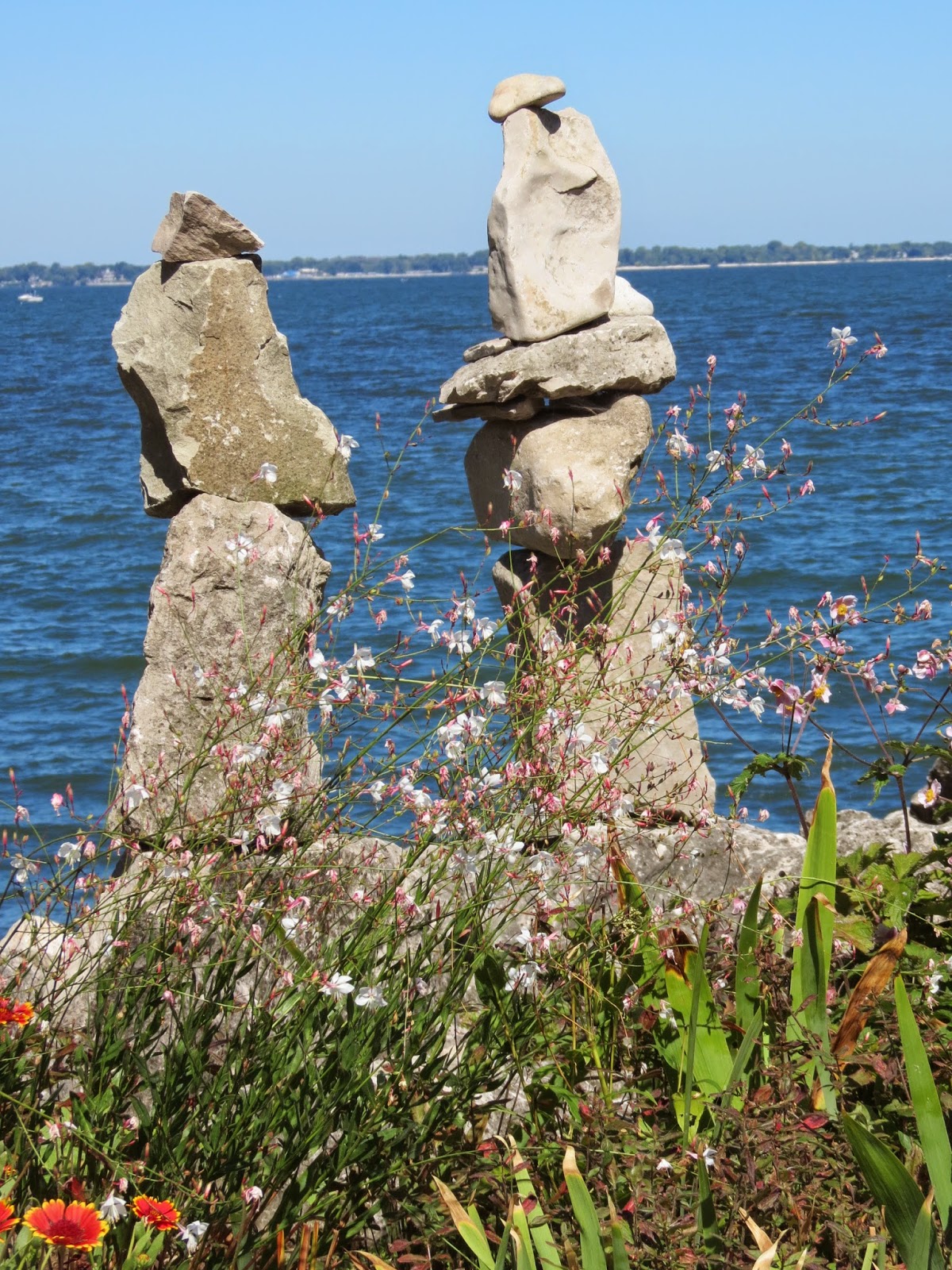
 There is something about this town. First it gets into your heart and then silently creeps into your very soul. The call of shore birds and gentle slapping of the waves speak to me.  The vista of Lake Erie's Islands, floral gardens and these playful stone cairns  delight the eye. They won't last for long against Lake Erie's storms, but they balance the joy of "today" against the "forever" of rock.

Jewel-weed, Impatients capensis  on the rocks.
Lakeside is well known for its history and architecture.  It is a gated community in the summer, where children rule the streets and ice cream is considered the nectar of gods. It is a Chautauqua, and I could probably devote an entire blog to that alone, if I have not already. 

But it has a compelling natural history as well.  For example, these orange flowers growing in wild abandon on the lakefront attract Ruby-throated Hummingbirds which visit them for sustenance on their migration south for the winter.


Lakeside's administration has turned a serious eye to this issue and is promoting native plants and the "natural look" of our great lake, Erie. The fall migration of birds and Monarch butterflies both pass through these historic grounds. Our wildlife will appreciate the consideration we are giving to milkweeds for monarchs and bee-balms for pollinators in general.

Our native plant enthusiasts should be proud of the on-going effort to select Ohio native plants for the restoration of the west end's lakefront.  I hope you will join me for the Ohio Natural Areas and Preserves Association's Annual Banquet and field trips this weekend.  Keynote, Allison Cusick will be speaking about our native Sandusky Flora, and we will be leading tours on this lovely stretch of Ohio's Most Beautiful Mile.


The gales of September on Erie.
 And "weather" it is windy or balmy, Lake Erie and Lakeside is always my favorite place to be each fall. Every moment is to be savored...


especially, during the sun sets.

Monday, August 5, 2013

Natural Beauty: Prairie Style

 One of the most significant preservation accomplishments in Ohio in the past decade was naming Daughmer Prairie Savanna a State Nature Preserve.   A lot of good folks were involved in this effort, and I have written about it numerous times: the Dedication ceremony, how it looks in late fall, Daughmer on fire, its cord grass and several other posts as well.

Daughmer Prairie on an early August morning
I have gone there many times and each experience is different and meaningful in its own way. Last Saturday Crawford Park District was hosting one of Ohio's most knowledgeable naturalists, Jim McCormac.

This virgin, never-plowed prairie is worth investigating over and over.  If you would like to take a guided tour of Daughmer, go to the Ohio Natural Areas and Preserves Association and sign up for our Annual Banquet

Jim McCormac, the ultimate nature guide.
Jim McCormac, author and employee of Ohio Division of Wildlife, leads people into nature like none other. He has been a wonderful mentor to me and thousands of Other Ohioans. He is a walking field guide to Ohio.  You would be hard pressed to find a better source on botany, birds, natural history. He also has a great understanding of both mammals and insects, including moths, dragonflies and any other creepy-crawlies.  I simply wanted to hear his take on Daughmer.


There was quite a crowd too!   I didn't count, but we had somewhere between 45-50 people. Those of us who were in the back of the tour were a good 1/8 mile away!  It was still an extraordinary trip.

Winged Loosestrife, Lythrum alatum
 We had not even left the parking lot before we discussed the "good" loosestrife, which is not to be confused with the invasive non-native.

Sullivant's Milkweed, Asclepias sullivantii
Next we ogled the famous milkweed that was named for Ohio surveyor and part-time botanist William Starling Sullivant.

Ann Budgeda from Lake County Parks with Swamp Milkweed.
 It became a "pretty in pink" day, with Swamp Milkweed, Asclepias incarnata rising high in the grassland.  This milkweed is just as beneficial for hosting monarch butterfliess, but it prefers wet soils.

Primrose moth, Schinia florida
Another high-light was the Primrose moth Jim found as it flitted through the vegetation.  We had wonderful opportunities for a photo shoot with this compliant creature.  This day-flying photogenic pink bug can be found (but is seldom seen) throughout the eastern U.S.  Primrose moths have an affinity for nectaring on Common Evening Primrose.   I once saw one in Florida, but it didn't stick around for a photo session!

Josh Dyer (Crawford Parks), Jim McCormac (ODOW), and Bill Fisher (Crawford Parks) at Daughmer Prairie

Thanks to Crawford County Parks for all they do to maintain the prairie (with the help of ONAPA) and for hosting this special program.

Please sign up for the fall Daughmer tour with Guy Denny sponsored by ONAPA. You will be amazed, too.


Tuesday, September 18, 2012

Service in the Preserves

 Columbus Audubon's  Katryn Renard  has been organizing service trips to Ohio Natural Areas and Preserves for many, many years.  She knows that the best trips are a combination of good works...

Katryn peeks through a tree's unusual root growth
 and having a little fun.


 Last Saturday things were looking up at Fowler Woods, just north of Mansfield.  It is a wet woods best known for its exceptional spring wildflower display.

The boardwalk, essential for access to this wet woods,  is in need of repair. Columbus Audubon was able and willing to help
.
Ryan Schroeder and Mike Grody of Natural Areas and Preserves.
 The job was laid out by the pros, Ryan and Mike.  They supplied the goods for repairs and we followed their lead.

Team Mayham strikes a pose.
The guys did some phenomenal work, but you know this is a posed photo- in real life they would never let me use the crow-bar!

Carrying the slats.
Mostly we carried the slats to the repair locations, and enjoyed the wonderful morning in the woods.

Brown (DeKay's ) Snake
Like all "big kids," we had to interact with nature a bit and admire some of the local residents. This is a DeKay's snake, a species that feeds on small insects and invertebrates in decaying logs and leaf matter.

Egg masses injected into a Viburnum stem
 Unfortunately, I found evidence of Viburnum Leaf Beetle damage and their egg masses.  We are just on the cusp of this infestation and need to be proactive now.  A good first step is to remove and destroy these egg masses.

These service trips are a wonderful example of the hard work, science, and fun that can be accomplished by a team. Our Ohio State Nature Preserves need constant maintenance and attention.  Not only to the trails and boardwalks, but as importantly- they need constant monitoring and removal of invasive species.

Invasive plants, animals and even insects can damage and ultimately  destroy these areas that were set aside for their natural beauty and unique biodiversity.  These little time capsules need to be constantly managed to prevent successional growth which would change and destroy these habitats the state deemed worthy of protecting.

If you would like to join us on a work program and have a insiders look at some of Ohio's most biodiverse habitats, join  ONAPA today.