Showing posts with label Lakeside. Show all posts

Friday, November 4, 2016

Thursday, July 7, 2016

Lakeside Flowers and Fun

The best vacations often combine beauty, relaxation and fun.  Our family thinks Lakeside, Ohio fits the bill perfectly.  It has been our long-standing tradition to be there for the annual Fourth of July festivities. But a huge part of my enjoyment comes from visiting the non-stop flower displays generously sprinkled across the grounds. Lakeside's lakefront has been declared as the "Most Beautiful Mile" in Ohio.

Hollyhocks as colorful as fireworks
The Gundlach Garden is an old-timey cottage style garden on the west end of town which features a brilliant firework-like display of hollyhocks. Visitors often photograph these stately flowers against the back-drop of Lake Erie. Every article written on hollyhocks warns us not to plant them in windy locations, so Lakeside hollyhocks persist with a spirit that defy all odds.

A closer look at the heavy pollen.
A closer look betrays a heavy pollen load at play here.  Most literature I read says they are very attractive to bees and hummingbirds. Hummingbirds?  Where is the nectar reward?  I'll be watching to see what takes an interest in these old-fashion favorites. It is interesting to look closely at our plants and to better understand their ecosystems at work.

Getting a nature, science and beauty "fix."
 Leave it to Lakeside to encourage one tho think "out of the box" a bit.  The Lakeside Campground Association was offering science courses to woman back in the 1890's!  The long standing tradition of education, recreation, religion and cultural arts are the very pillars of the Lakeside Chautauqua Movement. It is intentionally designed to feed both mind and soul.

Historic Hotel Lakeside
 Our Hotel Lakeside is a Victorian hotel which perfectly combines modern needs with the beauty of an age gone by. You too can stay in this Grand old Gal from June to early October. It is one of our designated conference hotels for  Flora-Quest and OOS's Rally for Rails.  This is your chance to see Lakeside in the off-season.

Summer fun on Lake Erie
During the summer the lakefront is active with swimmers and boats. A good, stiff lake breeze will bring out a fleet of Sunfish sailboats, too.  This is all part of the recreation for which Lakeside is famous. Mini golf, swimming, shuffleboard, tennis, bike riders, fitness walkers and plenty of runners keep this active town on the move!

Happy Fourth of July!
So here's to a wonderful Holiday!  I hope you all were able to spend time with your family and friends, enjoying beauty, fun and some physical activity.  Next year, feel free to join me and a couple thousand of my friends on the shore of Lake Erie!

Saturday, March 26, 2016

Flora-Quest is All Wet in 2016

Swamp, marsh and bog are seldom epithets for locations considered travel worthy.  However, there are a myriad of interesting and little-known plants in these habitats.  Wetlands provide important filtering eco-services to our state’s water, not unlike the way kidneys function in a human body.  Much of that filtration is provided by emergent wetland flora, grasses and those little-known aquatic plants.  Flora-Quest is bringing the botanical experts to Lake Erie to provide a crash course workshop on “Wetlands.”

 Marblehead's Meadowbrook Marsh awash with fall color.
Lakeside, Ohio will be the hub for this adventure to be held Friday, September 30, 2016.  Featured speakers will include experts Jim McCormac from Ohio Division of Wildlife and Mark Dilley of M.A.D. Scientists.  They will help us learn some favorite wetland species and better understand the biological richness of life in our wetlands.

Field trips to botanical hot-spots and general flora tours of local wetlands are available.  Our forays are varied to meet every level of interest and ability.  Whether you are hoping for those gorgeous Fringed Gentians and Nodding Ladies’-tresses orchids, or rarities like Inland Sea-rocket our guides know the way.  Featured locations will include Meadowbrook Marsh, Lakeside Daisy Preserve, Ottawa National Wildlife Refuge, East Harbor State Park, and trips further afield for rarities at Sheldon Marsh or Castalia Rest Haven Wildlife Area.


Fringed Gentian is a "must-see" fall bloomer. 
Evening offerings will be a friendly meal, loads of comradery and special guest speaker, Jason Lewis.  As Manager at the Ottawa National WildlifeRefuge, Jason will help us understand the importance of Ohio’s only National Wildlife Refuge and the conservation and economic benefits it provides to us.

For those interested in extending the fun to a second day, Ohio Ornithological Society will be hosting their “Rally for Rails” on Saturday Oct 1st.  This not-to-be-missed event will bring in bird experts from across Ohio and beyond to peak into the secretive lives of these wetland specific birds.

To learn more about our Flora-Quest Wetland Workshop
                                                                          www.flora-quest.com

Registration opening soon!

Friday, October 30, 2015

Fall Colors, Flagging invasive species

 If the recent rains haven't knocked all your fall leaves to the forest floor, this weekend may be your last chance to take in a color tour. Or if you have travel in mind, here is a link to a fall color travel map.

An Ohio forest in full Fall display.
 Here in Ohio we are lucky to be a part of that small percentage of the world which experiences these beautiful colors of leaves changing from green to yellow, orange and reds in response to cooler weather.  An experienced color watcher can develop a feeling for the composition of a woods by its colors.  Yellow is expressed by Hickories, Eastern Hop-hornbeam, and Hackberry.  Beech leaves turn to the warm color of copper.  Sassafras trees are total show-offs,  likely to range through color expressions of red, yellow and orange! University of Tennessee  offers a nice fall color chart, you can download here.

Fall is also a good time to identify invasive plants in your landscape.
 This photo documenting stunning pinks and reds dominating the fall forest, makes me wish I were just a little less forest-wise.  While most people enjoy this as a lovely display of color, land managers see this as a brewing problem in our natural areas.  The pink and red coloration is the tell-tale sign of a nasty invasive, non-native plant: Winged Burning Bush, Euonymus alatus.  It comes out the landscape plantings and spreads into natural areas. Unfortunately, for all its beauty, it becomes an aggressive colony which can quickly out-compete the woodland flowers and native shrubs.

Michael Woogerd attacks non-natives.
Since non-native plants get their competitive edge over native plants by holding their leaves longer in the fall and greening up first in the spring, those are ideal times to assess your natural areas and plantings at home.  If something appears excessively robust this late in the fall, that maybe a good indicator to take a second look!  Michael Woogerd, land manager for North Central Ohio Land Conservancy, attacks all of the Burning Bush which has crept onto land trust properties with great prejudice.  It can't hide its true colors in the fall!

Winter Creeper, a menace in green.
Some invasives are not so showy; they calmly head into winter in their glorious green. Winter Creeper, another euonymus, Euonymus fortunei is a particular problem at my own home.  It was the legacy of the previous owner who planted it as a "nice ground cover." Too bad it doesn't stay on the the ground!  It is given to climbing up trees and throwing seed to the wind. It is probably on every invasive list in the U.S.

Winter Creeper over-runs a natural area at Lakeside, Ohio.
Given a little room and some time, Winter creeper will gobble up any and all ground vegetation.  It has even strangled my Hosta specimens at home!  Ohio's delicate ephemeral flowers of the forest, like Trilliums and Spring Beauties, don't stand a chance against this "creep"!  Since this photo was taken, we have removed a portion of the Winter Creeper from this flagged transect. I plan to monitor which spring flowers will respond and reestablish themselves when given the opportunity.

Spring flowers will be a great reward for the little bit of work it took to remove a section of that nasty Winter Creeper!


Wednesday, July 15, 2015

Lakeside's Botanical Secret

If the cottages of Lakeside could talk, we might hear some intriguing stories.  After all, since the mid 1870's it has been a gathering place for families and the famous alike. You might be surprised to learn the exciting story which came to light during my recent visit to Lakeside.

Dewey Hollister, reknown plantsmen.
While attending the Gardening as Landscape Painting series, Dewey Hollister and I spent a good bit of our free time enjoying the gardens and grounds. We particularly savored the architecture and landscapes which incorporate a century's worth of designs.  We visited elaborately planned gardens and several of the most naturalistic remnants of plant communities on the Marblehead peninsula.
 
Hydrangea arborescens is the oldtime Lakeside garden favorite.
As we walked through town, Dewey noticed the cultivated hydrangeas which seemed to tell the story of Ohio's native plants and their appearance in our gardens. What could say "summer cottage" better than a foundation planting of hydrangeas?

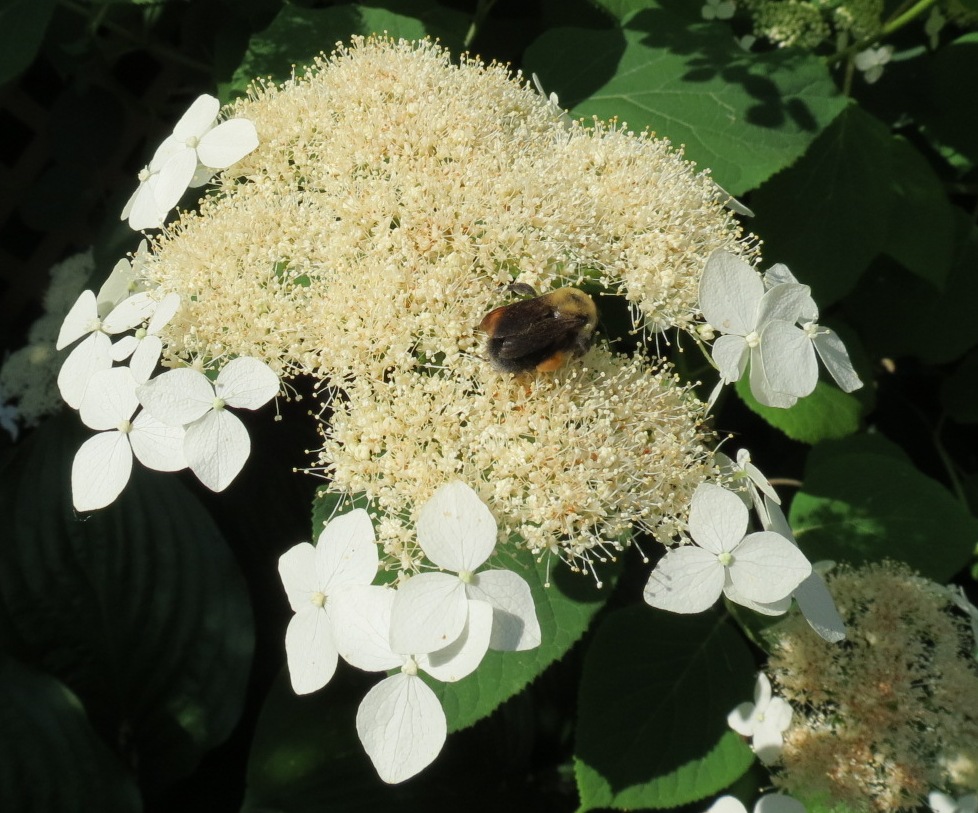
These wild hydrangeas have rather small flower heads and bear more fertile flowers than showy sterile florets. Fertile flowers are the smaller pollen-loaded reproductive portions of the flower.  Today's hybrid hydrangeas boast larger showier flowers which are preferred by many gardeners, but do not provide pollen for our much need pollinators.

A progression of Hydrangeas often surrounded the older cottages.
Some early Wild Hydrangeas, Hydrangea arborescens probably sported a more uniform Hydrangea arborescens var. grandiflora which directly translated from the Latin means: Hydrangea of the woods with grand flowers.  This grandiflora genotype was later developed into the standard and completely sterile "Annabelle" Hydrangea we all know today.

The classic Hydrangeas arborecens is a staple in Lakeside landscapes. 
 Through the years, nurseries and gardeners quit growing the old standard as the much showier "Annabelle" Hydrangea became commonly available. The basic grandiflora form has been all but lost, until Dewey's realization that Lakesiders have shared and preserved this plant for over 100 years!

It takes very little imagination to see how neighbors might have split off a start of their cherished hydrangea to welcome friends and family as their cottages were built in our fair Chautauqua.  What could be more neighborly or Christian than to share your favorite low-maintenance plant?

Hydrangea arborescens var. grandiflora on the left, Hydrangea "Annabelle" on the right.
The difference between "Annabelle's" larger leaves and the showy, fully-sterile flower heads become more obvious with a little practice.  Soon you will notice many cottages with their original Hydrangea arborescens by the door and a nearby line of more recently added hydrangeas from the horticulture industry.

Test your botanical ability on your next Lakeside walk.  Try finding Ohio's missing heritage hydrangea which has been hidden in plain sight all along!  One has to admire the old-time Lakesiders for having the ability to preserve something special through love and friendships.

Tuesday, July 7, 2015

Landscape Gardening and Native Landscape Design

It is no secret that Lakeside on Lake Erie has one of the most beautiful lakefronts in Ohio, if not the entire United States. They have officially declared the one mile stretch of walking paths "Ohio's Most Beautiful Mile." Against the back drop of idyllic lake scenes and sailboats, lie the parks and the shoreline of landscape plantings. It is easy to understand why we love Lakeside and why artists and photographers are compelled to capture its beauty.

Lakeside's Beautiful Mile- Photo provided by Lakeside website.
It is no wonder people came from all across Ohio to the gardening symposium, Painting Ohio in Broad Brush Strokes.  Lakeside was the ideal location to study landscape design and the new movement toward a new Naturalism, as seen in Europe.

Dewey Hollister, Hope Taft and Guy Denny
The program kicked off with three people who have made real strides in adding native plants into the landscape at the Ohio Governors Heritage Garden.

Former Ohio First Lady Hope Taft came up with a marvelous idea to show case the best of Ohio's floristic bounty into sectional gardens at the Governor's residence.  She enlisted landscape designer Dewey Hollister and native plant expert Guy Denny to create a Heritage Garden.  It is open for tour- just tap on this link http://www.governorsresidence.ohio.gov/home.aspx for details.  Hope is an amazing force for nature and still remains active in the development of the landscape gardens at the historic Ohio Governor's Residence.

Amanda Patton Garden designer from the United Kingdom
Lakeside, in conjunction with the Ohio Governors' Residence, hosted a tour which allowed Amanda Patton to travel with this special event.  Amanda gave four educational programs in all, entitled Towards a New Naturalism: All Gardening is Landscape Painting. She described the parallels between art and landscape design.  One should develop a landscape using the principles of good art design and the elements which guide those principles. Art based landscapes have balance and are pleasing to the eye.  The Fibonacci Sequence, the Golden Ratio and focal points matter. Artist Luca Pacioli said, "Without mathematics there is no art."

The second day of lectures focused on creating natural gardens and illustrated many examples of contemporary works in Europe.  It was interesting to see our prairie landscape being utilized in landscape design an ocean away. I highly recommend browsing Amanda's website  for more examples of this exciting trend http://www.amandapatton.co.uk/portfolio/.

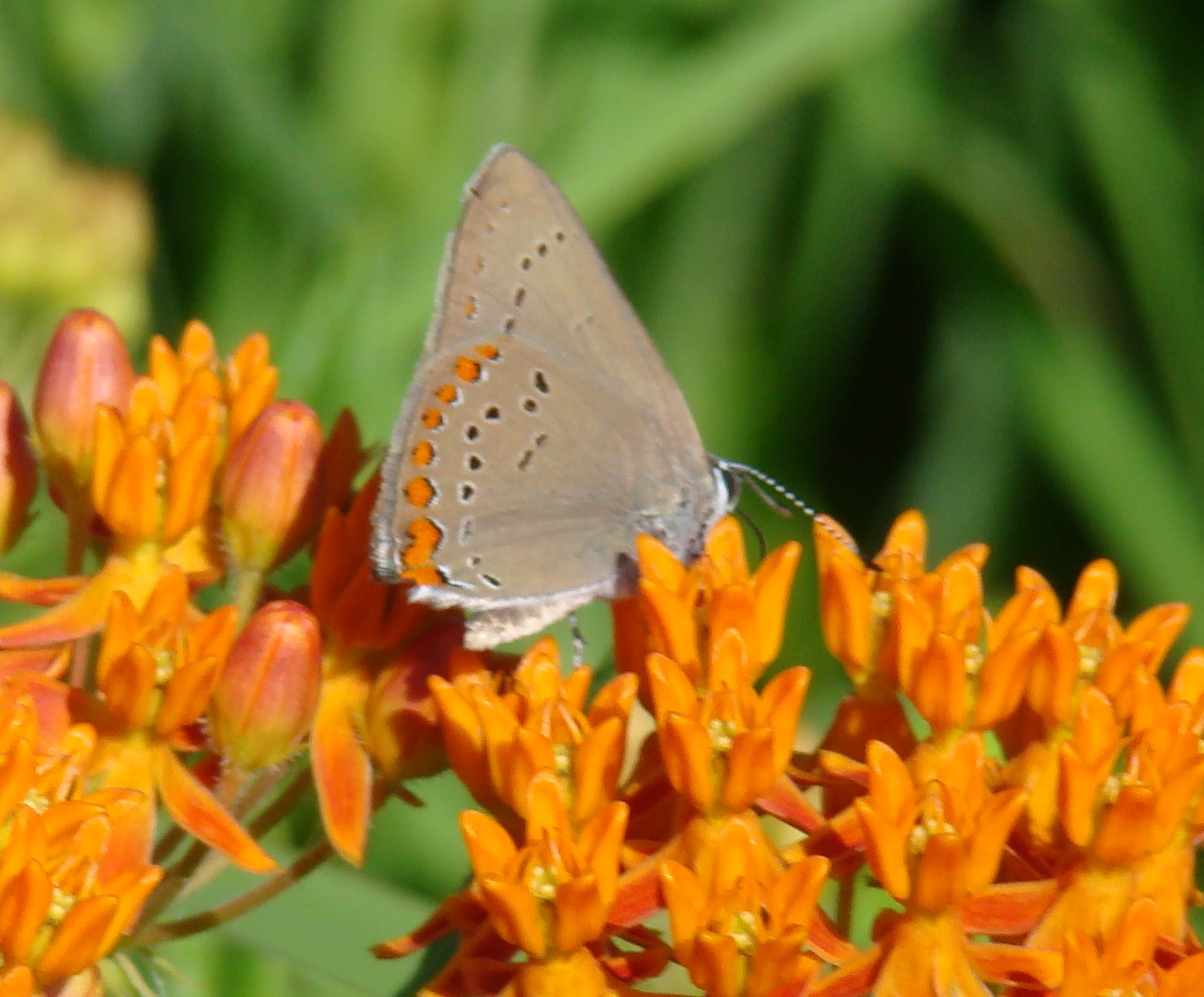
 Coral Hairstreak nectars on Butterfly-weed.
There are many benefits to this new naturalism and native plants in landscape.  Nature make us feel good.  Native plants are more sustainable and they sustain the fauna which we enjoy. They are environmentally beneficial and require less labor to maintain. 

Part of the event include field trips to natural areas like Lakeside Daisy preserve, Castalia's Prairie and Sheldon's Marsh.  These places are all wonderful examples of of Ohio's best Natural Areas and Preserves.

Lakeside boasts of many flowering hydrangeas.
During the course of our many walks we admired the landscapes and plants found within Lakeside. At one point,  Dewey Hollister had a realization about the lovely hydrangea species growing within the gated community, and perhaps unknowingly, how the good people of Lakeside have preserved them for prosperity.  We'll discuss these hydrangeas in a future blog. For now, let's just admire one of the many pollinators that was gathering sustenance at its fertile blooms.


Tuesday, May 19, 2015

Lakeside's Secret Gardens

Lakeside, Ohio has many attractions: the beautiful shores of Lake Erie, fine food and entertainment, friendly people and quaint architecture.  Now it even has a very special park for nature lovers.  It is a botanical "step back in time" featuring the historic flowers of Marblehead.

I'll be leading two walks on Saturday, May 23rd at 3:00 and again at 4:00 pm if you would like to experience this woodland garden in person.  Walk/field trip details can be found here on Lakeside's website.
Woodland Phlox and Mayapple leaves bespeak the richness of this forest floor.
Spring's ephemeral flora is short-lived but spectacular. Like mini-rainbows, the fleeting colors of flowers dance in dappled light, scattered across rich forest floor.  This year the outstanding display of Woodland Phlox, Phlox divaricata is as remarkable as any I have ever seen.

Moss-covered Rock outcropping
 The rocky outcroppings, remnants from Marblehead's rich history of stone quarrying, have an enchanting, verdant covering of moss.  Even winters in this secret garden boast of green.

Large-flowered Trillium, Ohio's state wildflower.
 The last of the Trillium are waning, but their leaves will bear proof of their presence.  A grander wild flower is not known in Ohio than this, Trillium grandiflorum.

Appendaged Waterleaf is now stealing the show.
 The newcomer blooming this week is the Appendaged Waterleaf, Hydrophyllum appendiculatum. It should be putting on an excellent show by Saturday. You'll not want to miss the opportunity to see these unusual flowers and trees growing in a natural habitat near the shores of Lake Erie.


Herb Robert, Geranium robertianum
 We will even discuss some of the local non-native flora, like this winsome gem, Herb Robert.  Some say it works as an insect repellent!

Join our walk to learn more stories of our favorite native plants and gain a greater appreciation for the unique Carolinian Forest flora found in this park. This newly "un"developed park is found at the corner of Sixth Street and Popular Avenue just north of the beautiful Chautauqua Memorial Gardens.

There is also a plant sale being held in Lakeside earlier in the day, and you may sign-up for this field trip at the registration table at the Legacy House at 217 Walnut Street.
Lakeside Daisy, Tetraneuris herbaca
While you are in Lakeside, you'll want to visit another very special "secret" garden on the Lakefront path in Perry Park. The rarest flower in the United States grows on our shores.  The last of this year's Lakeside Daisy blooms should still be evident in the garden maintained especially for their benefit.

Leave a comment below if you'd like help signing up for Saturday's walk. I hope to see you there!

Wednesday, April 8, 2015

Chasing Trees

Recently asked if I had any hobbies or unusual interests, it came to me: I like to chase big trees. Most folks understand if you want to chase rare birds, or keep a list of plants or animals in your yard, county or state.  Although big trees don't present a challenge by moving around, the Old Growth trees are harder to find than one might imagine.

Since most of our American trees have been cut over once or twice by now, any area with 200 year old-plus trees is a stand-out worth protecting for future generations.

In Ohio, Johnson Woods near Orville is one of our better examples of an Old Growth Forest. The Clear Fork State Nature Preserve in Mohican Forest also has some very old White Pine and Eastern Hemlock which are protected from timbering.  Old Growth Forests are the rarest wooded habitat left in Ohio, with only a handful of places qualifying. Any grove of ancient trees is worth protecting for posterity.

Monterey Cypress at Carmel-on-the-Sea, California
Whenever I travel, I actively search for old trees.  One stunning example was this Monterey Cypress,  Cupressus macrocarpa in Caramel. These ocean-side giants have a silent beauty all of their own.  I recently read of an even more famous Monterey Cypress at Pebble Beach near the golf course.  You can bet I will seek it out on my next trip to California.

Click here to read the L.A. Times' story.

Redwood at Julia Pfieffer Burns State Park in Big Sur, California
 The Coastal Redwoods, Sequoia sempervirens at Julia Pfeiffer Burns State Park near Big Sur are not the largest or most impressive Redwoods to be found.  However, they are the only Redwoods within my travel zone, and I was thrilled to commune with them.  Saying these giant trees are not "the largest" is much like complaining your line-backer is only 250 lbs.  That is still plenty big.

The only worthy complaint about trees this size is the difficulty they present in getting a meaningful photo.  One can either shoot the top or the trunk, but rarely can an amateur photographer make an actual reflection of their enormous size. 

Water Tupelo,  Nyssa aquatica at Congaree.

If seeking out big trees appeals to you, the Congaree National Park near Columbia, South Carolinia could be your Nirvana.  The giant Water Tupelo, Nyssa aquatica are one of the smaller "big trees" but the erratically shaped tops remind us of our much smaller  Blackgum, Nyssa sylvatica which we know in Ohio.  Like many aquatic trees, the buttressed base of this Tupelo is enlarged and appears swollen.


A past State Champion Loblolly Pine in Congaree.

Once thought to be the largest Loblolly Pine, Pinus taeda in South Carolina, this grand tree stands at over 150 feet tall and is the former State Champion.  It is easily found, adjacent to the raised boardwalk at Congaree, where the new Grand Champ is off the beaten path.  A personal photo of mine shows that large knot to be slightly below my shoulder level. Figure that knot at five foot tall and the trunk at least 15 foot around.

       Muir Cypress, Corkscrew Swamp, Florida 
There are plenty of Bald Cypress, Taxoduim distichum to be found in Congaree, but my current favorite is located in Corkscrew Swamp, near Naples, Florida.  It is named after conservationist John Muir. Their are numerous Cypress marked along the boardwalk, each grander than the next.  This preserve is operated as an Audubon refuge, but I was too distracted by the trees to do much birding. Good thing I had Greg Miller along on this trip to keep me on track!

Eastern Cottonwood, Lakeside Ohio
Just this week I noted a grand dame in Lakeside, Ohio.  This Eastern Cottonwood, Populus deltoides is not our state champion, but it certainly attracted my admiration.  Again, it is so large one can scarcely take in the whole thing. One might guess this tree was on the shore of Lakeside long ago when the first Methodists came to town.  It is a worthy piece of natural history in this Historic Landmark and Chautauqua. 

Weedpicker as a Tree-hugger

Just for a size comparison I wrapped my arms around the curves of one half of this mighty giant.  It wouldn't qualify as a champion tree with the duel trunks. However, it is no less impressive to me.   It would take four or five people to successfully link hands around this tree. Cottonwoods are a relatively fast growing tree, so this is probably much younger than the smaller, but still impressive oaks and hickories found throughout Lakeside.

If trees could talk, we might gain a better perspective of all that the aged carbon-based life forms have witnessed.  Some were here when the pilgrims landed at Plymouth Rock. Others were present for the French and Indian Wars, and during O. H. Perry's Battle for Lake Erie.

If we could listen to their experiences,  we might gain a little wisdom from these giant, living, breathing wonders.  I am humbled in their presence and always looking forward to meeting another big tree. 

Monday, January 26, 2015

LEAP into Landscapes

If your idea of a perfect snow day includes browsing seed catalogs, we must be friends.  Back in the days I ran a greenhouse, Stokes was one of my favorite catalogs.  It offers extremely detailed information on seed germination and is an excellent resource for planting information. If you have ever pondered the terms "scarify" or "stratify," Stokes is for you.

Plant like the professionals!
It is never too early to think about planting.  However, January is too early to actually plant, unless you have access to grow lights or a green house.  Raising your own flowers and vegetables can be very therapeutic. You can even grow them in the same beds, or try adding berry plants in your landscape.  Here at home we have blueberries and strawberries festooning the shrub bed. What could be better than having your landscape and eating it too?

A good variety of potted plants from Native in Harmony nursery.

 Once I became more interested in growing native plants, I found it was harder to find native plants and seeds to purchase.  In the last ten years, this has become much easier.  If you are looking for a place to purchase native plants, plan to attend the Midwest Native Plant Conference in Dayton.   They always offer a great variety of native plant vendors and many plants from which to choose.  You should also continue reading this blog, at the bottom of the page is a link to many native plant sources.

Weedpicker- planting native plants in the Lakeside landscape.
Planting a native plant garden is not very different than planting any other garden.  You should assess the soil, day light and water available to the garden. A native garden is more likely to use plants that will thrive in the local soil, where horticultural gardens often amend soils to nurture plants that would not be native.  For example in  mid-Ohio clay-based soils, we would have to add peat-moss and acid to grow azaleas.  Or, we might add sand to our soil to grow succulents. 

Native plants host native wildlife, like this moth caterpillar.  
Anyone know what moth this will become?

The landscape we planted last fall in Lakeside was comprised of Ohio native plants.  These plants are suitable for the soil along the lakefront and were chosen for their durability and sun tolerance.  The grasses were used to stabilize the lake shore and reduce erosion.  Many were one gallon potted plants, but some were even smaller.  I prefer using younger plant material and allowing it to become established in situ.


The LEAP (Lake Erie Allegheny Partnership) has developed a new interactive map where you can find the location and information about many of Ohio's native plant nurseries.  Just click on this link to visit their website.  It is important to use only reputable vendors who do not wild collect plants. This map will make it easier for you to find those reputable dealers.

Do you know of other nurseries specializing in native plants,which should be included on this map? Or do you know of seed vendors who supply the native plant seeds we might like to grow?

Leave me a note in comment section below and I will be happy to pass the info on to LEAP.

Now, back to my seed catalog...

Monday, December 8, 2014

The Lake

Lake Erie is the epicenter of life on the North Coast.  We love her temperate breezes in the summer and endure the gales of November.  Sheets of ice, lake effect snow and numbing squalls will greet January's ice-fishing crowds. Best of all, the return of spring and the migration of raptors and neo-tropical migrant birds.

The Marblehead Lighthouse
The Marblehead light keeps watch over the wave-washed shores. We tend to think of the light as a quaint piece of history; Ohio's most photographed location.  But before electronic navigation devices it was literally a life-saver for sailors navigating the lake during storms and dark of night.  The light is firmly built upon a dangerous, rocky outcrop at the eastern-most point of Marblehead.


The lake giveth, and she takes away. Our freshly groomed shores of Lakeside took a bit of a beating this fall.  An ambitious November storm, a Nor'easter, chewed on the landscape we planted in late summer.  Waves blew up over the rocky shoreline and re-distributed topsoil and gravel onto the lawn.

"Sticks"
 The lake deposited some "sticks," or rather large driftwood logs.  Timbers much too big for a man, or even two, to maneuver are tossed about like matchsticks by violent storms.

"Stones"
 Even more impressive is the sudden appearance of a large chunk of stone and concrete foundation.  What forces must have been exerted to push this behemoth about the lake!  One must wonder from whence it came?

 These six little survivors held their ground like true Ohio born champions.  The deep roots of Little Bluestem grass, Schizachyrium scoparium held the earth in place against the waves.  If only the other deep-rooted prairie plants had more than a month to become established before the storms!  Then, they too might have fared better in the defense of our shore. 

Shoreline project before the storms of November.
This was the new landscape as we left it in September. Unfortunately, as the shore was pealed away by the lake, many of the plants were taken for a cold swim.  Storm damage was a risk we seriously considered while planning the project, for there is no assuaging an angry lake.  Erie will have her way,

Fortunately, we allowed for that possibility and chose to keep plantings (and potential losses) to a minimum.  The grass line remains and demonstrates how vegetation is a key component in the fight against erosion.

Who can know what other abuses the lake plans to hand out this winter?  Once the ice forms, the land will be less susceptible to Erie's angry waves.  Recently some of the lakeshore parks in Cleveland have also reported the first large scale storm erosion they have seen in years.  We will watch and see, while planning logical steps to minimize future erosion and damage to our shoreline.

The lake giveth, and she takes away. 


Wednesday, October 1, 2014

A Sense of Place

Travel is the best way to experience the vast wonders of nature, and I have done my share. The verdant forests of West Virginia, the rocky mountains of Colorado, and the breath-taking vistas from Big Sur California, each are special for their own unique flora and fauna. 

Nothing annoys a plant enthusiast more than golf-course grass in the middle of a dessert or palm trees in Nevada! Seriously, we should travel to experience each unique location, not to visit some homogenization of landscape or the floristic counterpart of McDonald's fast food!

This gorgeous model has not been compensated to appear in this picture.
Yes, she is my daughter.
Experience the beauty of each place.  Breath deeply.  Let the colors penetrate your soul, and you will soon know why so many people migrate to the blue of Lake Erie for their vacations and relaxation.  This particular spot in Lakeside, Ohio is very special to my entire family.  One can visit our history and the natural world simultaneously.  View Perry's Monument on Put-in-Bay and scan little known Mouse Island, just off the point of Catawba Island.


No one enjoys horticulture more than I do.  After all, gardening is my primary hobby and it was once my livelihood. But, I have evolved.  Now I want more than ornamental plants such as hosta and day-lilies.  Subtle grasses and delicate flowers have their place too.

Quite possibly America's rarest flower, the Lakeside Daisy.
Too often we overlook the beauty in front of our very eyes. The Lakeside Daisy was considered unremarkable by locals, until visiting botanists recognized it for the rarity we now know it to be.

Consider the delicate flowers desperately clinging for life on an alvar, battered by waves of water and ice in hostile Lake Erie.

Little Blue Stem grasses line the shore.
Shorelines are given to erosion, by the same forces that batter those lakeshore alvars. So we are planting deep-rooted native grasses along the lake front on the west end of Lakeside. Native Ohio plants will do well growing in our climate and may have the fortitude to stand up to the temperament of the lake.
Butterfly-weed, Asclepias tuberosa is a host plant for Monarchs.
Milkweeds are also being added to the landscape in order to provide nectar and nursery space for Monarch butterflies.  Monarchs pass over these shores twice a year, on their way to and from Canada. Much has been written on the plight of our migration Monarchs, and we hope to give them a little assist.

Zebra-mussels may crowd our shore line, but make attractive slug control in flower beds.
Even alien invaders can be put to use.   Zebra-mussels are unwanted nuisances in our lake, clogging our water intakes and littering or shores with their sharp shells.  But, used as a mulching material, they blend in quite nicely with the existing shoreline and make a natural snail barrier for plants.  This is far better than using a poisonous snail bait which can harm pets.

Irish compost?  Sure, lake-weed is a natural for the garden!

The lake is determined to increase our compost piles with heaps of eelgrass, Vallisneria americana.
Farmers in Ireland have used seaweed to supplement their poor soils through-out the ages. Landscapes on Martha's Vineyard often utilize this bounty from the sea.  Why not? Eelgrass is filed with nutrients, readily adaptable to being used as a mulch and dries to a clean straw-like substance.

Piles of eelgrass on the shoreline.
When left to rot along the shoreline, eelgrass becomes rather rancid and fishy smelling. Pulled from the water and spread out to dry on the shore, it is odor-free and beneficial to shoreline stabilization. So we can clean up our lakeshore and put the material to good use at the same time.  This is just good old Yankee-engineering and common-sense gardening practices.

Planting Hibiscus moscheutos, our native marsh or rose mallows.
So join us where the sky meets the lake and the views of the Lake Erie Islands are unhampered! Lakeside is transforming the shoreline with a tidy little clean up along the lake. Plantings will re-introduce localized native plants and utilize some further afield Ohio natives that will thrive in this location.

We think it is a very progressive way to take a step back in time and witness our lakeshore au natural.