Showing posts with label Winter. Show all posts

Sunday, March 13, 2016

Unfortunate Winter Update on our Monarchs

Our migration Monarch are hardly out the woods, so to speak.  Although this year's wintering Monarch count in January showed great improvement over recent years, winter has taken an ugly turn. A late season snow has fallen in Mexico's Butterfly Reserves.  

Weather disruptions brought on by climate change, both winter storms and off-season droughts, have contributed to low population numbers.  Add a shortage of Milkweed for host plants, and the continued bombardment of herbicides and pesticides, and you will see our conservation work is far from done.

Read the full news release from MEXICONEWSDAILY.COM below:

Snow and cold takes toll on monarchs

As many as 11 million butterflies might have died


Mexico News Daily | Saturday, March 12, 2016
The beleaguered monarch butterflies can’t get a break. The numbers that arrived in Mexico for the winter were up, but cold weather has killed as many as 11 million in the last few days, according to one report.
Rosario spokesman Homero Gómez González was able to see the monarch deaths in a positive light. He pointed out that the majority had survived despite snowfall levels that hadn’t been seen in 40 years.At the El Rosario sanctuary in Michoacán, where winter storm No. 11 brought 35 centimeters of snow and temperatures that plunged to -12 C, they say about 1.5 million butterflies have died.
However, the National Protected Areas Commission said its inspection of the monarchs’ reserve revealed that the butterflies had resisted the effects of cold, snow and wind.
Conflicting reports should not be surprising considering the conflicts that evidently exist between the local stewards of the butterfly reserve and government agencies.
Gómez González said government representatives show up to have their photos taken and to justify their salaries, “yet in reality we receive nothing in the way of support. Proof of that is that we ourselves have reforested the areas [affected by logging].”
For government functionaries, he charged, “it’s pure bureaucracy.”
The butterflies, which migrate annually from the United States and Canada, were up in numbers this year after steady declines for several years. Numbers are estimated by the area they cover, which this year is about four hectares, up from 1.13 last year.
But two decades ago they covered as much as 20 hectares.
This year’s coverage of four hectares has been estimated to represent at least 100 million butterflies. Loss of habitat in the U.S. and Mexico has been blamed for the declining population.
Source: El Universal (sp)
- See more at: http://mexiconewsdaily.com/news/snow-and-cold-takes-toll-on-monarchs/#sthash.LBMkr6Tz.dpuf

Friday, February 14, 2014

Mid-Ohio HOLA!

Mid-Ohio birding in February can be a bit daunting. But like the postal service, "neither snow nor rain nor heat, nor gloom of night will keep me from making" my appointed rounds. Throw in ridiculous winds, three foot snow drifts, and unplowed roads and you have described the general condition of my neighborhood.

Horned Lark (HOLA in bird bander's code)
HOLA!  What have we here?   Hola = Greetings!  Hola is not just a Spanish salutation, it is also the bird bander's code for HOrned LArk. 

HOLAs, welcome to my winter world!

Horned Lark (left) and Snow Bunting (right)
Much has been made of this winter's appearance of Snow Bunting and Lapland Longspurs.  Both species are birds of the far north, which occasionally winter in small numbers in Ohio. They are often found gleaning for grain and generally fraternize with Horned Larks in open fields.

Large flocks of birds feeding in the open field.
Horned Larks are found year round in Ohio's farm country.  However, their dull brown backs blend with the soil in the fields, making them difficult to see most of the year. Snow cover makes them highly visible. Watch along the edge of country roads during heavy snow events, and you may see flocks of birds feeding along the gravelly road edge where snow plows have cleared down to the grass. 

Horned Lark, Eremophila alpestris  
 Horned Larks are easily overlooked by the novice, and difficult to study once found.  These skittish birds of the field flock together and move in large circular patterns when disturbed. When you see road-side birds take flight at the approach of your car, watch in the rear view mirror after you pass.  Most likely they will be re-forming their ranks on the edge of the road once again.

This winter, with its exceptional periods of snow cover, drove flocks of larks and snow buntings into feeders and fields baited with small grains or cracked corn on the ground.

Horn Lark of a different race- the all-yellow face of the Northern race or E.a. alpestris 
    Much of my last two weeks have been dedicated to watching and photographing Horned Larks in the local "baited" ditches. Face-on views reveal stunning yellow or yellow-and-white faces, both with the distinctive "horns," which are not horns at all. They are feathers that stick up, generally when the bird is excited or alarmed. There are 20 subspecies of Horned Larks which occur regularly in the US and Canada, but only three of those probably occur in Ohio. I have found it interesting to try to sort them, but I have no real confidence in my ability to do so. Therefore, I will bow to the advice of expert birder and friend, Kenn Kaufman:
    "I think for starters you can say, deep yellow face = Northern, bright white face = Prairie, all those others = unidentified. I don't even try to name the intermediate ones, but the extremes are fairly straightforward."
Looks intermediate to me!
 That sounds like a plan to me.  So, Horned Larks by any other name or race considerations are still Horned Larks. They are all immensely enjoyable to watch, when and if the opportunity ever presents.  I'll try not to get too hung up on sorting them out.

Horned Larks, E.a. praticola  "Prairie" male with a very light face and a probable female (right.)

The more I learn about these local "Prairie" birds, and the migrant "Northern" larks which come south to winter, the more I admire their differences.  And note, the various races mix peacefully in the field.  

Apparently, they have that one-up on us humans!  I always knew I liked these birds.

Sunday, February 9, 2014

Winter Fun

It is snowing again in Ohio, and many think, Enough is enough!  

However, I am here to tell you there is a world of fun out there. This winter has found me so preoccupied with X-C skiing and bird watching, one hardly has time to blog!

 Last weekend a group of us joined up in Burton, Ohio to participate in some fellowship and skiing.

Jim and Sandy Davidson
The organizer of the event, Sandy Davidson,  was looking quite stylish schussing about with husband, Jim.

 Lest you think north east Ohio has nothing to offer, you simply must check out Chapin Forest.

 The snow fell quiet and deep, making the ski trail a winter wonderland.

Katryn Reynard and Bruce
 Unfortunately, it had rained the night before, and the skis gathered the wet snow.  Katryn displays the dilemma, whilst husband Bruce scrapes the mess "ski-on-ski" style.  Jan Kennedy bailed us out with a scraper- a big "thanks" to Jan!

 Scenery?  It doesn't get much better than this.  Although, if you travel to Chapin Woods, I hope you will visit Penitentiary Glen as well.  It offers snowshoeing through a Hemlock forest.

 On the way back to Cleveland I happened across another hidden scenic treasure:  Pleasant Valley.  Unfortunately, it is not so pleasant as it would have been before someone drilled for oil/ gas.  These industrial distractions happened long ago, but they still spoil what was once a stunning view-scape.

 I doubled back, just to capture this photo from the bridge.

The Chagrin River from the Pleasant Valley bridge.
Ice jams in the river created pools and eddies of frigid water and snow pack. Lovely to look at, but a dangerous stretch of winter water.

Don't despair the February stretch of more cold and snow.  Nature has marvelous sights in store, every season of the year. Get out and discover your own winter wonderlands.

Tuesday, January 28, 2014

Bring on the snow!

Buck-up you whiners and complainers, we live in Ohio! Ohio gets snow, and cold, and cold snow.  So snap-out-of-it and go visit the wonders that may be hiding in your own back yards!

Snow rollers!  the coolest thing to blow into town.
 I have lived in the land of cold and ice all my life and never heard of snow rollers before.  But they are here now, in a big way.  When I decided to go look for some today, I had to go no further than my front door.  Across the street in a local farm field were the grand-daddies of snow rollers.   These partial sno-men are created when wind blows loose, wet snow across sheets of icy snow pack.

Next thing you know, it is a virtual snow-man factory!  Lots of postings in the news and web if you want to know more of the science behind this phenomenon.  Google round a bit, OK? Here is an explanation by my friend, Deb Marsh at  Around the Bend Ohio or Jim McCormac's take on the event at : http://jimmccormac.blogspot.com/2014/01/snow-rollers-snow-rollers.html.  Very cool, indeed.

Corn-fed Snow Buntings the field next door.
This is my local herd of Snow Buntings.  I admit to visiting them daily and leaving offerings of corn and bird seed, just for the privilege of seeing their black-and-white wings against the snowy backdrop of winter fields.

Snow Buntings are birds from the high arctic, and like Snowy Owls, we seem to have more than usual number visiting Ohio this year.  Crawford County is over-run with them! It is a great honor to have them in our neighborhood, keeping company with the local Horned Larks.


If you haven't the chance to experience Snow Buntings in your own backyard, here is a little video for you. Yes, it is windy, and about -3 degrees.  Aren't you glad you can watch this from the comfort of your home?

Bottom line, quit complaining about the cold and get out there and experience winter!   Besides, some of the best things can be experienced from inside your heated car.


Tuesday, October 30, 2012

Sandy's Side-effects

Here in Mid-Ohio we are seeing some of Hurricane Sandy's (now downgraded to a winter storm) side-effects.  Our temps were just cool enough to turn that rain into snow.

The first snow of the year, Oct. 30th, 2012

The view from my office window this morning.  I have seen snow pre-Halloween before, but this probably sets a record for the amount of snow.


The side yard is protected by several large pines, and this is the location I chose for my rain garden/ bird feeding stations.  I installed the rain garden when I was developing a program on wetland plants (The Soggy Bottom Boys)  for the first Mid-West Native Plant Conference.  This garden was the end result.


 I have tinkered with the water garden for several years, never happy with its look or flow.  This year I finally got it right.  It looks pretty natural to me- like a rivulet or stream in Mohican.

What do you think?

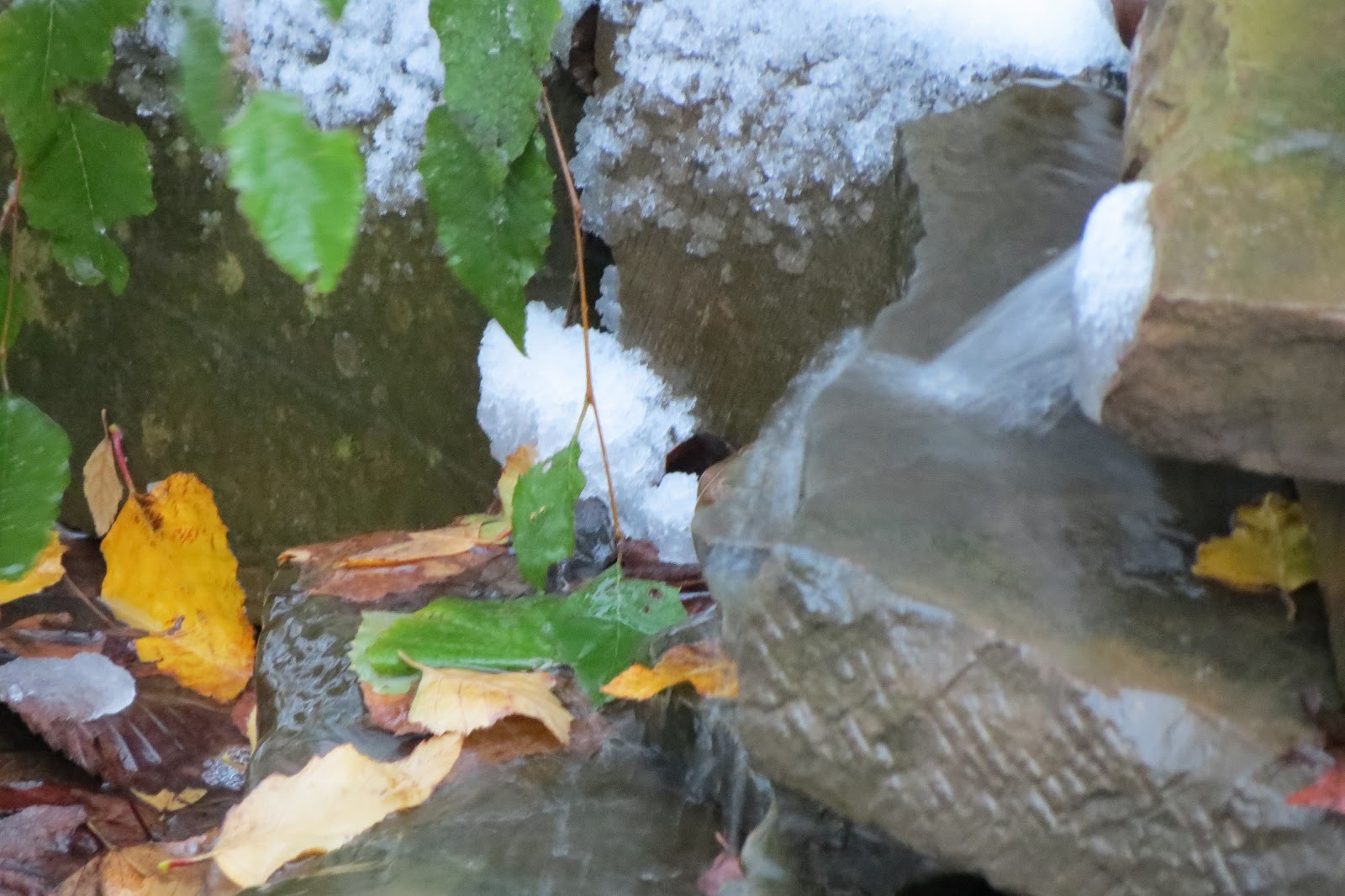
 Close up.  Water runs gently from the stones, creating a natural bathing location for the birds.

 The bird seed tray is filled with Pine Siskins this morning.  The snow doesn't bother them at all.

Hang on!  It is still mighty windy, little siskins.  The tray is rocking in the wind, but this northern visitor doesn't seem to mind.

The best part of bird feeding is the non-stop entertainment value on a winter day.  Birders get to reap the benefits of their landscape 364 days a year.  You can keep your big screen TVs, this is my "Home Entertainment System"!