Showing posts with label Ottawa National Wildlife Refuge. Show all posts

Saturday, March 26, 2016

Flora-Quest is All Wet in 2016

Swamp, marsh and bog are seldom epithets for locations considered travel worthy.  However, there are a myriad of interesting and little-known plants in these habitats.  Wetlands provide important filtering eco-services to our state’s water, not unlike the way kidneys function in a human body.  Much of that filtration is provided by emergent wetland flora, grasses and those little-known aquatic plants.  Flora-Quest is bringing the botanical experts to Lake Erie to provide a crash course workshop on “Wetlands.”

 Marblehead's Meadowbrook Marsh awash with fall color.
Lakeside, Ohio will be the hub for this adventure to be held Friday, September 30, 2016.  Featured speakers will include experts Jim McCormac from Ohio Division of Wildlife and Mark Dilley of M.A.D. Scientists.  They will help us learn some favorite wetland species and better understand the biological richness of life in our wetlands.

Field trips to botanical hot-spots and general flora tours of local wetlands are available.  Our forays are varied to meet every level of interest and ability.  Whether you are hoping for those gorgeous Fringed Gentians and Nodding Ladies’-tresses orchids, or rarities like Inland Sea-rocket our guides know the way.  Featured locations will include Meadowbrook Marsh, Lakeside Daisy Preserve, Ottawa National Wildlife Refuge, East Harbor State Park, and trips further afield for rarities at Sheldon Marsh or Castalia Rest Haven Wildlife Area.


Fringed Gentian is a "must-see" fall bloomer. 
Evening offerings will be a friendly meal, loads of comradery and special guest speaker, Jason Lewis.  As Manager at the Ottawa National WildlifeRefuge, Jason will help us understand the importance of Ohio’s only National Wildlife Refuge and the conservation and economic benefits it provides to us.

For those interested in extending the fun to a second day, Ohio Ornithological Society will be hosting their “Rally for Rails” on Saturday Oct 1st.  This not-to-be-missed event will bring in bird experts from across Ohio and beyond to peak into the secretive lives of these wetland specific birds.

To learn more about our Flora-Quest Wetland Workshop
                                                                          www.flora-quest.com

Registration opening soon!

Monday, February 1, 2016

Ohio's National Wildlife Refuge

The national news might have you convinced that America is almost a lost cause. Not true! If the political debates or racial injustices are getting you down, here is a flash of good news.

America was the first nation to ever set aside land for the people.  The National Parks are the people's parks. In the same spirit of preservation and protection for the enjoyment of future generations, America also set-aside National Wildlife Refuges.  These lands belong to all of the citizens of America and we all benefit from their protection.

Ottawa National Wildlife Refuge, Oak Harbor, Ohio
National Wildlife Refuges preserve dynamic landscapes set aside for wildlife and the enjoyment thereof.  Ottawa NWR is the largest wetlands remaining in Ohio. It was once part of a gigantic complex called the Great Black Swamp.  For millennia these wetland "swamps" have provided breeding, nesting and migratory passage stop-overs for hundreds of species of birds, mammals and even butterflies.

Welcome to Ohio:  land of commodity corn and beans.
Without protection, these vital wetlands which cleanse our ground water and provide habitat for wildlife would no longer exist.  Ohio has lost somewhere between 90-94% of our wetlands.  Some have been lost to development, but much of it was drained, tiled and tilled for agriculture.  It should be no surprise that our once common wetland birds and insects have suffered losses as a direct result.

Wetlands are not only for the birds.
The National Wildlife Refuges are lands all across our great country, providing eco-services for our wildlife and scientific research opportunities.  They are dedicated to connecting Americans to the natural wonders which were once common. Many of those species are struggling to survive. Too often they have become wildlife's last resort.  These refuges have become the Alamo of our last natural lands.

We cannot let greed or lack of awareness destroy the lands set aside and managed to provide habitat for wildlife displaced by development, cattle or corn. Yes, we need farms and cities to provide habitat and food for people.  But we cannot afford them at the expense wild species we have yet to study and barely understand. The lessons provided by these species should be early warning system for us.


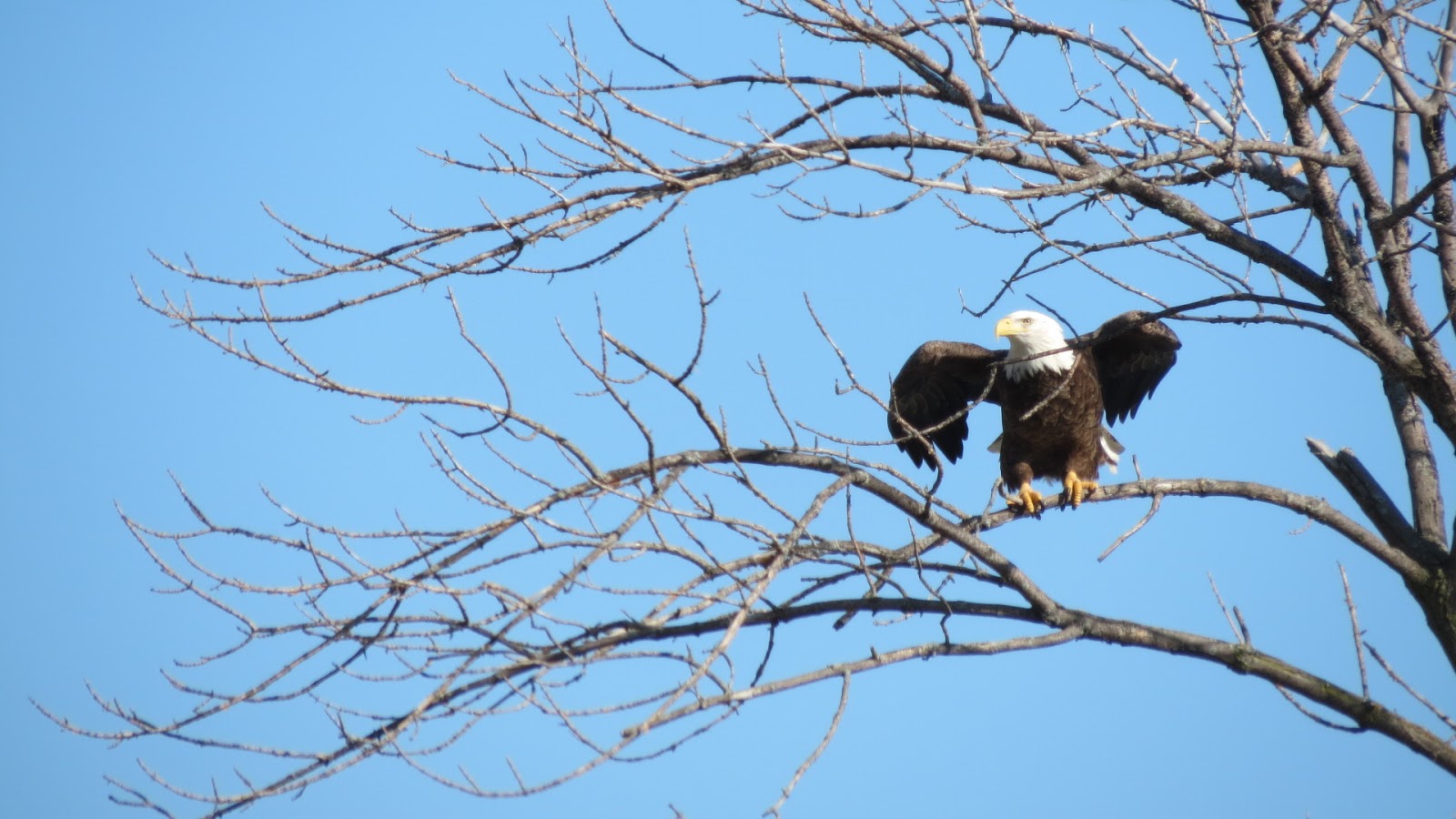
The lesson from our National emblem, the Bald Eagle:

Within my lifetime, we nearly lost the very species used to represent this great nation. How little we understood the impacts of DDT.  We carelessly spread it upon our lands and waters with no thought for the long-term impacts.  When scientists warned of the dangers, they were rebuffed and personally humiliated. We seem to reject the messengers of bad news, as if that could change the course of history.

Ohio was the epicenter in the reintroduction and study of Bald Eagles. We learned that the fragility of their eggs was caused by DDT and it was banned our farms and cities. Forty years later, we now have a thriving population of eagles.

Hopefully, today we better understand the implications of the chemicals we use.  Ottawa National Wildlife Refuge could rightfully be called "home of the screaming eagles" and a laboratory for the birds.  It is not just about hunting and waterfowl, but the hunters have certainly paid for much of those conservation lands we enjoy.

Bronze Copper butterflies are wetland specialists.
The our native Ohio vegetation is also protected by this great refuge.  Both the rarely known aquatic species and the terrestrial wetland gems that provide food for insects and seed for birds are found in abundance.  Therefore, our Ottawa National Wildlife Refuge is also is a hot spot for wetland butterflies and dragonflies. We have reports of the occasional rarities, too!  Few years back I wrote a blog featuring ONWR butterflies and you can find it at: Ottawa NWR: A Copper Mine
  • In the fall of 2016 we are planning a big botany and birding event to be held in Lakeside with field trips into the Ottawa National Wildlife Refuge.  So mark a HOLD on your calendars for Sept.30 - Oct 2.  You'll be amazed at what we have in store!

Tuesday, September 24, 2013

Altered Landscapes

Having just returned from Midwest Birding Symposium, it will take a day or two to process all the photos, unpack the bags and deal with life's pressing issues that were going on without me.  Work, speaking engagements and family life are demanding my attentions today.  However, I would like to offer two photos from my whirlwind week on the "North Coast."

Oddly enough, my two favorite photos speak of the man-made changes and the impacts of industry along our Great Lake.

The loading dock at Marblehead is bathed with moonlight. 
Upon returning to my dear friend, Dottie's lakeshore cottage after Saturday evening's program, we enjoyed the moonscape on Lake Erie.  The LaFarge-Standard Slag loading dock was bathed in moon light. Lake Erie freighters have been hauling stone out of Marblehead for a long as I can remember, but the lights on the loading dock seem much brighter than before. It is probably due to ramped-up gravel production and shipping, as well as modern day safety requirements.

Although it speaks of an industrial and altered lake shore, aesthetically it was pleasing.  True Marbleheaders (residents of Marblehead) are inured to noon-time blast "aftershocks" that rumble through the community each day, as well as the gigantic wheeled loaders' backing lights warning "beep-beep-beep" as work continues all night long.  

Davis Bessie nuclear power plant as seen from the Port Clinton Water Works Park.
This second photo was taken from the parking lot at Water Works Park in downtown Port Clinton, Ohio. We were gull watching and photographing water and shorebirds along the city beach when I snapped off a few random shots of fly-by gulls.  I can not say what atmospheric conditions occasionally make the islands or far off shore line look so close, but the views were exceptional on Sunday evening.  The surreal effect of the fly-by gulls struck me as a page from the Crossley ID Guide.

Crossley created a new sensation in guides when he photo-shopped various poses of birds, in varied ages and plumages, against a "typical" background. This would be the page on Ring-billed and Bonaparte's Gulls.

Unfortunately, this typical back ground includes the nuclear power plant that is considered a blessing or a curse, depending on the local to whom you speak.  The federal fines levied for an incredibly scary lack of maintenance and its cover-up allowed First Energy to pay for our new visitor's center at the Ottawa National Wildlife Refuge.  It is a sad way to get good accomplished for nature, but at least sometime nice happened after the lives of hundreds of thousands were put in jeopardy.  Click on the link for an amazing news article from the Toledo Blade which tells the whole story.

Meanwhile, enjoy these altered landscapes as best you can.

Monday, October 1, 2012

OOS Conference 2012

Birders and Lakeside- a match made in heaven.  The 2012 Annual Conference of OOS was held in Lakeside, Ohio this weekend and just one of the popular events was a breakfast with the birds.


Sunrise greets the birders at Lakeside, Ohio.  This fabulous breakfast was a joint effort of  Birding Ohio  Facebook group and OOS. It is good to mingle with fellow birders and share with friends.

Lukas Padegimas and Greg Miller- entertaining birders!
Lukas Padegimas  lead off the Friday evening program with a mind-blowing account of his summer surveying birds near the arctic. He is a young birder you'll want to watch, as he could be our next "Greg Miller!"  

Greg gave some fun commentary during the movie The Big Year. He has been a wonderful ambassador for the birding world and we are very proud he is one of Ohio Ornithological Society's founding board members.


Birding!  Of course, there was birding.  Saturday morning, birders thrilled to the opportunity to bird with Kenn and Kim Kaufman  (foreground-in gray) at Meadowbrook Marsh- a wetland recently conserved by the joint efforts of OOS, Carbon Offset, and Mid-West Birding Symposium.  Black Swamp Land Conservancy is doing the actual land conservation.  Kudos to Danbury Township for its foresight to set aside land for bird (and fish) conservation.

 The Ohio Young Birders will be doing their Big Sit!on this platform at Meadowbrook, and you can go here to donate to that cause.

Kevin Karlson, author of -"Visions: a Photographic Celebration of Birds and Nature"
 Kevin Karlson of Cape May birding fame is a reknown photographer and shorebird expert.  He gave two presentations.

The first,  Saturday mid-morning, was a review of "impressions" of shorebirds.  Forget plumage- Kevin says to look at the body structure of shorebirds to make your ID.  He has us all eager to join him on a beach at Cape May!

His evening keynote address "Visions: a Photographic Celebration of Birds and Nature" was both relaxing and inspiring at the same time.  His book is going on the top of my Christmas list!  (Did you read that, family?)

Ottawa National Wildlife Refuge, the location of our well-attended shore bird trip.
We are fortunate to have the largest area of wetlands in the entire state of Ohio as an active partner.  
Jason Lewis, Director at Ottawa is a powerful ally for birds (and butterflies!)  He has made the refuge more accessible and allowed great folks like Rebecca Hinkle, Sherrie Duris, Tom Bartlett  and others to lead educational trips into otherwise unavailable areas.  We appreciate this generous cooperation.


Native botany at Ottawa
Ottawa National Wildlife Refuge has a beautiful native garden filled with butterflies and pollinators! The birds "flocked" to this area while the birders enjoyed it during our lunch.  It is an excellent example of native plants in the landscape providing a function along with their form. 

Botany tip of the day:  Did anyone else smell the fragrance of Butterscotch? Those white Heath Aster Symphyotrichum pilosum have a unique fragrance you can use to identify them. Unfortunately, they have so many common names: Heath Aster, Frost Aster, Hairy White Oldfield Aster-you need the scientific name for the sure thing. 

Oh Asters, you just have to be confusing!