Showing posts with label Ohio Natural Areas and Preserves. Show all posts

Monday, September 29, 2014

ONAPA visits Lakeside

 Saturday the 20th of September 2014 was a big day for Ohio Natural Areas and Preserves Association.  Our second Annual Meeting was held in Lakeside, Ohio. This organization is only two years old, but it has grown by leaps and bounds!  We have amazing volunteers working in preserves and the backing of some very impressive scientists and educators all across our state- and beyond.

Mr. Allison Cusick gave the Keynote address.
 Retired Ohio Natural Areas and Preserves Chief Botanist, Allison Cusick, gave a rousing program on The New Sandusky Flora.

Besides being an excellent public speaker, Allison has also authored or co-authored 3 books. Currently, Allison is a Research Associate of the Carnegie Museum of Natural History in Pittsburgh, PA. This man has hardly retired!

 He encouraged us to  "lament what has been lost, marvel at what has persisted and cheer at what has been preserved."  We literally cheered for some plants during this program, as Allsion is a gifted orator who knows how to engage a crowd!

His program referenced E.L. Moseley's Sandusky Flora which cataloged the plants of the Marblehead Peninsula and surrounding areas at the turn of the century (1900.)


 There were displays by supporting non-profits, Ohio Ornithological Society and Mid-West Native Plant Society were both in attendance (special thanks to Julie Davis and Kathy McDonald.)

Kevin Sibbring visits the ONAPA display.
The ONAPA display (thanks to Jan Kennedy) was also present, and Lakeside's CEO, Kevin Sibbring attended the event and gave us all a warm "Welcome to Lakeside."

Black Swamp Bird Observatory's display.
ONAPA supporters Kim and Kenn Kaufman.
 My friends, Hugh and Judy Kolo-Rose brought along the BSBO display and offered an amazing selection of books for sale.


ONAPA's Silent Auction, was an outstanding success, thanks to the efforts of Mary Christensen and Katryn Renard.  A special thank you goes out to the generous people and companies that donated items to this auction.  You have been a great blessing to ONAPA, and we appreciate your kind support.

Guy Denny
ONAPA  President, Guy Denny, gave an overview of the year and the amazing things ONAPA has accomplished.  Of course, he wouldn't say this, but Guy is the glue that holds this organization together!  We appreciate all he does and the incredible knowledge of leaders like Guy, Dick Moseley, Jim McGreggor, Bob McCance, Tim Synder, Ray Heithaus, Jim Mason and all the other board members who attended (and those who were unable to be with us.)  They do so much to protect our natural areas.

One field trip was held in Lakeside Ohio along the Ohio's Most Beautiful Mile.
 Field Trips!  What would an ONAPA event be without free Field Trips?  Guy Denny led a group to Castalia Praire, while Dick Moseley led a trip to Sheldon Marsh.  Meanwhile, your blogger got to lead a field trip on the shore of Lake Erie in Lakeside, Ohio.  We had wonderful groups both Saturday and Sunday. We discussed the unique Carolinian Forest botany of Lakeside and visited many native trees and plants along the lakefront path.

The self proclaimed "Cane Brigade."
As always, when leading groups one often gets more than they give.  It was such an honor to spend time with friends on this beautiful shoreline to exchange information on botany and plant ecology.  But even more than that, I was reminded how important it was to have this simple offering available to some wonderful folks who would have physical barriers to enjoying the other field trips.  Lakeside lends itself to the enjoyment and education of people in all walks and ages.  It was a distinct honor to be able to share one of my favorite vistas with my botanical friends.

Thank you to everyone who attended and supported the Silent Auction.  You are making this state a better place by supporting our Natural Heritage!


Wednesday, September 17, 2014

September on Lake Erie

Having spanned the country and visited countless parks, forests, natural areas and sea shores, I can assure you, it is nearly impossible to find anyplace more beautiful than Lakeside, Ohio.


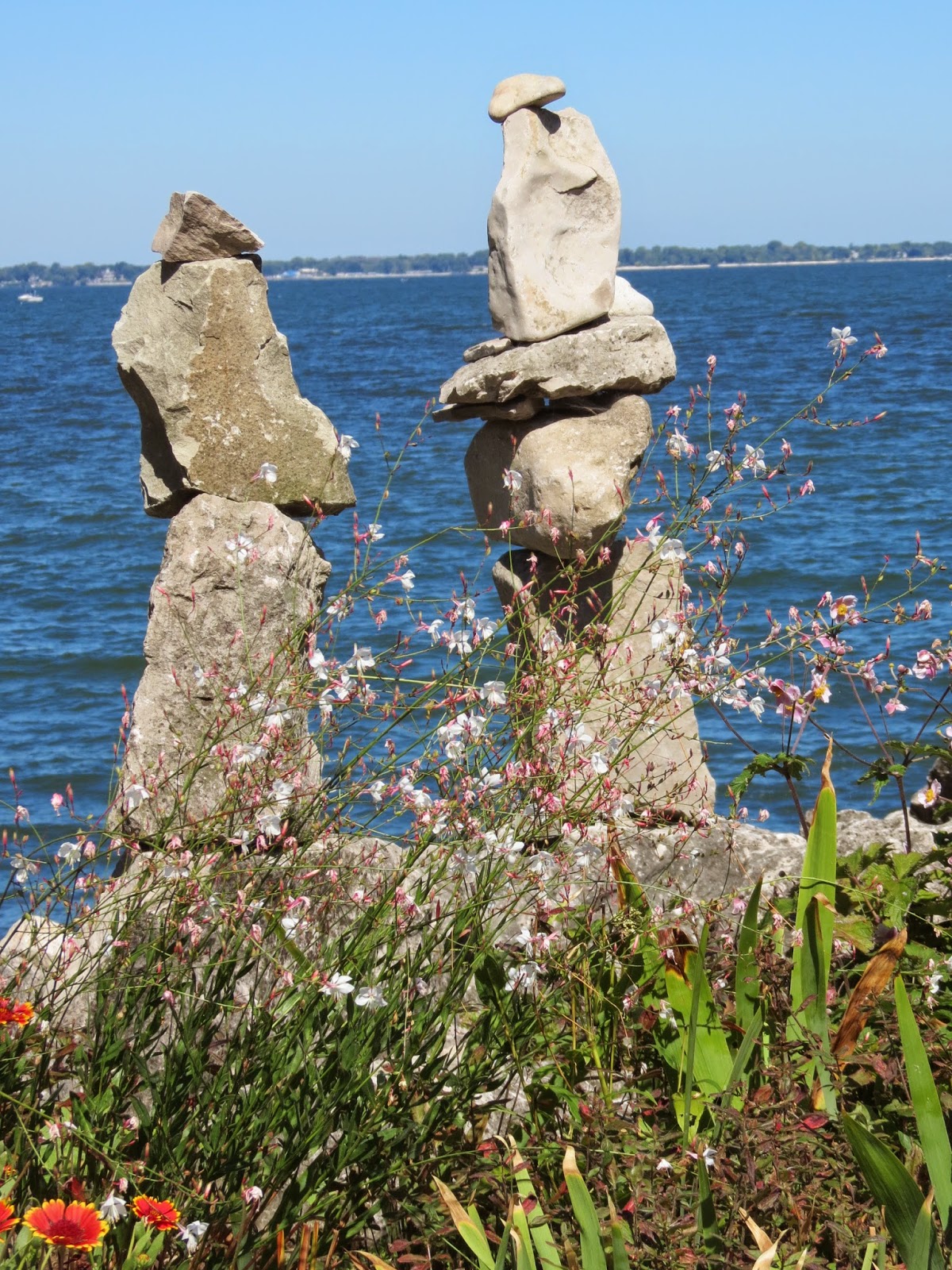
 There is something about this town. First it gets into your heart and then silently creeps into your very soul. The call of shore birds and gentle slapping of the waves speak to me.  The vista of Lake Erie's Islands, floral gardens and these playful stone cairns  delight the eye. They won't last for long against Lake Erie's storms, but they balance the joy of "today" against the "forever" of rock.

Jewel-weed, Impatients capensis  on the rocks.
Lakeside is well known for its history and architecture.  It is a gated community in the summer, where children rule the streets and ice cream is considered the nectar of gods. It is a Chautauqua, and I could probably devote an entire blog to that alone, if I have not already. 

But it has a compelling natural history as well.  For example, these orange flowers growing in wild abandon on the lakefront attract Ruby-throated Hummingbirds which visit them for sustenance on their migration south for the winter.


Lakeside's administration has turned a serious eye to this issue and is promoting native plants and the "natural look" of our great lake, Erie. The fall migration of birds and Monarch butterflies both pass through these historic grounds. Our wildlife will appreciate the consideration we are giving to milkweeds for monarchs and bee-balms for pollinators in general.

Our native plant enthusiasts should be proud of the on-going effort to select Ohio native plants for the restoration of the west end's lakefront.  I hope you will join me for the Ohio Natural Areas and Preserves Association's Annual Banquet and field trips this weekend.  Keynote, Allison Cusick will be speaking about our native Sandusky Flora, and we will be leading tours on this lovely stretch of Ohio's Most Beautiful Mile.


The gales of September on Erie.
 And "weather" it is windy or balmy, Lake Erie and Lakeside is always my favorite place to be each fall. Every moment is to be savored...


especially, during the sun sets.

Wednesday, September 12, 2012

Among the Ancients

We humans are are but short lived species, compared to some of the ancients on earth.  The term "Old Growth Forest" has many different meanings, but a general rule of thumb would be a forest that has attained significant age (pre-settlement in America) without significant disruption.  They are filled with ancient trees.

These forests are rare and unique communities, and probably less than 1%  of them remain.  Giant Sequoias certainly come to mind, but there are a few examples in our Eastern deciduous forests as well.


 Recently I have been entranced by this book listing 26 forests in the east.  You can believe I have map-quested my way to the ones within striking distance and have made plans to re-visit Ohio's representative in the book: Johnson Woods.  Yes, it is one of our Ohio State Nature Preserves.

 Joan Maloof, the author, gave a compelling program at last week's "Forest Management" seminar at Cleveland Museum of Natural History.  Not only is she a admirer of these big, bodacious trees, she is working hard to protect the last of our giants in arboreal natural history.

Old Growth Forests are rated as more beautiful.
Old Growth Forests are not only more beautiful, they are quantifiably more diverse and often protect unique organisms.  Is it any wonder some of our extinct or nearly extinct bird species (Ivory-billed Woodpeckers, Red-cockaded Woodpeckers, Black-backed Woodpeckers) prefer these- now nearly extinct forests?

But is not just beauty and diversity these forests add.  They are also good for our environment.  They have enhanced hydrology and are excellent at carbon sequestration. Both are huge pluses for a world undergoing climatic change. For a long time we thought young forests were better at carbon sequestration, because young trees take up carbon at a higher rate.  However, now we know due to their additional mass, old growth trees sequester carbon just as well.


Learn more about these forests and the goal to protect our remaining ancient trees.  Joan is quick to say she has “no problem with forests set aside for production.”   However, she also believes some
“public forests should exist for more than fiber and dollars.”  

Let's work to set aside ancient forest for our children's children.  These trees can easily outlive us, but only if we protect them now.  Go here to read more about the Old Growth Forest Network.  It is truly  America's Next Idea.

Tuesday, July 31, 2012

Ohio's Cemetery Prairies

As part of the Midwest Native Plant Conference, Jim Davidson and I led a field trip to two of Ohio's Natural Areas and Preserves, Smith and Bigelow Pioneer Cemeteries.


These historic relics mark time from white settlement of Ohio, gravestones mark the lives of our early pioneers.  Life was hard on these plains,  their short lives are inscribed on numerous family plot markers, many engraved with multiple children's names and dates.


Weathered stones still stand upon these two small plots of  land. The soil here has never been tilled; the original flora from pre-settlement still remains.  Standing like islands within fields of corn and beans, native grasses and flowers bloom all summer long. 


Shaded by giants oaks, a peace and solitude transcends the quiet paths,  only bird song and insect calls to disturb the settler's sleep.


 This year's drought has stunted the grasses, but a sea of  white Flowering Spurge, Euphorbia corollata dances in the sunlight and wind.


 The Purple Coneflowers, Echinacea purpurea are under siege.  Many of them have been stem-chewed, causing the flower head to dangle in death's repose.

A closer look at our Prairie Dock reveals the culprits,  wee beasties: Sunflower Head Clipping Weevils (Haplorhynchites aeneus) as seen in this photo. Their eggs, laid in the flower heads,  will hatch about the same time the flower finally drops to the ground.  To control this pest in your prairie or garden, simply remove all the clipped flowers, and you will be removing their eggs.  OSU's Buckeye Yard and Garden has a complete article on them here.

To see the cemetery in a previous year's post, go here.

From the giant oaks to the tiniest weevils, these prairies are important remnants from our past which need to be protected and preserved.  Please go to Ohio Natural Area and Preserves Association and volunteer today.