Showing posts with label Milkweed. Show all posts

Tuesday, March 1, 2016

2016 Monarch Update

Let's all take a moment for some good news!  

Too often environmental work is all gloom and doom.  Today we thank everyone for all the hard work, milkweed planting, caterpillar rearing, fall tagging and public education efforts on behalf of America's best known butterfly, the Monarch. A little congratulations is due.

Monarch in Richland County, Ohio
When it was first reported in the 1990's that the migratory Monarch was headed for trouble, we hardly believed it.  After all, they were so... common.  Sixteen years later, there was an entire summer in which I did not see one Monarch. Didn't we all wish we had taken more photos of them when they were abundant?

We stopped taking them for granted. In fact, many organizations rallied around the Monarch, calling for change.
Monarchs headed to Mexico roost at Whiskey Island, Cleveland Ohio.
Photo by Chuck Slusarczyk, Jr.
Keeping tabs on a butterfly population is difficult work. Winter is the best time to assess Monarch populations,  The winged ones gather in the Oyamel firs in the mountains of Mexico, where the entire migratory population can be counted as they rest.


This year's news from Mexico is finally good.  The numbers of wintering monarchs is at a five year high. But one good year means very little in insect biology.  We can't afford to stop now,  the job is not done.

A full report can be found at http://monarchjointventure.org/news-events/news/population-numbers-for-eastern-monarchs-increase-during-2015-16-season.


These striped caterpillars are the larva form of the Monarch butterfly.
Monarch conservation is rather complicated. They have four distinct life stages ( egg, larva, pupa, adult) and each stage has its own hazards. They are impacted by insecticides and herbicides.  Lawn care chemicals and mosquito sprays also put the smack down on them. They are subject to winds and weather.  These critters cross two international borders, in spite of walls and guards.

The effort across the borders to protect wintering habitats, and plant milkweed has certainly been key to their rebound.

A native bee pollinates this Butterflyweed, Asclepias tuberosa.
Our efforts on behalf of the Monarch are likely to pay off for all pollinators. Increasing milkweed and other native plants along roadside corridors and in natural areas could benefit all types of insects. As we continue to improve conditions for Monarchs, let's also remember to limit the other activities which endanger them.  Lawn chemicals and excess mowing have become a way of life for suburbanites, but they are not compatible with our natural world.  We have seen the true cost.

We need to turn the pages of time back only to the fifties, where ditches were filled with flowers and milkweed reigned.  Children still played outside and bees buzzed as the butterflies bounced from flower to flower.  We chased lightening bugs at night.

Technology is great, but we need to decide if our chemically enhanced lifestyle is compatible to the health of the world in which we need to live.  The insects have been trying to tell us something.

Monday, July 27, 2015

Midwest Native Plant Conference 2015

Having recently returned home from the Midwest Native Plant Conference in Dayton, I am excited to share news of all the fun and festivities!

One of the many native plant sales booth and a few of the conference organizers,
L to R- Judy Ganance, Kathy McDonald and Teri Gilligan.
NATIVE PLANTS: Everyone wants native plants.  It used to be so difficult to find them and virtually impossible to find knowledgeable sales people. Now it is shop-til-you drop natives all at one location!  Thank you from the bottom of my heart for this event with numerous vendors and an incredible selection of native plants.

The Bergamo Center's ground are the perfect location for this event.

DAY FIELD TRIPS at Bergamo: Brother Don Geiger (center) has been a major player in the development of this ecologically sound environment.  The Bergamo grounds hold many acres of native plantings and wood lots. It is perfectly suited to field trips- both day and night.  This photo is from a day-time nature walk lend by arguably Ohio's best naturalist, Jim McCormac (far right), and aided by Brother Don.


John Magee speaks on water features- and some native plants.
SPEAKERS: There are so many wonderful speakers and topics to choose from. The keynotes were author Don Leopald on "Native Plants for Sustainable Landscapes," John Magee (Magee Design) on "Water in the Landscape," and Kenn Kaufman of the Kaufman Focus Guides on "Why Butterflies are Better than Birds."

The breakout sessions make it harder on attendees- you have to choose! I didn't get to attend all the programs I would have liked, but here is a shout out to the excellent program given by Hal Mann, Erika Galentin, Michelle Banker, Jason Larson, Carol Mundy, Judith Nastlly and especially to new comer Bethanny Majeski. Her program on mycorrhizal fungus was amazing!

Thanks also, to the many folks who stopped by for my "Urban Landscapes- Life in the City." It was wonderful to see so many friends in the audience and their kind words were greatly appreciated.


Evening sessions: Moths were covered  by Elisabeth Rothchild and night singing insects are the domain of Lisa Rainsong.  These women are powerful educators and and they are helping people understand in importance of our insect world.

Common Milkweed at night.
 NIGHT FIELD TRIPS: This incredible plant is working a double shift. I have a whole new respect for milkweed, and I am going to make more trips out to my garden at night to learn about my own pollinators.

Moths encircled for your viewing pleasure.
 I have circled the night fliers on the same milkweed photo.  This was an eye opening experience for me and I thank Elisabeth for encouraging us in the field.  This was very timely for me as my newest garden at home is specifically for night blooming plants and pollinators.

Kenn and Kim = Kaufman2
FRIENDS and co-conspirators:  Midwest Native Plant Conference is a wonderful place to connect and share time with friends and like minded conservationist.  They may not even know they are fellow conservationist yet.  But if you grow native plants, you are my kind of people!

It is always a special treat to be with friends like Kenn and Kim Kaufman, Hugh and Judy Rose, and Jim Davidson. It makes the whole event feel like a family reunion.


Cecropia caterpillars at the Flora-Quest booth.

ORGANIZERS: Thank you to all of the organizers for the excellent program they bring to Dayton, Ohio. Most of all, a special thank you goes out to organizers Kathy McDonald (speakers), Yvonne Cecile (field trips) and Karen Arnett (venders) for making it easy for me to attend, with my caterpillar buddies in tow.

Wednesday, August 20, 2014

Re-thinking your lawn

 Today I had a marvelous time with the Ohio Association of Garden Clubs at their annual meeting, which was held at Mohican State Park Lodge. They asked for a program on attracting  critters into one's yard with native plants.  That happens to be my favorite topic!


 The program ended up entitled Native Plants Add Drama.  Believe me, they do!  I can hang out all day taking pictures and following the birds, butterflies and mammalian wildlife around in my yard.  It is an ongoing circus, and I wouldn't have it any other way.


This saying from "The Wild Ones" tells the tale best.  IF you don't have action in your yard, you need to re-think your plants and your chemical usage. One of my most requested programs is Butterflies as Bioindicators.  If your yard is healthy and chemical free you should be seeing butterflies.

Pipevine Swallowtail, Battus philenor philenor
 The latest hatch in my yard was Pipevine Swallowtails. But before one can have these lovely insects, you must have their host plant. I believe my pipevine is Aristolochia tomentosaGood thing I planted one several years ago and it now festoons the side of my barn.

Prickly-ash, Zanthoxylum americanum in seed
 Another unusual plant on my property is the Prickly-ash.  It occurs naturally along the edge of my woodlot, and is the host plant for Giant Swallowtails.  Imagine my surprise when I realized there was already a well established population right in my own yard!

Giant Swallowtail, Papilio cresphones
These seven inch beauties have two broods each year.  The early spring brood loves to nectar on my Azalea plants, and the second brood heads for the Purple Coneflowers. I also had a Giant nectaring on a Common Milkweed a week or so ago.  It is important to cultivate milkweed for Monarchs, but other species of butterflies and bees will use milkweed too.  It is a staple in my home's habitat and vital to Monarch conservation.


Thursday Aug. 21th at 7:00 pm I will be previewing a program Midwestern Monarchs at the Gorman Nature Center in Mansfield.  I will also give this program for the Cleveland Museum of Natural History's Conservation Symposium- The Point of No Return- on Sept. 5th.  They have a stellar line up for that event, and I encourage you to go the notice in the side panel of this blog, and follow the link to register.  There is a lot of information on Monarchs that has slipped past the general public and I hope you will join me for one of these programs.

Monday, July 21, 2014

Milkweed pollinators

Milkweeds are well known as the host plant for Monarch butterflies.  It is also an nectar source for many, many other insects.  This summer I have spent a lot of time in my garden monitoring my milkweed for Monarch caterpillars (none so far.)  The rewards for that effort has been witnessing a host of other amazing "bugs" in my yard and garden.

Giant Swallowtail nectars on my garden Milkweed patch.
This Giant Swallowtail butterfly was very fresh, nary a mar or mark upon it.  It must have recently eclosed from its chysalis. As a caterpillar this swallowtail probably fed upon the Prickley-ash in my yard.  By offering both host and nectar plants, my opportunities for butterfly watching and photography are greatly increased. Watching one of these seven inch large butterflies never gets old!

The Banded Hairsteak quietly goes about its business.
This Banded Hairstreak is a much, much smaller butterfly.  These diminutive insects require a good macro lens camera or a magnifying glass to identify.  There are numerous hairstreak species and the Banded is fairly common one.  It is a challenge sort hairstreaks to species. Advice to beginners: start with the size of the red and blue color cells.  They alone are often diagnostic.

Death trap to bees.
Common Milkweed (Asclepias syriaca) is a robust plant, so no whimpy pollinators need apply.  It has a nasty habit of capturing little bees in "leg hold" traps. The pollinia of the milkweed is sticky and can hold a weaker bee in place. Not all bees get trapped, but if you look at enough milkweed, someday you will find one of these little guys hanging upside-down.  I have never seen a butterfly trapped by this mechanism, so lepidoptera (the butterfly family) must be better suited for the pollination of milkweed.

What are you finding on your milkweed plants?
If you are interested in learning more about milkweeds or pollinators,  I highly recommend the Midwest Native Plant Conference.  You will hear extremely knowledgeable speakers from all across Ohio and beyond.

One of my favorite resources for milkweed and pollinator information is Bob Klips of OSU.  Please check out this link on Bob's Brain on Botany.  Bob is also a speaker at this year's MWNP conference.  See you in Dayton!

Wednesday, September 4, 2013

Where have all the Monarchs gone?

As the summer of 2013 winds down, a few things have become fairly obvious in the Midwest.  Monarchs have been nearly non-existent.  Ohio Lepidopterists have a strong core of citizen scientists tallying weekly butterfly counts.  None of my friends were reporting Monarchs in the early summer months.  I have seen only six Monarchs in all of Ohio this summer, and two of those were raised on my own property.

Easily the most recognizable  butterfly in the United States, our population of migratory Monarch butterflies is in deep decline. Not only are they suffering dramatic losses on their wintering ground in Mexico, our farm practices are decimating their chances for reproduction in the mid-west. 

Monarchs must have milkweed plants, and modern farming with herbicides, pesticides and fungicides have nearly wiped out Ohio's milkweeds, thereby striking a death-blow to Ohio's Monarchs.

Regal Fritillary nectars on Butterfly-weed milkweed (Pennsylvania.)
 Will Monarchs go the the way of Regal Fritillaries?  The most colorful members of the Fritillary family were extirpated from Ohio about 30 years ago; now one must travel to prairie remnants in Pennsylvania, Indiana, or much farther west to view this regal butterfly.


Prairies, filled with native grasses and flowering plants -including milkweed-  were once abundant in Ohio. However, we have lost 99.9 percent of Ohio's prairies to "progress", just as agriculture and urbanization have claimed most prairies elsewhere in the mid-west and west.

If we have lost 99.9 percent of our prairies, is it any wonder that we are losing our "prairie butterflies" as well?


Prairie soils are perfectly suited for crops of another grass: maize, or our modern day corn.  Unfortunately modern chemicals "weed" out the milkweed, unlike the corn fields* of my childhood Ohio.  Milkweed used to readily grow along the field edges and in the ditches along the road.  Now, it is only found in abandoned lots and butterfly gardens.

*The corn in my neighborhood is also terrifyingly silent this year.  Where are the crickets, grasshoppers, katydids and bees of my youth?  Monarchs may only be the first blow to the eco-systems in our region. 


Monarch caterpillar feeds on Common Milkweed in Richland County, Ohio.

There a several varieties of milkweeds, the host plant for Monarchs.  Their caterpillars thrive on milkweed in spite of the "milky" white toxic sap the plant produces to ward off other herbivores.

 No milkweed- no Monarchs. 

Bon voyage!  Safe journey to Mexico!
Most years in the past, many, many Monarchs have fed upon the nectar of milkweeds and laid eggs on my pesticide-free milkweeds.  This year, I have seen only two caterpillars.  I raised both of them indoors, away from predators.  Normally, I let nature take care of her own, but this year the Monarchs seem to need every break we can possibly give them, if we hope to have migrating monarch for future generations.  We may feel helpless to change the way farmers manage their lands, but we can still make a difference if we all do two very simple things.

1. Plant more milkweed in our yards and gardens. 

2. Stop using pesticides, fungicides and herbicides on your lawn and landscape.  It can be done, and you and the butterflies will be healthier for it.

Changing your own yard is the first step to changing the world.

Friday, July 26, 2013

Seney Michigan Monarchs

There is plenty of marsh, as well as dry land habitat at Seney National Wildlife Refuge in Michigan's UP.  I was particularly pleased to note the blooming Common Milkweed, Asclepias syriaca along the embankment. 

Common Milkweed in bloom attracts many insects.

This is the host plant of the Monarch butterfly.  The large pink-to-lavender flowers attract many pollinators and butterflies as a source for nectar, but the milky toxins in the plant stems protect the plant from most "grazers.'  


The Monarch caterpillar is one of the very few species of lepidoptera that can withstand milkweed's toxic load.  In fact, Monarchs are able to retain the chemical compound into their adult (butterfly) stage, rendering them unpalatable to birds and other predators. 

An adult male Monarch photographed at Seney NWR in July 2013.
The Monarch butterfly is indeed king of the butterfly world.  An individual monarch may migrate 1,500 up to 2,000 miles in its short life.  It is but one part of the migratory stream of butterflies which migrate north- as far as Canada, only to return to turn and fly back to Mexico to spend the winter.  It takes five full generations to make the round-trip.

The Monarch population has suffered devastating losses the last several winters.  Between horrific weather conditions and illegal logging operations, their wintering grounds in Mexico have provided little sanctuary. In fact, monarch migration is now officially listed as a threatened phenomenon by the IUCN. 

 Most butterfly enthusiasts  have barely noted a movement of monarchs in Ohio this year.  Fortunately, I saw at least 6 or 7 Monarchs at Seney and have great hopes they will provide offspring for the fall journey south.

Consider planting some milkweed now to help them on their return trip.  Join us at the Mid-West Native Plant Conference in Dayton this weekend, and you find loads of native plant vendors with the Milkweeds you want to grow.  I'll hope to meet you at my presentation on Lawns and Lawn Alternatives. 

You can make you back-yard more exciting than a alien-grass lawn; make it a wildlife habitat!

Thursday, June 21, 2012

Stream Side

With temperatures cranking up to the 90's, today I decided to do something terribly un-American.  I turned off the air-conditioner and wandered  outside to plunk myself down in the stream.


Having spent much of the day reading a book about our "growth" economy,  I have to recommend Deep Economy  by Bill McKibben.  He had me thinking deeply, in particular, musing over the concept that  "money consistently buys happiness.right up to about $10,000. per captipa income, and after that the point of correlation disappears."  


Seems that a booming economy doesn't really predict happiness. Good health and nature are more likely to  enhance your well-being.  No surprise there.

 I  soon remembered, as a child, nothing made me happier than sitting by (or better yet in) a stream.  I resolved to put to practice this practical knowledge and cease my carbon consumption for a couple of hours.  
This is the creek-side philosopher's equivalent of stop the world- I want to get off... at least for a few hours.


The fishes swam about my feet, and I waded underneath the new bridge.  The county replaced our old  metal one (that the Phoebes loved) with a slick-sided, concrete monstrosity.  So I vandalized it last year... just a little.  I glued nesting shelves onto the walls in hopes my favored birds would return.
A new nest with a green mossy lining and  delicate white eggs suggests my "evil" plan worked.  

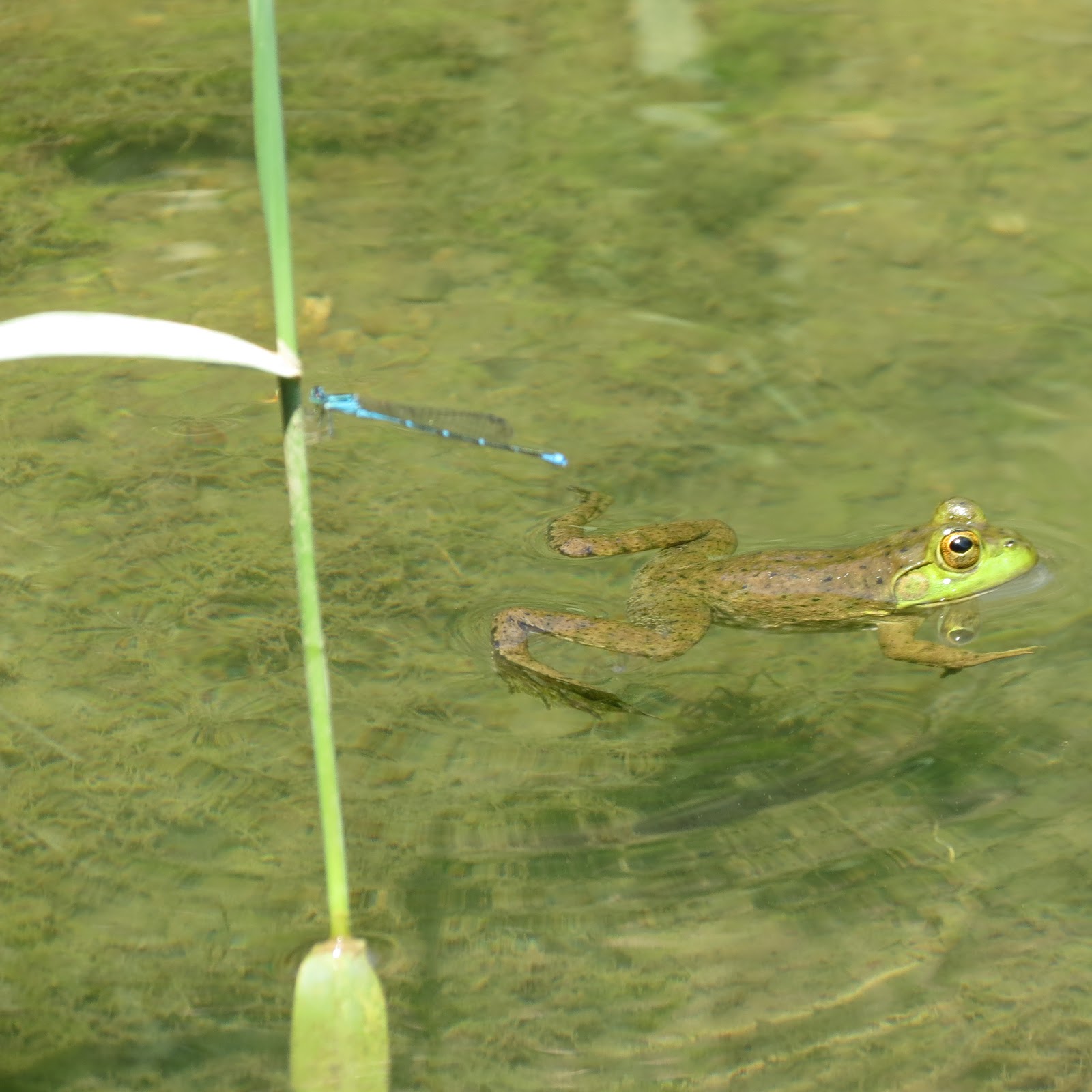
 Nearby a Stream Bluet damselfly rested on the blades of  reed canary grass...

                ... a bit too close for comfort, sits the green frog.


The steep banks support a fine crop of Milkweed, and the Monarch seem to approve. This one fluttered along nectaring on the sweet honey scented flowers.

My bank side stroll produced a well-concealed nest, woven neatly into a Joe-Pye-Weed.  I didn't get too close for fear my scent-trail might give the location away.  After all, raccoons visit this stream too.

A terrible ruckus was being made, suggesting this handsome Red-winged Black Bird is the proud pa-pa.  He bobbed and weaved, riding the wind currents atop of the sapling, as skilled as a hang-ten surfer.


And the sky was so blue.

The whole exercise makes me agree,  I should spend more time at a frog's-eye view of the creek.  It is certainly more sustainable, and guaranteed to use less energy: both carbon fuels' and mine.