Showing posts with label Honeysuckle. Show all posts

Monday, October 28, 2013

The Kill and Grill


It is not quite a scary as it sounds, we only "killed" invasive honeysuckle plants.   The grilling followed. It was a combined service project for some bio students from Wilmington College and the fabulous Cincinnati Wild Ones! 


 Ellen -the only student's name I successfully remembered- and some fellow students really went to work on the Caesar Creek Gorge invasive honeysuckle. They were an amazing team.

 The guys were cutting and treating the stumps with chemicals like old pros!

 The chemical treatment had a blue dye in it, so we could tell what we were spraying.  The ultimate goal is to treat only the stumps and not a lot of the surrounding vegetation.

Christine Hadley and Jim Mason

Thanks to some professional help and backing by the Cincinnati Native Plant Society, the tools and chemicals were provided by Jim Mason with help by Christine Hadley.

I guess I have failed blogging 101, because I did not get good ID photos of honeysuckle or the piles of the plant cuttings we left behind.  All I can say, I was impressed.  They students pitched in and did a mountain of good work, and were some of the nicest and most intelligent  kids you could ever want to meet.
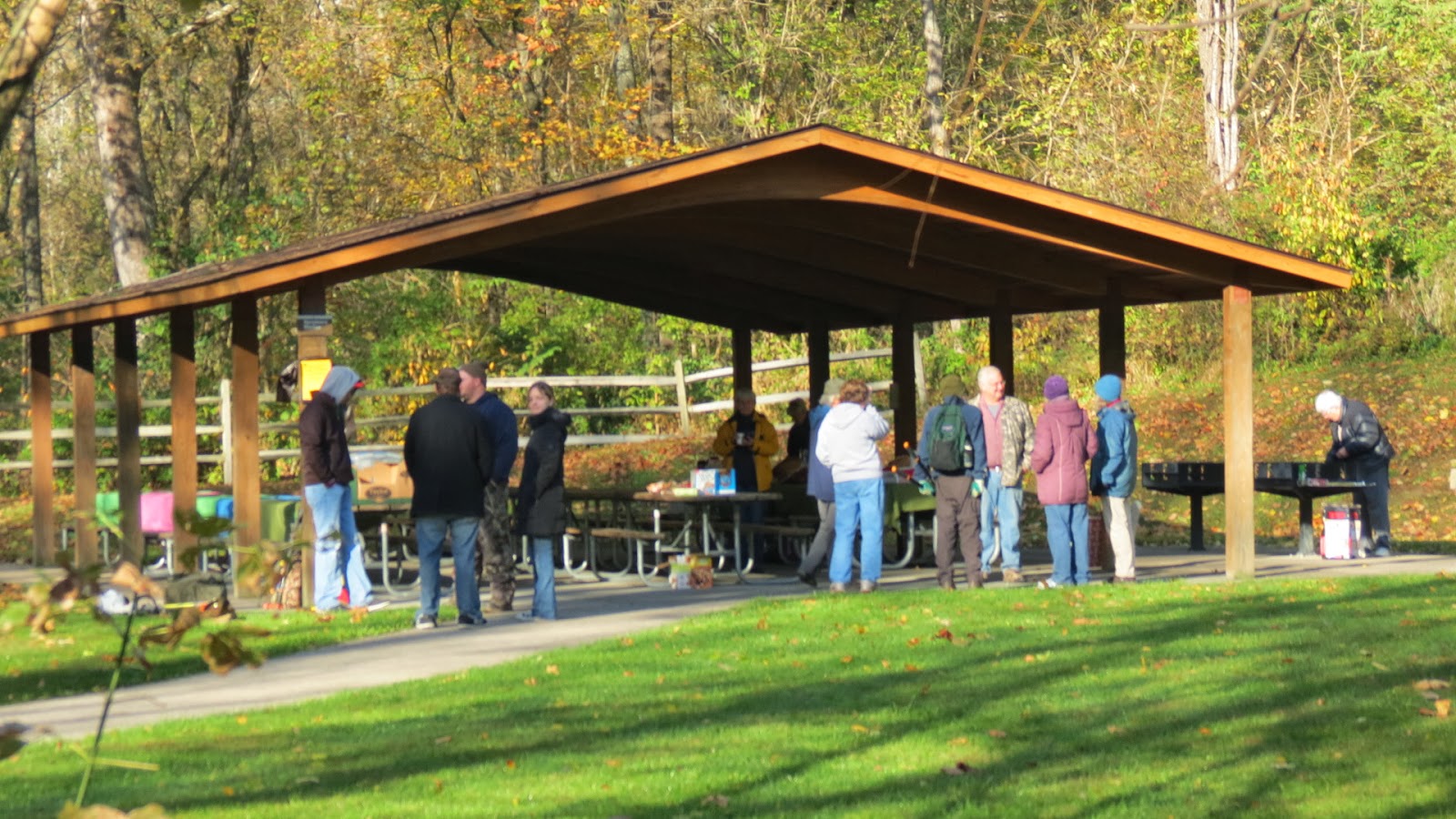
 The "grill" portion held at the shelter house followed the morning "kill".

 These fellows dove right in.  I can assure you the food was great!

Debi Wolterman
 Here is the dynamo that organized the event, Debi Wolterman.  Thanks to her, the native plants at Caesar Creek have a little more elbow room to grow, now that the invasives have been removed.

Chris McCullough, Sandy Seiwert , and Barb Stiglar

The food was prepared by the members of the Cincinnati Wild Ones. We sure appreciated all they did, too!

Cincinnati Wild Ones is an extraordinarily active group who have hosted many educational events as well as the Midwest Native Plant Conference.  Special thanks to Kathy McDonald and Ned Keller for inviting me along!

We are excited to see similar events spreading across the state!  What area would you like to see rid of invasive plants? Another event is scheduled for November 2nd, 2013. See the details below.

             ____________________________________________________________


Please contact Christine Hadley, president of the Cincinnati Wild Flower Preservation Society (founded in 1917 by Lucy Braun), at 513-850-9585 or email christinehadley@earthlink.net for information (See the list of volunteer tasks below.)
Volunteers needed for this day are:
*        Crew Leaders for honeysuckle removal teams
*        Honeysuckle Cutters: (Loppers, bow saws, non-power equipment)
*        Chain Saw Operators (must be pre-registered)
*        Steel Blade Trimmer Operators
*        Cut Stump Treatment (using spray bottles)
*        Registration: meet and greet participants
*        Lunch Crew: setting up tables and chairs, minimal food prep
*        Couriers: taking teams to their worksites
*        Plant ID: botanists and other knowledgeable volunteers to help cutters ID invasives and avoid cutting desirable plants, i.e. hydrangea, blue ash, spice bush, etc.
*        Rock Outcrop Specialists: volunteers with the agility to easily maneuver the rocks in the gorge to cut and treat woody invasives in, on and around the rocks. (Most areas are much easier to work than the rock outcrop areas.)

Bring your favorite tools of the trade: gloves, pruners, loppers, saws, trimmers and protective gear for power equipment. We will have tools and safety equipment for all those new to the volunteer effort conquering the alien, invasive, amur (bush) honeysuckle. Spray bottles and gloves for cut stump treatment will be furnished.
There will be an area available for your organization’s table display and literature.
Directions: Clifton Gorge SNP is located in Greene County on State Route 343, 3 miles east of Yellow Springs and 0.25 mile west of Clifton at the east end of John Bryan State Park.

Christine Hadley , President, Cincinnati Wildflower Preservation Society
513-850-9585 or email
christinehadley@earthlink.net ,    www.cincywildflower.org

Wednesday, May 30, 2012

Scent-uous Plants

Late May and early June serves up a special temptation for gardeners, exotic scents.  These heavenly fragrances can make one long to forget the issues surrounding invasive species, and give into to their spell.

The heavy perfume of a Japanese Honeysuckle, Lonicera japonica begs one to pull a flower from the vine to taste its sweet nectar.  No wonder hummingbirds and moths are attracted to this non-native.  It smells absolutely...de-vine.  Who knew it would try to eat the landscapes of southern Ohio with the vigor of a Kudzu?  It is listed as an noxious weed in Texas, Illinois and Virginia.  You know it is a problem if Texas doesn't even want it.  

 Dame's Rocket, Hesperis matronalis is Garlic Mustard's pretty cousin.  It is considered invasive, but it is easy to fall under the spell of  its jewel-colored charms and sweet fragrance.  After all, it really isn't that invasive, is it?  Lie to yourself all you want, but the purist avoids this lady of the evening.  Yes, her scent is sweet and she is charming in a cut-flower bouquet.  But, once she moves in it may become difficult to rid yourself of her at a later date.


A Cloudless Sulphur nectars on Dame's Rocket at Magee Marsh.
 Dame's Rocket invades native places, especially enjoying a damp-ish spot in the dappled sun.   The boardwalk at Magee Marsh Wildlife Area even entertained a small population.  It is difficult to dislike a plant when it is a nectar source for an unusually early wandering Cloudless Sulphur butterfly.  Both the plant and the butterfly were May records for in this north western Ohio location.  It is hard to think a plant this beautiful could be problematic, but it is banned in both Connecticut and Massachusetts.


Multiflora Rose, Rosa multifora is an insidious devil in Ohio.  Once promoted by the U.S. Soil Conservation service as a hedge row for erosion control and living fences, this fragrant beauty has worn out her welcome.  Shown here at Magee Marsh, it rapidly spreads by the fruit-loving-bird vector.  Once believed to be sterile, the avian species have proven otherwise.  But even as I loath its thorns and the tangles on the landscape, I can barely help myself when I smell its sweet perfume.  Oh devil, your sweet smell belies the terror you inflict upon property managers.

Is it any wonder that the most noxious of invasive plants smell the sweetest?  Perhaps, as put forth in Michael  Pollan's book The Botany of Desire, these plants are cultivating us.  Do they use their beauty and sweet scents to entice gardeners to grow the very plants we will curse and attempt to eradicate in the future?

Ah, perhaps we smell a successful ploy for self-preservation?  Maybe these invasive species should make one wonder who is cultivating whom?