Showing posts with label Guy Denny. Show all posts

Tuesday, July 7, 2015

Landscape Gardening and Native Landscape Design

It is no secret that Lakeside on Lake Erie has one of the most beautiful lakefronts in Ohio, if not the entire United States. They have officially declared the one mile stretch of walking paths "Ohio's Most Beautiful Mile." Against the back drop of idyllic lake scenes and sailboats, lie the parks and the shoreline of landscape plantings. It is easy to understand why we love Lakeside and why artists and photographers are compelled to capture its beauty.

Lakeside's Beautiful Mile- Photo provided by Lakeside website.
It is no wonder people came from all across Ohio to the gardening symposium, Painting Ohio in Broad Brush Strokes.  Lakeside was the ideal location to study landscape design and the new movement toward a new Naturalism, as seen in Europe.

Dewey Hollister, Hope Taft and Guy Denny
The program kicked off with three people who have made real strides in adding native plants into the landscape at the Ohio Governors Heritage Garden.

Former Ohio First Lady Hope Taft came up with a marvelous idea to show case the best of Ohio's floristic bounty into sectional gardens at the Governor's residence.  She enlisted landscape designer Dewey Hollister and native plant expert Guy Denny to create a Heritage Garden.  It is open for tour- just tap on this link http://www.governorsresidence.ohio.gov/home.aspx for details.  Hope is an amazing force for nature and still remains active in the development of the landscape gardens at the historic Ohio Governor's Residence.

Amanda Patton Garden designer from the United Kingdom
Lakeside, in conjunction with the Ohio Governors' Residence, hosted a tour which allowed Amanda Patton to travel with this special event.  Amanda gave four educational programs in all, entitled Towards a New Naturalism: All Gardening is Landscape Painting. She described the parallels between art and landscape design.  One should develop a landscape using the principles of good art design and the elements which guide those principles. Art based landscapes have balance and are pleasing to the eye.  The Fibonacci Sequence, the Golden Ratio and focal points matter. Artist Luca Pacioli said, "Without mathematics there is no art."

The second day of lectures focused on creating natural gardens and illustrated many examples of contemporary works in Europe.  It was interesting to see our prairie landscape being utilized in landscape design an ocean away. I highly recommend browsing Amanda's website  for more examples of this exciting trend http://www.amandapatton.co.uk/portfolio/.
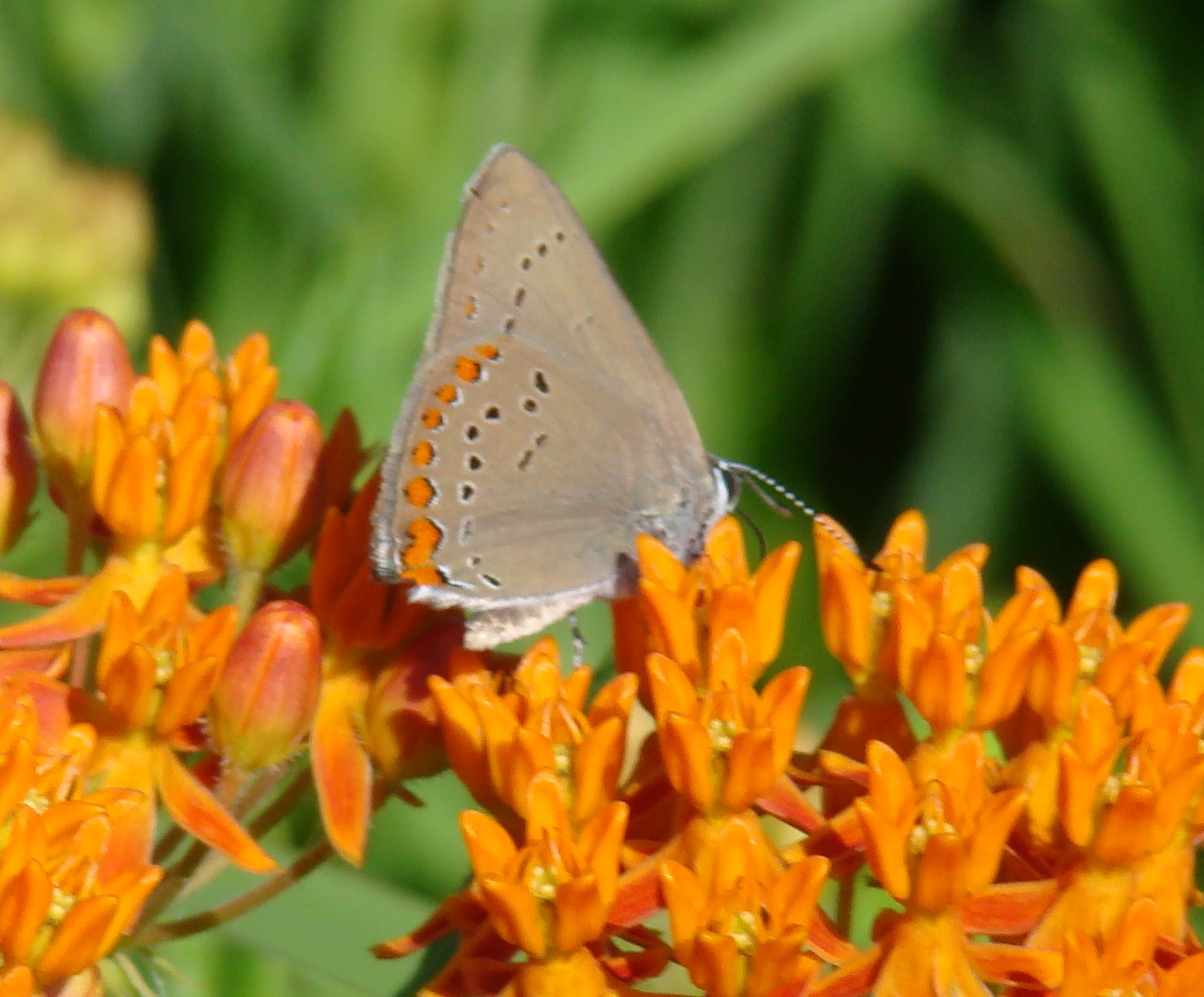
 Coral Hairstreak nectars on Butterfly-weed.
There are many benefits to this new naturalism and native plants in landscape.  Nature make us feel good.  Native plants are more sustainable and they sustain the fauna which we enjoy. They are environmentally beneficial and require less labor to maintain. 

Part of the event include field trips to natural areas like Lakeside Daisy preserve, Castalia's Prairie and Sheldon's Marsh.  These places are all wonderful examples of of Ohio's best Natural Areas and Preserves.

Lakeside boasts of many flowering hydrangeas.
During the course of our many walks we admired the landscapes and plants found within Lakeside. At one point,  Dewey Hollister had a realization about the lovely hydrangea species growing within the gated community, and perhaps unknowingly, how the good people of Lakeside have preserved them for prosperity.  We'll discuss these hydrangeas in a future blog. For now, let's just admire one of the many pollinators that was gathering sustenance at its fertile blooms.


Thursday, May 15, 2014

Flora-Quest invades Marblehead

It was a perfect time to pair two of my great interests, Flora-Quest and Marblehead, Ohio.

This was our eighth year for Flora-Quest and it was time to change things up.  Coincidentally, May 13th was also the 25th anniversary of the dedication of the Marblehead Lakeside, Daisy Preserve.  Perfect timing for a pairing.

Lakeside Daisy Preserve in full bloom on May 13th, 2014.  Photo by Paula Harper
Back in 1988 the rarest flower in the United States- Lakeside Daisy, Tetraneuris herbacea- acquired its own preserve carved out from quarry land.  This seemingly unpretentious yellow daisy is only found naturally occurring in Marblehead/Lakeside Ohio and in Ontario, Canada.  It is a globally rare flower.

Lakeside Daisy was named for the town of Lakeside on the Marblehead Peninsula. Photo by Paula Harper.
For a few short weeks around Mother's (early May) these daisies turn the preserve's rocky ground into a carpet of gold.  Except for some stunted Red Cedar trees, this gravel lot looks more like a place to park than a habitat for unusual botany.

Dick Moseley tells she history of the Lakeside Daisy Preserve. Photo by Paula Harper.
 Flora-Quest gets the most knowledgeable guides to lead our trips, and this year was no exception.  The daisy preserve had three excellent guides: Dick Moseley, retired Director of Ohio Division of Natural Resources.  Allison Cusick is the retired Ohio Heritage Botanist, and Rick Gardner, the current Ohio Heritage Botanist, led our tour.

Guy Denny was prepared to lead trips into real adventure. Photo by Paula Harper
 Guy Denny, past Chief of Division of Natural Areas and Preserves is also one of our guides.  These leaders have a life-time of experience in interpreting naturals areas.  People love to learn from them.

The Monday morning field trip to Meadowbrook Marsh.  Photo by Kevin Joyce.
 We had a botany/ birding trip to Meadowbrook Marsh.  Jason Larson (yellow shirt) and your blogger (coral shirt on right) had more fun than should be legal.  We both like birds and botany, although he probably missed the other "Sunshine Boy," Pete Whan.  Jason and Pete led the popular Flora-Quests to Adams County for several years.

"Miss Paula" Harper brandishing her umbrella. Photo by Cheryl Harner
 Jason steps up to do his guide duties and tells a bit about the American Bladdernut, Staphylea trifolia  growing along the parking lot at Meadowbrook.  It is one of our under utilized, decorative native shrubs. Paula wasn't actually poking him with that umbrella, although the photo does look incriminating!

Allison Cusick gave an excellent program on  "What is an Alvar?"
 Our lunch time meals were a welcome retreat from Monday's rain and Tuesday's heat.   On Monday, Allison Cusick, the retired Ohio Heritage Botanist kept us enthralled with his story-telling ability and tales from Marblehead's glacial impacted topography. He also gave brief accounts and locations of the very few other alvars in the world. So how do the glacially scraped surfaces of an alvar differ from a parking lot? They are likely to have plants, very rare and stunted plants.

Doty Twyford, long time Questor in front of the Marblehead Lighthouse.  Photo by Paula Harper
 Many of our questers ended the workshop at the most photographed location in Ohio: the Marblehead Lighthouse.  Built in 1821 by the Kelley brothers from Sandusky, our longest operating light on Lake Erie is a popular tourist gathering.

Looking out from the rail surrounding  of the beacon.  Photo by Ian Adams.
It was a special occasion to have the lighthouse open for tours, and Ian Adams participated in Flora-Quest by giving photography tips to the eager questers.  The 80 degree weather and bright sunshine made for a welcome surprise in May.

All in all, the event couldn't have been any more fun or successful, and we thank our partners, sponsors and patrons for making Flora-Quest the place to be in May.

Wednesday, July 11, 2012

King of the Prairie and Butterfly Eco-tourism

Eco-tourism is big business.  It can improve a local economy and entice communities to protect nature- once they realize its economic value. Consider the Monarch trips to Mexico, birding trips to Costa Rica or locally, the Biggest Week in American Birding and Flora-Quest are are good examples of how nature travels are economic boosters for small communities in Ohio.


IF you have an interest in butterflies- THIS is the program you need to support.  The Regal Fritially Tours  are offered 4 DAYS only each year at Fort Indiantown Gap, Pennsylvania.  They are held by PA Wildlife in conjunction with the National Guard.

The people come in droves!  After signing a few papers to remind you that you are on an active base, with active ordinance (live ammunition), we carpool out into the field where the flutterbys await!

 Wildlife program Manager, Joe Hovis  gave us an excellent run-down of the life history of the Regal Fritillary and the land management at this base designed to enhance the frit population.  They have something very special here, and they are working hard to preserve and protect it.

 A mega-bonus: in your face views of the bugs.  Since we are not allowed to enter the fields (KaBoom!) the staff has scouted ahead to procure an up-close sample for us.  This was an expected benefit of this tour, and no butterflies were harmed.  It was strictly an educational presentation and release.


There were plenty of opportunities to photograph butterflies
(at least 17 species!) from the safety and comfort of the road.  Expert lepidopterists and local families blended together on this tour.  There was something for everyone!

Nick, a land manager for the Fort, discusses the grassland management with Ohio's Guy Denny.  We learned much about the regal Fritillary and the role disturbance plays in the preservation of this endangered (in Ohio) butterfly.
" Regals love ranges," say their promotional materials.  In fact, violets love ranges and the Regals love violets.  Disturbance, ie.  fire (historically caused here by live ammo) and big military equipment (like tanks and half-tracks) running around, tears up the grasses- creating habitat for violets.  Without disturbance the grasses soon close in on the violets and crowd them out.


Now these areas are managed with a series of techniques to enhance Regal's habitat, and  Regal larva are being raised to repatriate other landscapes in Pennsylvania- like the Gettysburg battlefield, a National landmark.   Regals were once common there, but the populations died off- as fire has not been a component of the landscape management at that park.  We need to look at the big picture for these butterflies, to understand how to protect and preserve some pockets of their populations for the future.

The winner: the Regal Fritillary and the people who come to visit.  Help protect this rare butterfly by planning your 2013 trip to Pennsylvania to see this majestic King of the Prairie.  You will be impressed with the excellence of this program and the knowledge of your guides.

Sunday, July 17, 2011

Family Farm Field Day

Yesterday was much like an opportunity to visit times past, as this idyllic scene unfolded near Sugarcreek, Ohio.

Hundreds of horses rested in the shade, freed from their burden of buggy and riders. Pony carts, family buggies, work carts and a battalion of abandoned bicycles lined the farm lot in Amish country.


The excitement was almost palatable, as the families and older children raced to the tents. There would be food, exhibits and games. Speakers for the grown-ups. A live llama, chicks hatching from eggs, a leaf and seed collection, bird and bug displays... a world of excitement!


The big tents circled on an open field, with wooden playground equipment taking an honored spot in the center. I would love to show more pictures of the scene, but for today you must use your imagination. With somewhere around 1,500-2,000 Amish folks gathered, there was no way I could take photos without infringing on their hospitality. I was a guest, it would be beyond rude to take photos as if I would studying some alien species. It is not proper.


This gathering would be the equivalent to an Amish state fair, without competition. No ribbons, no dog and pony shows. These are simple, plain people after all. So imagine your county fair without the lights and rides, and add in nature displays and walks through a wetland. Yes, there was food, but the lines were too long to get to the pie. Fortunately, the tent with homemade ice cream made up for it.


Several things come to mind when I have spent an afternoon with this Amish community. Children seem to be well appreciated here- however they know their place. Children gather quietly and respectfully, and I have never seen pushing, shoving or angry words. Of course, there is a bit of shy curiosity, as we "English" are the strange ones in this gathering. These small children have grown up speaking "Dutch" and for the most part, only speak when they are spoken to.
We spent much of our time in the "Nature Tent" where people gathered for trips to the back lot trail through woods and wetland: Birding with Ed Schlabach, Nature with Guy Denny, Dragonflies with Ian Adams, Wetlands with Don Beam... to name a few.


It was my good fortune to be asked to tag along with Guy Denny's Nature walk. I made myself useful near the back of the walk, where I could talk to the women and children. Many of them enjoy watching birds at their feeders at home and growing plants in their yards and gardens. We had much in common to talk about.


Guy Denny, retired Director of Ohio Division of Natural Areas and Preserves, and Don Beam of Stucker Meadows Native Plants discuss the lay of the land and the sightings of the day. This was one of the few places I felt comfortable with my camera- in the nearly empty car parking area.

We also spent a bit of time with good friend Ian Adams, an amazing photographer with several books in print. Ian was leading the Dragonfly walks, as he is not only a gifted photographer but also an excellent birder, butterfly and dragonfly guide.


If you are not familiar with Ian's work- you should immediately go here to order your copy of his newest book. It is filled with lovely images of many of my favorite places in Ohio and tips for getting the photos in many of these locations.


I'll leave you with Ian's image of one of my favorite locations in the world: the Marblehead Lighthouse, and the good reasoning of a man who loves this book, even though he is not a photographer.


"A photographer's guide to Ohio is written to help photographers improve their camera skills, but I treasure it most for its beautiful illustrations. Typical Ian Adams- a superb book."


David Kline- editor of Farming magazine (and organizer of Family Farm Field Day.)

Wednesday, July 13, 2011

Planning a Prairie


  • The recent Midwest Native Plant Conference provided some excellent speakers, and opportunities for learning from some of the top botany experts in Ohio. Guy Denny spoke on "Tall Grass Prairies" and gave us a "Recipe for a Prairie."


Purple Coneflower, Echinacea purpurea with Question Mark butterfly posing on top.
Guy's home prairie is a beauty to behold. He artistically stages the grasses towards the center and the edges consist of repeating waves of Purple Coneflowers. Not only is it appealing to the eye, it is appealing to the butterflies as well.

Acres and acres of breath-taking beauty. But prairies are not only beautiful, they are practical too. Guy pointed out several benefits during his program:


  • Sequesters atmospheric carbon dioxide


  • Sequesters atmospheric nitrogen


  • Increases organic matter into the soil


  • Stabilizes the soil


  • Increases rain water absorption


  • Provides critical wildlife habitat


  • Increases ecological diversity


  • Enhances the beauty of the landscape

    So if you are interested in attracting beautiful creatures like Slaty Skimmers...

..or in providing habitat for rarities such as Duke's Skippers. You may want to visit a few prairies this summer to get a feel for the broad brush stoke of native plants.


But be warned: visiting prairies can become habitat forming!

Sunday, July 10, 2011

Queen of the Midwest Native Plants

Just sorting through my 6,000 photos from the Midwest Native Plant Conference and hope you'll enjoy seeing some of the highlights. It was a madcap time with tons of good friends, fabulous speakers and loads of hard-to-find native plants for sale.

Queen-of-the-Prairie, Filipendula rubra

Queen-of-the-prairie was the plant of the year for MWNP 2011. A perfect selection, too. I bought yet another for my yard!

This year seems to be a banner year for this 3-4 foot tall blooming mascot, and the ones I saw at Beaver Creek Wetlands were in peak form.

Brian Jorg, from the Cincinnati Zoo, gave the Friday evening program. Brian travels extensively to see the rarest of the botanically rare. We were treated to some of his best photos and a whirlwind tour of the midwest's orchids.


And yes, he had photos of Cypripedium reginae, Showy Lady's-Slipper and some other orchids that are currently blooming at Cedar Bog. Several of us visited bog/fen today, but that story is for a later post!


Steve McKee and Jim Davidson

(Shown here with a sound amplifying devise to help with those high pitch insect calls.)


Steve and Jim both gave programs and led field trips for the conference. These two are the best mentors one could ask for! Steve gave a wonderful keynote presentation on "The Botanical Detectives." His sense of humor and botanical encouragement are perfect for empowering beginners (like me!)


Jim Davidson is my go-to-guy for all things butterfly. His program focused on butterflies and the native plants they use as host plants.


Jim McCormac and Guy Denny


Two more of Ohio's best botanical minds! Jim, who is also an expert birder, gave an inspired program on Hummingbirds and pollination. Guy, who could be the King of Ohio Prairies, spoke on tall grass prairies and how he planted his. We can probably cover a bit more of that in an upcoming post as well.


Thanks to the many tireless folks who put this program together, it was an outstanding event once again! I will look forward to planting my many new plants this week, and know we will be enjoying them for many years to come.

Sunday, June 26, 2011

NOT about Bobolinks!

Bobolinks at Byers Woods. This events just keeps getting better and better each year- but as I recently told the Ashland County Commissioners- this is NOT about the Bobolinks.

This event is about conservation, education, eco-tourism and that feel-good-feeling one gets when you show a kid (even the ones aged 50 or so...) their very first Bobolink.

It is food, displays, crafts, vendors, native plants, bird walks, butterflies and dragonflies! Dragonflies?

Oh, and yeah. Maybe... Bobolinks, too.


Two of the stars of our show were Jen Brumfield and Greg Miller. (If you think these two look "normal" remind me to show you my favorite photos of them!)


Jen is a fabulous talent in her own right, a crack birder, butterflier and dragonfly expert. And her art work- simply amazing! Greg is the most lovable guy around- and popular character of the book- about to be released as a movie- The Big Year! Greg is never too busy to help someone find a bird in his scope or help us sort out a call. We're glad he is a GMAS member!


And here are Hugh and Judy Kolo-Rose and other friends from BSBO just getting off the bus! Black Swamp Bird Observatory is the busiest bird banding station in the USA, but they took time and showed tremendous support for our little event. Mark Shieldcastle even drove the bus down - woot, woot!!! (or is that toot-toot?)


Tim Leslie, long-time guide at Byer's Woods gathered the people with a brief history of the past-landfill and the birds found there. The local Friends of Ashland County Parks were right there working shoulder to shoulder. This event would not happen without their support!


Guy Denny, retired from Ohio Dept. of Natural Resources, promotes Jen Brumfield's work in the Dragonflies of NE Ohio. Guy led an afternoon walk (with Jen's assist). It was a little windy for butterflies, but some dragons were found so folks loved it. Besides, Guy could just talk about dirt and make it interesting!


Julie Davis, Jen Sauter, Sue Evanoff .. and Cheryl Harner (aka Weedpicker)


My peeps from Ohio Ornithological Society showed up to lend support and get their first of the year BOBOLINK! Even great birders have to schedule trips to see this bird- they are becoming rarer each passing year.


Crafts! Food! Mowing and weeding the butterfly garden! Ashland County Park District is all volunteers- and some of the nicest people you'll ever meet! A special thanks to them for the work they do, not only for this event- but for all their educational events hosted throughout Ashland County all year long!


Gary Cowell, (center) chief tent pitcher and bird-whisperer, and Don and Diana Plant (far right) have forgot more about bats and bluebirds than I will ever know- and we greatly appreciated their display.


And Bobolinks. Did I mention Bobolinks? A male perched on his landfill-vent pipe, giving the what-for to everyone who passed by their nest. Deep in the grass Mrs. Bobo must have been silently brooding some eggs, as he was ever vigilant!

And this year, those baby bobolinks have until July 10th to clear out safely. Let's hope it is enough time: cross your fingers for successful fledging. Wouldn't it be great if Ashland county could be #1 in Ohio Bobolink exports!?


Again Special Thanks: to Tim Leslie, Jen Brumfield, Guy Denny and Greg Miller for guiding folks to bobolinks and interesting insects.


KUDOS: to Black Swamp Bird Observatory and Ohio Ornithological Society for all of their support in this effort to conserve bobolinks.


And to all of those people from both ACPD and GMAS: Sam W., Jack and Lolle L., Tom K., Louise F., Gary C., Jan K. and Annette M., Bianca D., Don & Diana P., and Miss Paula- Go Team Bobolink!

Sunday, July 25, 2010

House on the Prairie

Don't expect a post about cute little girls running across the Midwest. Although, there were cute little girls present when Greater Mohican Audubon had a field trip to a tall grass prairie in Knox County yesterday. We spent a fascinating afternoon learning more about prairie plants and the unique ecosystem they create.


A view from the upper rim of the prairie looking across the woods and home site. This prairie, planted in five sections, was carved out of former farmland and now stands tribute to the landscape of mid-Ohio before the agricultural boom. Guy Denny planted his prairie in stages, creating pockets of flowering forbs within the tall grasses.


Our host, Guy Denny is a gifted naturalist and story-teller, he brings to life the history of the prairie with stories of the plants and the people who lived with the grasslands. He explains how Compass plant, Silphium laciniatum, a native sunflower said to be used as directional aid, orients its leaves North/South to reduce the impact of summer days in the scorching sun.

Our group of nearly 30 listen intently to stories of the prairie plants, as the wind teases the grasses well above our heads.
...
Prairie comes from the French word for meadow. French explorers were stunned by the sight of these massive "meadows" covering the midwest. Nothing in France could compare to these vast oceans of grass and flowers, and all the life forms contained within. Imagine the astonishing array of biodiversity, from bees to buffalo and everything between.

As storm clouds rolled across the open horizon we surrendered to the awe. This is a land where the whole is "greater than the sum of its parts."
...
How can one describe a circus by one ride, or a prairie by one plant? Grasses, sunflowers, coneflowers, blazing stars, butterflies, bees and dragonflies in abundance. This was our land before it was rendered to corn and beans.
...
I'll try to highlight some of the individual features in the next couple posts... as I can't pack all of its beauty and diversity into one.