Showing posts with label Fernwood. Show all posts

Wednesday, April 7, 2010

Of Ravens and Unraveling

About a week ago, I led a fact finding group on a mission to Fernwood State Forest. The others, Greg Miller and Su Snyder, were along to help locate Ohio's only known nesting ravens. Common Ravens, most under appreciated birds, are extremely intelligent and have interesting historical implications as well. Something about these Corvids really excite me, and you'll find an interesting treaties on ravens here. And yeah, I would be lying if I didn't admit, we wanted to add it to our Ohio's birds list too.


Ravens can easily be mistaken for a American Crow, but for the wedged shape tail, "big honking" bill and somewhat larger size in general. The American Crows are common in Ohio. The Common Ravens... not so.


It is all about habitat, and the high walls the ravens love to nest on are more commonly found in Pennsylvania and the Virginias. It is not a regular feature of Ohio's geology, unless... the area has been mined for coal. Strip mining laid bare portions of the Ohio landscape and older sites were never "restored" to current Government standards. So, it is those high walls at Fernwood that lured in our first ravens.


We conducted a pretty thorough survey, including the local landfill. Greg Miller brought along a super-sensitive listening devise, but nada. No "Rawk" of the raven was heard.


And what does this all have to do with unraveling? It is symptomatic of an unraveling ecosystem.
...
In the immediate area of the Common Raven's uncommon nest was an on-going logging operation. We probably shouldn't be surprised that the ravens felt threatened and vacated the area, especially since it happened during their nesting season.
...
The analogy that best describes this type of forest fragmentation can be found in David Quammen' s Song of the Dodo. You'll want to read the book, but here is the quick version:
Start with an expensive oriental rug. Now, take a carpet knife and cut that rug into 16 equal squares. It should be worth the same amount, right? Wrong. You have a dismembered whole, which no longer retains the same value. Each square has ragged edges prone to unraveling, or in forest terms, invasive species eating away at the edges of our natural areas.
...
Every gas line right-of -way, every roadway, every timber operation fragments the whole and reduces biodiversity a forest or natural area can support. You see fewer and fewer native species as invasive species force them out. Common Ravens will just fly away, to a more suitable habitat. Unfortunately when the garlic mustard takes over, West Virginia Whites, small butterflies with weak and short flights, just disappear.
...
And meanwhile, our edges keep unraveling....


Saturday, April 3, 2010

Fernwood: a forest out of balance

The previous post featured the West Virginia White butterfly, a charming and altogether unexpected find at Fernwood State Forest. Unfortunately, an isolated rock dome named Little Round Top may be a last outpost in this "forest". Unlike the Ravens we sought, West Virginia Whites are weak fliers, doomed by habitat disturbance. Forest fragmentation and invasive plants are the primary causes for their decline.


Marginal Woodfern, Dryopteris marginalis was one of the few native species hanging on for dear life. If this was once a "Fernwood," the name has long outlived the reputation.


Many non-native species have taken hold, like Coltsfoot, Tussilago farfara, shown here eking out a living along a creek.

The creek color, tinged with Yellow Boy, tells the whole story: coal mining was here. If you are ever told the tale of "clean coal" you need look no further. Much of southern Ohio bleeds the orange of acid mine runoff. While student teaching in Athens' elementary schools, my daughter noted the children color the creeks orange in their artwork; the only color of water they have ever known.


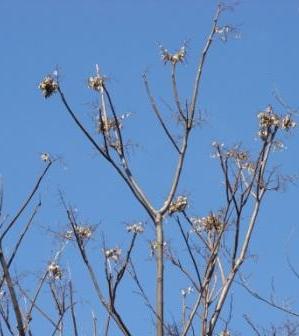
Fernwood was strip-mined before the days of Federal standards for reclamation (i.e. The Wilds). Left to recover by its own devices, invasive species rule. The Armageddon of nature, Ailantus altissima or Tree-of-heaven, must come straight from hell, as it can endure anything. Honeysuckle, buckthorn, garlic mustard- looking for a noxious weed? Look no further. Once stripped of native soil, the non-natives move in.


And if it wasn't bad enough, the Forestry service helped them along with Russian Olive, another noxious and invasive weed. Too often these invasive plants provide attractive but non-nurturing fruit to birds but do not provide host material for our native insects, including lepidoptera. Caterpillars, the bio-mass most preferred by nesting birds, are a vitally important link in the food chain.
....
So, we Weedpickers go on-and-on about invasive species and non-natives... it is not just a preference for our natural world. It is actually the life-line that holds our natural world together. Botany drives the wildlife, and geology drives botany. And strip-mined areas, become biological deserts filled with invasives. Coal has a long-term cost we haven't begun to measure.