Showing posts with label Dragonflies. Show all posts

Thursday, June 18, 2015

Aquatic Adventures

If it is flying, flapping or swimming, it is worth chasing, studying and sharing with friends.

Spatterdock Darner
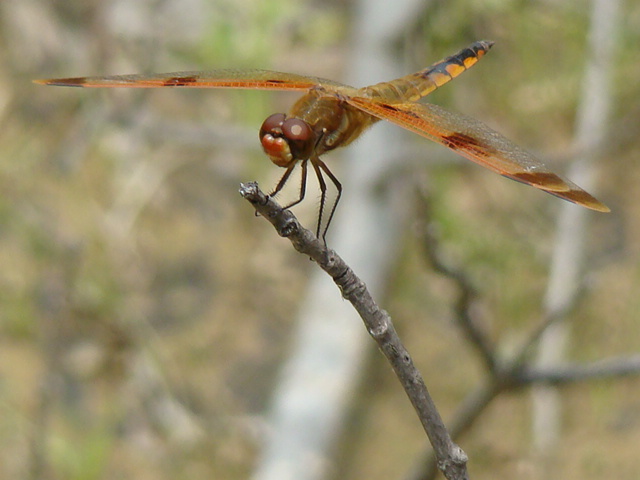
Today we were harassing dragonflies at the Gorman Nature Center in Mansfield, Ohio. For a little pond, the list was amazingly varied!   Eastern Amberwings, Eastern Pondhawks, Dot-tailed White-face, Comet and Green Darners, Slaty and Twelve-spotted Skimmers, and many others- including this amazing Spatterdock Darner! It was a feast for the eyes.

Judy Semroc and Larry Rosche
Two of my favorite guides and dragonfly experts Judy and Larry gave an excellent program and led the field trips.


They do professional outreach for the Cleveland Museum of Natural History. The are also the authors of one of the best dragonfly and damselfly guides written in the Eastern U.S.  If you don't have it, you can buy it on-line: just click here.

The bridge at Gorman Nature Center's pond.
If you are interested in learning about Odonates (dragonflies and damselflies), the pond behind Gorman Nature Center is a well-stocked location. You can spend an afternoon and see up to fifteen species!
Our field trip to the pond.
We did plenty of milling around, catching the adult fliers and netting some aquatic life in the form of immature Odonates, water bugs and frog tadpoles galore!


 Judy waded right out into the water to get the best specimens, while Larry identified all the goodies we brought to him on shore.  If you have never ventured into the field with these exceptional leaders, you have been missing out on a lot of fun!

They will be leading part of the Aquatic Adventures for Flora-Quest, Aug. 27-29, 2015  in the Mohican Area.  For those of you in the Cleveland area, the Cleveland Museum of Natural History  is offering a sign-up on line to drive down in the bus from CMNH. Just go to this link to sign up from the CMNH calendar.


Or go directly to the Flora-Quest website to see all our offerings.  If you are interested in plants or natural history, this is the conference for you.  Hotel rooms are limited, so contact me if you need help finding a room.

Hope to see you there, chasing Dragon Hunter dragonflies and Hellbenders!


Tuesday, June 26, 2012

Lake Kelso's Tiny Treasures

Yesterday I had the good fortune of being a speaker for the Geauga County Park District at  West Woods.  Northeast Ohio has some wonderfully diverse parks, well worth the visit.


The Geauga Park District has the classiest signs! The combined logo of the Sugar Maple leaf and the Red-headed Woodpecker tell you a lot about the habitat.

After my program on "Homegrown Butterflies" we high-tailed  it over to Burton Wetlands to see what was flying about.  Lake Kelso, a kettle hole bog, is the centerpiece of this park.  It is the remnant from the last glacier that rolled through.

 We were lucky enough to have some experts along!  Lisa Rainsong and Linda Gilbert along to help with identifying all manner of insect life. We also enjoyed the calls of Alder Flycatcher, Veery and numerous Catbirds. This glacial relic has fascinating botany too.


 It was most entertaining watching the honeybees "bumble" around in the water lotus.  Lake Kelso has a lovely display of the Fragrant Water-lilies, Nymphaea odorata.


We found several Pink Lady Beetles, Coleomegilla maculata- Since they were pink, it is a pretty good name and easy to remember.  These are one of our native Lady Beetles which are in decline, possibly due to the competetion of the non-native Multi-color Asian Lady Beetle.  
The tiny larva are also Pink Lady Beetle larva.  To learn more of Ohio Lady's beetles you can go here.

 We spent a good bit of time examining exuva, or sheddings from the larva of dragonflies.  Linda Gilbert may well be the best expert in the state on that topic, as she has raised many odonates through the larva stage, right up to the time they eclose (or shed) into a dragonfly.

 Many dragons were flying, including this Slaty Skimmer, Eastern Pond hawks, Blue Dashers and Dot-tailed White-face.

While sorting through photos, I notice this larva looks as though it has not yet eclosed.  The exuva is much darker, as it is still being occupied!  Had I realized, it would have been fun to hang around and watch it develop into an adult dragonfly.

Each dragonfly species has a unique larval form, and an expert can recognize them even at this stage.  To see many types of dragonfly exuva go here.

Thanks to all the folks who attended my program and to my friends that visited Lake Kelso afterward.  By the way, Lake Kelso is one of the spots you will want to visit for a photograph to enter TNC and Honda's competition for a new car.  Go here for details and visit some Natural Treasures this summer!

Tuesday, July 19, 2011

Jr. Naturalists Study Dragonflies

Summer is here, bring on the Odonates! You may not be enjoying this hot weather, but I guarantee the damsel and dragonflies don't mind it much. They are enjoying the high-life feeding on insects, fighting with competitors and breeding in the local streams and ponds.

The Ebony Jewelwing is one of Ohio's most common damselflies, sporting an irridescent blue/green body propelled by blackened wings. Truly jewel-like as they flit among the sedges shrubs along woodland paths, they are some of the most easily identified of the damsels.

When the Ohio Bird Sanctuary's Jr. Naturalist (J. Nats) decided to learn more about these charismatic wetland insects, they went straight to the top!

Judy Semroc (second from left) from the Cleveland Museum of Natural History came down to teach a class and spend some time in the field with Jan Ferrell and her crew. What a jump start on the world of Odonata!


Larry Rosche pointed out an Eastern Forktail hiding in the grasses along the trail. Larry and Judy are two of the most experienced dragonfliers to be found, and are the principle authors of the fabulous Dragonflies and Damselflies of Northeastern Ohio. It is considered the best guide for learning about and identifying the transparent-winged ones in all of Ohio.


Go here to order your copy from the Cleveland Museum of Natural History. It is filled with life histories, photos, and line drawings to help you sort the species we generally see. Although it is specifically made for NE Ohio, it works well for the rest of the state as well.


Tule Bluet, Enallagma carunculatum-


Our big find of the day. Larry and Judy netted several of these unusual species, and we proceeded to photo document them, as they have not been recorded in our county.


It may be hard to get too excited when the damsels are so small and look so much alike. So start slow; learn those stand-outs, like the Ebony Jewelwings and the big flashy dragonflies. You can learn a few new species each year, and in no time you will be amazing your friends! Besides it gives you something to do in the hot weather!

Congratulations J. Nats for a very successful day!

Thursday, June 23, 2011

Wings

You may not think insects are all that interesting. Sure you like plants and birds, but bugs? Who cares? If you like plants and birds, you better care- because bugs are a huge part of their life.

Pollinators have been big in the news the last couple of years, since Colony Collapse Disorder. Our government is concerned, because bees provide the pollination of all those food crops we rely upon. Go here to learn more about pollinators.

Tricolored Bumblebee, Bombus ternarius
Canada and Michigan have bumblebees which are a little different than the standard yellow and black job found in Ohio. These colorful cruisers had my attention from the onset, and I wasted plenty of other-wise good birding time trying to photograph them.

Tricoloreds, also commonly called Orange-belted Bumble bees, are three colors and this picture shows it well. I haven't run across much info about these cruisers, but I did note they spent a good bit of time in solitary efforts of digging tunnels or holes in the sand. If anyone has an explanation for that behavior, certainly we would all like to know. Please pass it on!


Chalk-fronted Corporal, Libellula (Ladona) julia


This dragonfly is a major rarity for Ohio, but they were as common as dandelions in the UP of Michigan. They hang out on the roads by the hundreds!


Four-Spotted Skimmer, Libellula quadrimaculata (quadri = four and maculata= spotted)


Seney National Wildlife Refuge was an excellent location for many species of dragon and damselflies, many not commonly found in Ohio. It was fantastic to see a whole new range of species!


Elfin Skimmer, Nanothemis bella in a mating "wheel" ( female curled below)


The smallest dragonfly in North America is found in Ohio, but it is rarer than hen's teeth. This mated pair is no bigger than a singular wing of the previous skimmer. Denizens of bogs and fens, Michigan has plenty of Elfin Skimmers, while Ohio has only a few known locations. The best place to look for them is at Cedar Bog.

If you like interesting insects- be sure to join us at the Bobolinks at Byers Woods festival this Saturday (June 25th.) Guy Denny will be leading a walk at 11:00 am to help us identify all the dragonflies and butterflies in the surrounding fields. Hope to see you there.

Friday, June 11, 2010

The Dragons of Summer

Every once in a while, when we are out there botanizing, birdin' and butterflying... I get distracted. And it is usually one of those fast flying winged jewels in the family Odonata that catches my eye.
......
Oh, do nata 'nother insect I would rather watch as they eke out a living on a pond or stream edge. It is all sex and violence, with constant feeding in between. What an exciting life- more unbelievable than Las Vegas!


Painted Skimmer-

First one was seen on Kelley's Island in May, and in June we were fortunate to find another in Adams County. My first impression is always.. Hm, not quite right for a Halloween pennant... and it is not! But a golden body with tiger-striped wings is a perfect description for this 1.5" long uncommon dragonfly.


Unicorn Clubtail- .............photo by Greg Cornet

This one is not such a rarity, but the clubtails always get me excited! They look like the "Apache" attack-style fighters, small (2") and fast, compared to some of the bigger or slower dragons and damsels. Note the last couple segments of the tail are all black, with a serious-looking pincher (cercis). That's not for "pinching"-exactly. Cercis are used by the male to hold on to the female while mating.


Lancet Clubtail- ...............photo by Greg Cornet
Just under 2" the Lancet Clubtail has more yellow on the final tail sections (what we call S-9 and S-10). This fellow has some handsome blue eyes, and is given to some fancy flying to impress the ladies. Oh, he is a "common" one, but you can see how easy it would be to fall for him. Note: he is at rest on the familiar frond of a Sensitive fern, Onoclea sensibilis .


Eastern Red Damsel-
This crimson hued fellow is the rarest and one of the tiniest, under an inch long! Known from bogs and fens, it is difficult to find them as they rest on low vegetation and especially favor small spike rushes. It can be tough to photograph them so low to the ground. I have seen them at Cedar Bog, but this one was found in a ditch not far from my home. His blue-black thorax and tail markings make a distinctive impression as he rests on an emergent Touch-me-not or Jewelweed, Impatiens capensis. This little damselfly really stands out from the common "bluets".
...
Not just another "pretty" face, dragonflies are also bio-indicators, as some require pristine water quality. The more you learn about these fascinating creatures, the more addicted you'll become too!

Saturday, February 13, 2010

Dramatic Dragonflies

Since I've been in the mood for dragonflies, John Howard sent me some of his best finds from 2009. I've been drooling over this file of incredible dragonflies, each one is better than the next... and hopefully, you'll enjoy them too!

Blue Corporal - this one was found in Adams County- is a real rarity in the rest of the state. It was big news when several of these were found a year or so ago.


Black-shouldered Spinyleg- is an impressive beast. It may only measure in at 2" but it looks mighty serious with those jagged spines on the hind legs. I have never seen this "uncommon" dragonfly, but John's photo of one perched on Ironweed, Vernonia sp. makes a picture suitable for framing.


Can these eyes be mistaken for anything but an Emerald? It is a Clamp-tipped Emerald, in fact. Again, an uncommon species in Ohio, named for the male's obvious-looking cerci (these are for some serious business with the lady clamp-tails.)


An utterly gorgeous photo of Slaty Skimmer, probably not as rare as most of the others shown here, but this photo was so beautiful, it simply begged to be shown. And it is a good one to be familiar with, as it is very similar to the much rarer Spangled Skimmer (which would have a speck of white along with the black dot on the wing stigma.)
Have patience and learn one or two at a time, and they are not as confusing as they first seem. Dragonflies can be sorted by habitats and behaviors as well as color. Be aware that dragons are often sexually dimorphic and the males and females can vary greatly. It only adds to the adventure!

Again, special thanks to John Howard for allowing me to share these wonderful photos. If you ever want a real challenge, try to photograph some dragonflies!

Tuesday, February 9, 2010

Wetland Plants and Dragonfly Fever

Seasons change in due time, and I am not one to push them. Each one has something special to offer- winter: snow skiing, spring: wildflowers and warblers, summer: dragonflies!

Oh man, I miss those dragonflies and the lovely wetland plants.

Gorman Nature Center has a pond edged in Pickerel-weed, Pontederia cordata. This is one of my favorite spots to watch the wild-winged dragons in pursuit for food, mating and fighting. That pretty much sums up a dragonfly's lifestyle. It is just like an aquatic Las Vegas- without the gambling.


A river edge dragonfly, the American Rubyspot is commonly found hiding amongst Water- willow, Justicia americana. This beaut was photographed along the Batelle-Darby, which will be the location of the upcoming Great Lakes Odonata Meeting- July 9-11, 2010.

Keep an eye on the Ohio Odes website for details.

Ah, a once in a lifer: Carolina Saddlebags (on a sedge, possibly Carex lacustris?), this is one worth longing to see. Maybe 2010 will be my lucky year again.


Least Clubtail is a bit of a rarity, found along the edge of the Black Fork in the Ashland park of the same name. This will be one of the field trip locations for the Managing Wetlands for Biodiversity Workshop- Ashland April 10, 2010, hosted by GMAS and FOWL.


And the coolest ever, Mr. Dragonfly himself (don't tell him I said that... ;) Dr. Dennis Paulson (shown here with Mary Jo White) who was infinitely patient with beginners at the Ohio Dragonfly Conference in 2007.

So if you like dragonflies and wetland plants... high-tail it over to the Friends of Wetlands (FOWL) website and sign up for the workshop on Saturday April 10. John Mack and Jim Bissell will be on hand to teach us the ins and outs of wetland plants (can't have dragonflies without them.) And the added kicker: Greg Lipps, the salamander king!
Hope to see you there!