Showing posts with label Adams County. Show all posts

Tuesday, March 10, 2015

Adams County Birding- Amish style.

Adams County Ohio is known for quaint country roads, patch-work quilt barns and unique flora.

It is as far south as you can get without plunking into the Ohio River. It lies between Portsmouth and Dayton.  Generally it is about a month ahead -weather wise- from the rest of the state.  Some might say it is a decade or two behind, in other ways.


 Country roads are likely to wind along creek bottoms and gullies, until crossed by a bridge.  Likely as not, it may be a covered bridge. This scenic crossing is in Harshaville.

The Murphin Inn

 There is a country Inn on Murphin Ridge Road where hospitality is not a lost art form.  The food is excellent and the comfy rooms are well appointed.


Adams County also hosts a great birding event each year.  Folk art abounds and several vendors display their goods, from bird feeders to paintings and they offer a variety of  authors and educational exhibits.

Emcee- Jim McCormac and speaker- Cheryl Harner
Jim McCormac, well-known speaker, author and bird expert was our emcee for the Amish Birding Symposium.  He gave one of these beautiful hand-painted plaques to each of the speakers.  I was the first up, presenting a program on Birding by Habitat and Habitats for Birds.  We got a little conservation message in as well. 

The Nature Conservancy's Dave Mehlman
 Dave Mehlman gave a wonderful program on bird conservation with an emphasis on birds and migration.  Birds need protection on their breeding habitats and on their wintering grounds.


Amish Birding Symposium packs the house with about 300 folks each year.  It is a high tech event, run on a generator and a prayer. Folks don't seem to mind and are content to enjoy the rustic atmosphere.

Katie Fallon speaks on Cerulean Warblers.
 Katie Fallon joined us from West Virgina to speak on the topic of her book, Cerulean Blues.  She follows one of America's most beloved and declining warblers.  It is no secret mountain top removal coal mining has destroyed many of the mountains where Ceruleans were known to breed.

Dave FitzSimmons also gave an engaging program on photography and offered several books for sale.  My apologies to him for not getting my own shot during his program. I must have been too wrapped up in the program to think about it!

Thanks to the committee who works so hard to host this event, especially against the odds of this years difficult weather. The snow piled up, but it was not too big of a challenge for the men and women who shoveled snow, prepared the meals and set up endless chairs and tables for the crowd.

Killdeer in the snow covered fields.
There were plenty of jokes about not being able to bird at Adams Lake due to the iced over conditions.  No one seemed to be in a hurry to birdwatch in the cold, anyways.  The ten to twelve inches of snow which fell just days before the event had evenly coated the county in a magical blanket of white.

But spring is coming, as foretold by the Killdeer  working the fields as we pulled out of town on Sunday morning.  

It cannot be far away now that the rains have come to mid-Ohio and as much as I like the snow, it is time for it to be gone. After all, spring always follows the Amish Birding Symposium.

Monday, March 4, 2013

Adams County Amish Birding Symposium

In the dark days of late winter, we bird and botany people ban together and do whatever we can to cheer up and preserver until spring's arrival.

 One of those things, just happened in southern Ohio: the Adam's County Amish Birding Symposium.


We filled the hall with a maximum capacity of 300 people!  The generator purred outside the backdoor, making it possible to power the speaker's computers and power point programs.  In an "Old Order" meets "new birders" scenario, folks gathered in from many miles away to enjoy home-bakes, loads of vendors, displays, and an outstanding line up of programs.


 This year's kick off was Connie Toops, with a program featuring the Albatrosses of Midway Atoll.  I must admit wondering how this would be relevant to my life.  But, Connie brought it home!  Her excellent presentation wrapped up with a reminder...

our trash (think plastic islands floating at sea) has become a major killer of seabirds.  Reduce, reuse, recycle- the albatrosses are counting on you.  We featured this theme before with programing from the Cleveland Aquarium.

Kenn Kaufman waits in the wings...
as Chris Bedel announces, The Vast Parade.


Migration: the great spectacle of  life and survival, a drama played out in our skies each year.  Kenn Kaufman spun new thoughts on the topic and made us reach inward for answers.  Maybe the greatest gift of migration is the wonder it creates in people.
Especially people who choose to do something with that wonder.Meet Kristina Polk. This is the live wire that sparked hope into an entire audience.  She gave us a vision for the future, in spite of all the "bad" impacting nature: plastics, wind-turbines, glass/ buildings, climate change, natural disasters.  This is the Young Birder who calls us to look- really look- at each individual bird, as you will not see that particular one again.  She came face to face with this Catbird at The Biggest Week in American Birding, and became fired for conservation.  

We are expecting big things from this little dynamo.  Watch for her program at birding venues, you'll not want to miss it.

Operation Migration's Joe Duff
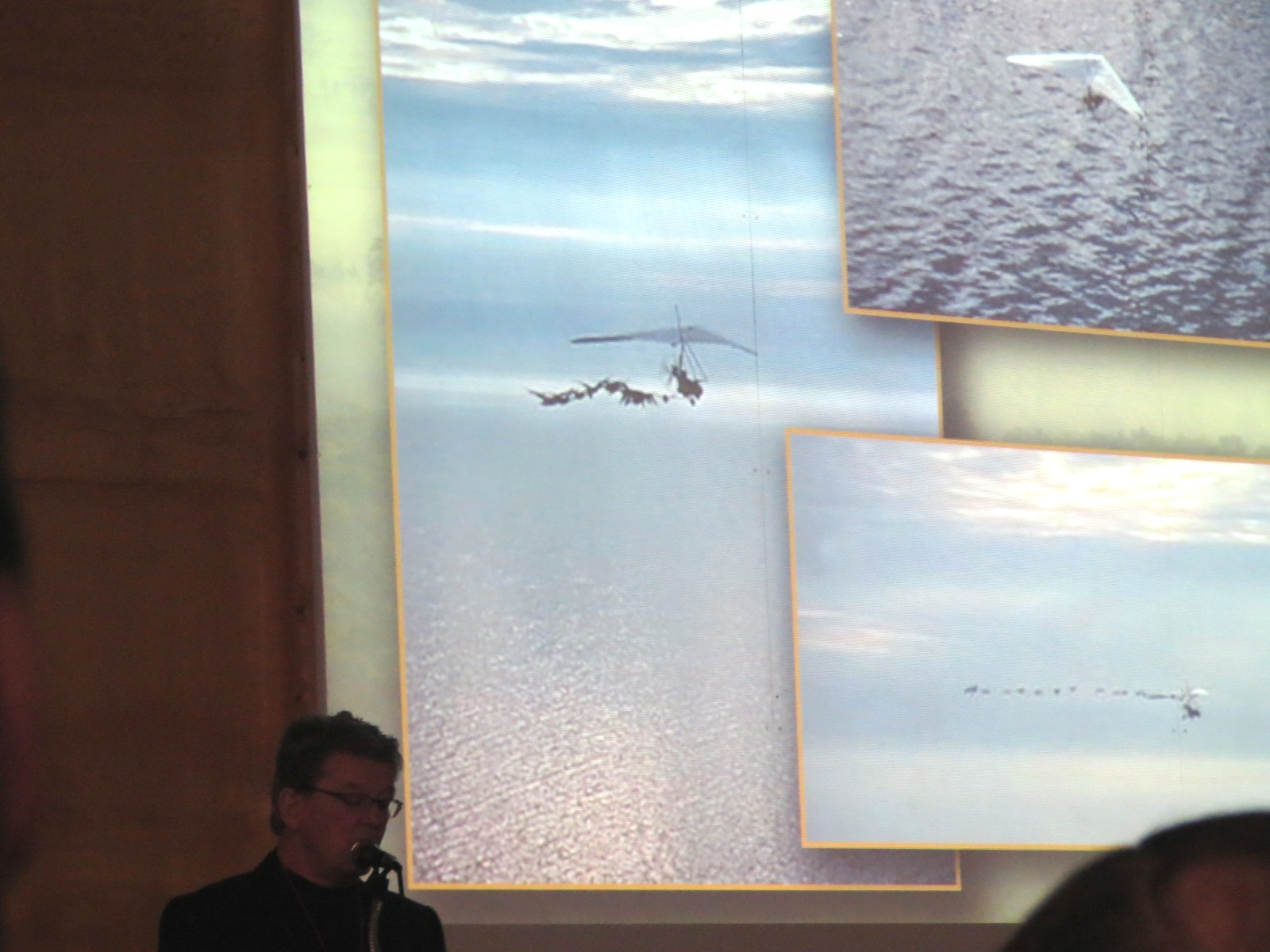
The last program of the day had us howling with laughter.  Joe Duff  (see Adams County's web page for photo and program description.) described a year dedicated to raising and migrating with a flock of Whooping Cranes, America's most endangered bird species.  To increase the odds for their survival, it was deemed best  to create a separate flock from the one at Aransas, Texas.  

Joe told the story from hatching, to training and the flight of these marvelous birds, as well as the dedicated bird handler's extraordinary efforts to prevent imprinting upon them throughout the entire endeavor.  It was an incredible story.

We laugh, we cried and we were so glad we attended.   Hope to see you there next year!


Saturday, October 6, 2012

Southern Style

This weekend the Weedpicker is in Adams County, Ohio. It is as far south as you can go in Ohio before falling into the great river of the same name.  It is the location for many of Flora-Quest's trips, and the home of several of our guides.

Tobacco in flower
While driving across the country side, we saw a plant in flower that I had not seen before: Tobacco!  It was the unusual flower that first caught my eye.  

Tobacco in the field
 Rows and rows of  'baccie (as the locals call it) in the fields.  I believe this is a late crop, as we saw other fields that were already harvested.

Tobacco plant
This is the true tobacco grown for smoking-  Nicotania tobacum.  Gardeners may be more familiar with flowering tobacco, a Nictotina grown for its fragrant night blooming flowers.


The Lewis Farm
The drying process is as fascinating for this Yankee as the growing process.  I know the tobacco is cut  by the whole stock in the field, and transported to hang in drying barns.

Ventilated barn

These wooden barns are often natural wood or painted black.  These ventilators are unique to southern barns, and not something I have ever seen in Mid-Ohio.


A peek in the barn shows the tobacco all hung to dry.  Each stock is 4-5' long.

One of the leaves was laying on the ground.  The fresh leaf had little or no aroma.  I found a small dried out leaf on the ground - and laid it on the large leaf for comparison.

Tobacco: once dried it has a lovely fragrance, and a surprising appeal.  Fortunes have been made on this plant, but I am glad I gave it up years ago.

Botany is often a key player in the economies of communities.  And once upon a time in the South, Tobacco was King.


Sunday, April 8, 2012

Charmed, I'm sure

No matter how many times I venture into Adams County, we always see something new.  This weekend the Eastern Fence Lizards were real crowd pleasers.

Eastern Fence Lizard, Sceloporus undulatus

Don't worry, we didn't hurt this little gal.  She is just resting comfortably in John Howard's hand. He used the old "alligator belly-rubbing"  trick to hypnotize it.  


Ned Keller had caught the critter and John volunteered to show us his "magic" with the little lady.  We didn't believe it until we saw it, but fact is- John has a way with the lizards.  
The males have a trick of their own in the springtime: a spectacular blue-belly.  All the better to impress the lady's with, I am sure.  No lizards or handlers were harmed in the photo sessions, oh, except  Nina.  This male did put a chomp down on her finger.  Unfortunately, I missed that shot. Not to worry, she was relatively unharmed as well.

Now who is Jim McCormac trying to charm?   
That's too small to be a lizard. My goodness, it is no biggger than a dime, whatever it is. 

It is Ohio's only green butterfly- a rarity for sure!  The Juniper Hairstreak butterfly was "puddling" for minerals and gave us an incredible show.  After an intense half-hour photo session, Jim decided we best move the little guy out of the road before we left. Occasionally butterflies will sit on your dampened finger; they are probably after body salt. Note his tiny proboscis in the photo, it is uncurled and taking up minerals.  Slurp.

No matter how many times we hit the trails in Adams and Scioto Counties, we always find something new.  People love to come to Flora-Quest year after year, because we always find something we have never seen before.  

This year the botany will be different than most, due to the unseasonably warm weather. Who knows what we will find!  Call or e-mail today to get one of the few places remaining in Flora-Quest 2012.

Tuesday, June 7, 2011

Appalachian Discovery

Still having many photos from the OOS conference to share, today's blog will feature some of the botany as well. Tourism supports the local economy, and birding is a low-impact/ high return form of tourism. Adams County does it right!

There is an entire publication designed to help you find the best places to bird in Adams County. Maybe we need to come up with a botany trail as well! Let's start at the Conrad Tract-

Nina H., Faye S., your Weedpicker, and "Kat Doc" are standing by the trail head sign at the Conrad Tract. To get there, follow the directions to the Wilderness Ttrail, but stop a 1/2 mile short- at this sign.


The 24 acre Conrad Tract was conserved through the efforts of OOS , The Nature Conservancy and Clean Ohio Funds. To read more about that, go here.


Conserving property for birds and botany is a worthy cause, and unprotected natural areas are in grave risk these days. Unfortunately, many places people thought were protected, like National and State Parks are in danger's way as well.
Walking fern, Asplenium rhizophyllum


But let's talk ferns. The Conrad Tract features some dolomite rock out croppings, covered with rare and unusual plants... and a hand-full of fabulous ferns that even I can remember! This Walking fern with its long tapering pinnae tip, touches down on the mossy rock and starts a new plant. Hence its growth habit suggests "walking" across the rocks.


Purple Cliffbrake, Pellaea atropurpurea is a rarity for Ohio. There are several other cliffbrakes, but this one sports purple stems.


Resurrection Fern, Pleopeltis polypodioides - looking very withered and dead. This southern plant, rarely dipping into Ohio, lives up to its name by drying up and conserving energy during drought and returning to a lush mat of green after a rain.

In a Weedpicker science experiment, we poured a little water on one frond at the beginning of our hike. When we returned, the plant had already started to green and looked a bit resurrected.


This property is also known for its White Cedar, Thuja occidentalis both living and dead. These standing remains are monuments to past forest lives... possibly hundreds of years old.


Much of the property is a high, dry ridge-top which protects the view scape of The Wilderness property. This photo was taken from below.


One might get a sense of the steep ridge-top from the background of this photo I took while we were birding. It is good to know these habitats are protected for the future.


Be sure to check out the birding trail map locations next time you travel to Adams County!


Sunday, March 22, 2009

Micro-flora fest 2009 It's How Big?

Our fearless field leader, John Howard hones in on a Draba reptans.


Leader of the micro-flora fest, John Howard is also a wonderful photographer and mighty fine person. His photo of a Leavenworthia uniflora in bloom is placed in perspective by the cap of an acorn in the foreground. Barely an inch across, it could almost make an appropriate sized pot for the miniature mustard.

Many of these early blooming plants we pursued in Adams County are in the mustard or Brassicaceae family: Levenworthia, Drabas and the more familiar Cardamines: Purple Spring-cress and Cut-leafed Toothwort. Perhaps their small size makes finding them seem like such a big deal!