Monday, November 29, 2010

The North Coast

The Western Basin of Lake Erie is known for its Bald Eagles. The Division of Wildlife has monitored their successful nesting and enjoyed their return from the brink of extirpation in the 60's. No other bird captures the hearts of non-birders like this majestic emblem of our country.

And while visiting the Magee Marsh Sportsman's Center, we witnessed 4 fly-bys, along with this artistic rendition of a pair of Bald Eagles on a nest. The center has an amazing collection of birds and bird history from the Great Lakes.


And what makes the region so dog-gone birdy? It is perched on the intersection of not one..


... but two Fly-ways. The Atlantic and Mississippi Flyways converge here, and migration takes place from February through December each year. The north bound waterbirds start the year off, and the parade to the breeding grounds continues through early summer, when some south bound shorebirds begin their long trip back to the wintering grounds. It may be the worlds most fascinating drama- of life and death- played out each year in our "backyard."
...
And that is why we feel so strongly that wind power is a disaster-waiting-to-happen in this region.


The next time you are on the North Coast - stop in and say "Hi" to the fine folks at Magee. The Friends of Magee operate a gift shop, and the displays are a fascinating way to see birds up close.
...
And while we all love to be at Magee for the spring warblers, migration is happening most of the year on the North Coast. It is a drama you'll not want to miss.

Thursday, November 25, 2010

On Being Thankful...

It is not a traditional day of turkey and pie for me- but that doesn't make me a bit less thankful. A cooking incident that went horribly awry has left my house a difficult place to for me to be, while the smoke residual is cleaned away. Hopefully, it will be put back to order in a week or so. Until then, I find myself in need of being away.... no matter.


For I have wonderful friends with whom to share the most beautiful locations in Ohio (Huron Lighthouse.)


I can see birds that make my heart soar... (Sabine's Gull)

And spend time with people who love nature, respect the awesomeness of our natural world, and work to preserve it for the future.
...
It all makes little things like kitchens and pies seem less important, and family- especially my family of friends- more important.

So no matter what life hands us, as long as we count our blessings- like the call of tundra swans on the wing, ruddy ducks paddling about our reservoirs, and gigantic sandhill cranes... the rest is not important. I can always bird.

Wednesday, November 17, 2010

Marshes and Migration

Lake Erie and the surrounding marshes are magic- and just like magic- they are disappearing before our very eyes.


Think of the incredible pressure development has put on these natural bird and wildlife sanctuaries. Cedar Point Amusement Park- home of the Blue Streak was once home of the Great Blue Heron. Condos, marinas, restaurants- all concentrated on the lake shore- have certainly made a tremendous negative impact on our wildlife.


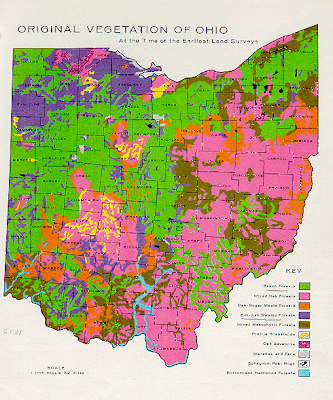
Here is the original vegetation map of Ohio- purple indicates wetlands. See the purple stuff in the Northwest corner? That was the Great Black Swamp; now only 5% of that area remains wetland. Perhaps it is due for a name change: The Little Black Swamp. Were it not for Ottawa National Wildlife and the State of Ohio's holdings, I fear our migrating birds would have no place to "fall out" during migration.

Here is a "bird's -eye-view" of the Marblehead Peninsula from the sky- (shot out of the airplane window as we were headed west on vacation)
...
Spring and fall each year, a miracle goes on above our heads. Birds migrate to and from their breeding grounds in Canada and beyond. Their only hope for continued survival is to cross that lake in hope of successful nesting. Each year hundreds of thousands of birds need to make a critical "re-fueling" stop at the wetlands along Lake Erie: Metzger Marsh, Ottawa National Wildlife Refuge, Magee Marsh, Sheldon's Marsh, and Old Woman Creek.
...
These are all critical habitats for our avian species.


And now, these birds are being handed an obstacle course to maneuver on take-offs and landing. Radio towers, buildings and a new danger- wind power.
...
The thought of greener, cleaner energy is music to any environmentalist's ears. But if wind turbines are placed at the intersection of two major migratory flyways, it is hard to believe it won't become a massive slaughter. This is not something that could happen in the future- this is happening NOW. The Black Swamp Bird Observatory needs our help to put the brakes on this wholesale disaster- before it happens.
...
  • Please sign their petition for a 3 year moritorium to study the effects on wind turbines on the birds passing through the Great Lakes. Please go here.
  • If you really want to make an impact- Send a check to BSBO to help them protect these birds.

For more information- go to the BSBO website or read Kenn Kaufman's blog post.

....

IF we do not act now, who will speak up for the birds? An ounce of prevention is worth a pound of cure- and once wind power comes- it will be too late to stop it.

* I would be ALL FOR WIND POWER as long as it is properly sited. A migratory path is NOT a proper site.

Monday, November 15, 2010

Mudflat Mavens

Mudflats attract all kinds of species-
...
lots are two legged waders- and the birdwatchers that follow them. This year, many of my best looks at birds were - at close range- from a kayak. It is surprising how much tolerance shorebirds have for a person well ensconced within a giant orange plastic bobber.


...
Greg Cornet shot some great photos of this Western Sandpiper at Hoover Reservoir in late October. Western Sandpipers and Dunlins are some of the later fall migrants to pass through Ohio on their southerly route.

...

...
Saturday we floated along with three Dunlins who were foraging on a sandbar mudflat at Pleasant Hill Lake near Mohican State Forest. Many species can be targeted simply by the habitat they prefer. Both Dunlins and Westerns tend to hang out on moist mudflats, where one might also expect to find Pectoral Sandpipers, Least Sandpipers or Common Snipe.
...


Today at Ottawa National Wildlife Refuge, the shallow water along the drive held good numbers for Canada Geese and various ducks. I was intrigued by the 4 Sandhill Cranes peeking out of the taller grasses in the back. Often I hear folks criticize DOW or the Feds for "only managing for ducks." But if it is good for ducks, other species benefit as well. Even mudflats covered with 2-4 inches of water will attract shorebirds; they are just more difficult to see! Fly a Peregrine Falcon over and you soon find out how many were hiding in that stubble!
...
Ottawa NWR hosted Mark Shieldcastle of the Black Swamp Bird Observatory for an informative program on Shorebird Monitoring and the management of wetlands. It was a scientific look at the habitat needs and preferences of migrating shorebirds, and the management portion is much more complex than it looks to be!
...
Mudflats are a fickle habitat, in need of constant rotation. What provides excellent habitat one year, may be poor habitat the next. And not too surprising, much of it is based on vegetation. Vegetation has in important role in feeding the invertebrates, which in turn feeds the shorebirds. It is a complex cycle of drying and flooding at the proper times to encourage specific species.
...

Why am I not surprised that botany plays a huge role?
...
This close-up photo, a mudflat covered in emergent vegetation, was taken at Hoover Reservoir a couple of years ago. The minute pink flowers of Sessile Tooth-cup (Ammannia robusta) would barely be notable, unless you were on your knees admiring all those micro-sedges no bigger than a dime. And yes, I got muddy.
...
It is a fascinating world of wet- and one I hope to delve much deeper into understanding. The intricate relationships between invertebrates, mud and plants that makes finding the birds all the more interesting!
...
Hope you enjoyed the balmy weekend weather long enough to visit some mudflats and the of the last of 2010's migrant shorebirds. Like old friends, we will really miss them when they are gone.

Friday, November 12, 2010

Preserving Daughmer Prairie

Have you ever admired a singular oak tree?

When left to grow uninhibited by man's buildings, power lines, or cramped in woodlots, their breadth and spread is simply a work of art. This legacy tree speaks to us of what was - before white man changed the land known as O-hi-yo (meaning- "it is beautiful".)

Unencumbered in a Crawford county field, this oak stands tribute to passing time and our country's history. One oak, a last remainder for bio-diversity, in the plowed ground "canvas" for agricultural monocultures.

...


...
Now imagine a hundred of these trees.
........
Behemoths in the landscape, Bur oaks (Quercus macrocarpa) spread as wide as they are tall, reaching across unplowed soils boasting of over 150 some species of native grasses and forbs. Wet sedge meadow meets prairie grass on this 30 acre museum of natural history. This savannah was maintain by fire in Crawford county's pre-history, where Native Americans appreciated the end result of flame to the landscape: large open grassland where only the heat resistant oak could survive. Plentiful game- with grass to graze and acorns to forage. This was their O-hi-yo.


These Sandusky Plains are celebrated by a state marker, and this patch of land has created many a sleepless night for a handful of concerned naturalist in Crawford, and many other counties throughout our state. The stakes are too high to lose this last living remnant of what once was. Daughmer Prairie is well noted as the best example left of a prairie / oak savannah in the mid-west, and it looks like Ohio Division of Natural Areas Check-off funds will be used to achieve its long-awaited preservation.


Indian Grass (Sorghastrum nutans) blows freely in the breeze.

...
This land of incredible beauty is also a land of incredible bio-diversity. Red-head Woodpeckers thrive on this open lot, while dragonflies and butterflies of every manner cruise the grassland and wet meadows all spring and summer.
...
Thank you to everyone who has worked so hard to achieve the permanent conservation of this land. You are giving the gift of our past- to the future.