This post could be named as "A Day in the Life of an environmentalist." But rather, let's focus on the important things- calling it "A Day in the Life of the Environment."
+Jim+Bissell.JPG) |
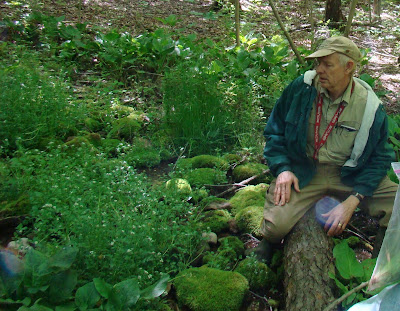
| Dr. Jim Bissell, Cleveland Museum of Natural History, Dept. Botany |
The day starts out at a property protected by the North Central Ohio Land Conservancy. Jim Bissell had already found a rare grass, an
Andropogon (Elliot's Beard Grass) and had moved on to the wetland. He was scrutinizing the water cress- something just didn't seem right. Is this a rarity, too?
Jim brought a team of elites: Dave Kriska, Judy Semroc, Larry Rosche and others to comb through the land trust property for a complete documentation, including possible rarities. It is our job to discover the secrets this land has held in silence as it has remained undeveloped, except for one close-call with a timber company.
+Poss.+App+Azure.JPG) |
| Appalachian Azure, in Mid-Ohio? |
As we wandered through the giant Skunk Cabbage a large, or rather largish for a blue, butterfly flitted by. Dr. Bissell had asked if we ever had Appalachian Azures here, based on the botany. I had dismissed them as being out of range. And yet, like a phantom one appears. Judy Semroc is the butterfly expert of this crowd, and we both feverishly photo document the lep. This was too good to be true. And we will see if it is...
 |
| Steve McKee Displays a frond of Blunt-lobed Woodsia |
Another find! A few miles away, while gathering for a press conference, Steve McKee stumbles into the largest and only 3rd population of the Blunt-lobed Woodsia in the county. Steve has only seen this plant in ones-and-twos prior to today. Here he discovers a thriving population.
Many life-times of botanists, entomologists and other scientists have made and continue to make new discoveries in Mohican and Malabar. We are still finding great discoveries, and sadly today we are gathered at this very location for fear of what we might lose.
 |
| The press corps roll footage and take notes under the towering canopy. |
Ohio State Parks, including Mohican and Malabar are currently on the block for fracking and timbering. In an unprecedented grab for money, the political powers in Ohio believe mining the parks for resources is a way to "save" them.
Who knows what rare fern, butterfly or grass could be forever lost, before it has even been found.
A press conference was held to announce the
Coalition to Protect Ohio Parks. Please click
on this link for more information. Columbus Dispatch coverage
here.
 |
| Portrait of a Rough-winged Swallow |
The day ended in hush evening bird song, along the Clear Fork River. Wood Thrush and Veery set the stage for this photo of a Northern Rough-winged Swallow settling in for the night. I had watched a pair of swallows hawking for insects along the river. My view from on the old covered bridge afforded this Monnet-esque view with the dappled river as a background.
Day draws to an end, and those of us who commune with nature pray,
It will not the end of days for Mohican, as we know it.

+Jim+Bissell.JPG)
+Poss.+App+Azure.JPG)


