Thursday, March 1, 2012

Making a difference

Never under estimate the power of the local ladies' club. And definitely, don't mess with a whole angry group of them! Prohibition and Audubon Societies are just two examples of by-products of women united with one common goal.

Woman's hat with plumage, photo courtesy of Audubon Magazine

Prohibition may not have lasted, but the fascinating story of the formation of the first Audubon Society bears witness to the influence of women. Just before the turn of the century women's hats were decked out with plumes, feathers, and whole bird carcasses. (photo courtesy of Audubon Magazine) This millinery industry was the booming business driving the massacre of egrets, herons and all manner of song birds. Fortunately, a group of women in Boston were outraged by the slaughter and re-defined high fashion and the bird laden hats were declared to be in bad taste. By the late 1890's Audubon Societies combated the feather trade and a conservation movement was formed.

   Goshen Pass, photo by Virginia.gov

Another fine example is the Garden Club of Virginia v. Virginia Public Service Co. Seems that the "Public Service" Co. planned to help themselves to the Goshen pass to generate power. After all, who needs a scenic view when there is money to be made? We just might take a lesson from those ladies whose grandchildren are still enjoying the rhododendrons along this riparian corridor.

Today, individual women/men and garden clubs can still make bold moves for conservation. Hold your local representatives accountable for what is happening in our public lands. Join a local conservation organization. Make a difference in your state and in your own backyard..

Request Ohio native plants from your local plant nurseries and landscape designers. Supply equals demand. If we demand the native plants that feed our biodiversity and stop wholesale pesticide poisonings, we will feed the food chain and take a step in the right direction to swing the balance back. Bringing Nature Home is something we can all feel good about.

If you agree this this article, share it with a friend, and let's start a conservation movement of our own!

Friday, February 24, 2012

Blackwater: Tides of Change

Rarely does one get a chance to see global change expressed any better than in the microcosm of Blackwater National Wildlife Reserve.  Hard to think of 27,000 acres as a microcosm?  Well, consider it in the world perspective, it looks pretty small in contrast.

 Much of Blackwater is composed of rich tidal marshes, ebbing and flowing with the sea.  However sea levels are on the rise and it has become all too apparent at this coastal marsh. These flats once extended well beyond today's boundaries.  The area has been supplemented with silt from dredging operations and under a management plan which includes plantings of vegetation.

Wanting to understand the ecosystem better,  I had conversation with manager who spoke of one of the primary plants used to stabilize the mudflats.
 Spartina alternaflora, Smooth Cordgrass photo courtesy of USDA plants database.

This cordgrass is related to the Prairie Cordgrass, Spartina pectinata we know so well in Ohio.  However, this Spartina is much better suited to rising tides, standing water and increased salinity levels.  It is being used to improve conditions, but the sad fact is:  Blackwater is rapidly losing ground to rising seas. And in the long run this is a losing battle, lost to global warming.


Blackwater NWR is an excellent location for birding, with recent sightings of Golden Eagles among the numerous Bald Eagle routinely found there.  We counted 15 adults and juveniles in the two hours we spent there.

Get to know your National Wildlife Refuges; they are fascinating places.  And while you're at it, buy one of those Duck Stamps to help support these natural areas.

Monday, February 20, 2012

Life in a Tree

I know for certain- there is life after death.  At least for large trees.

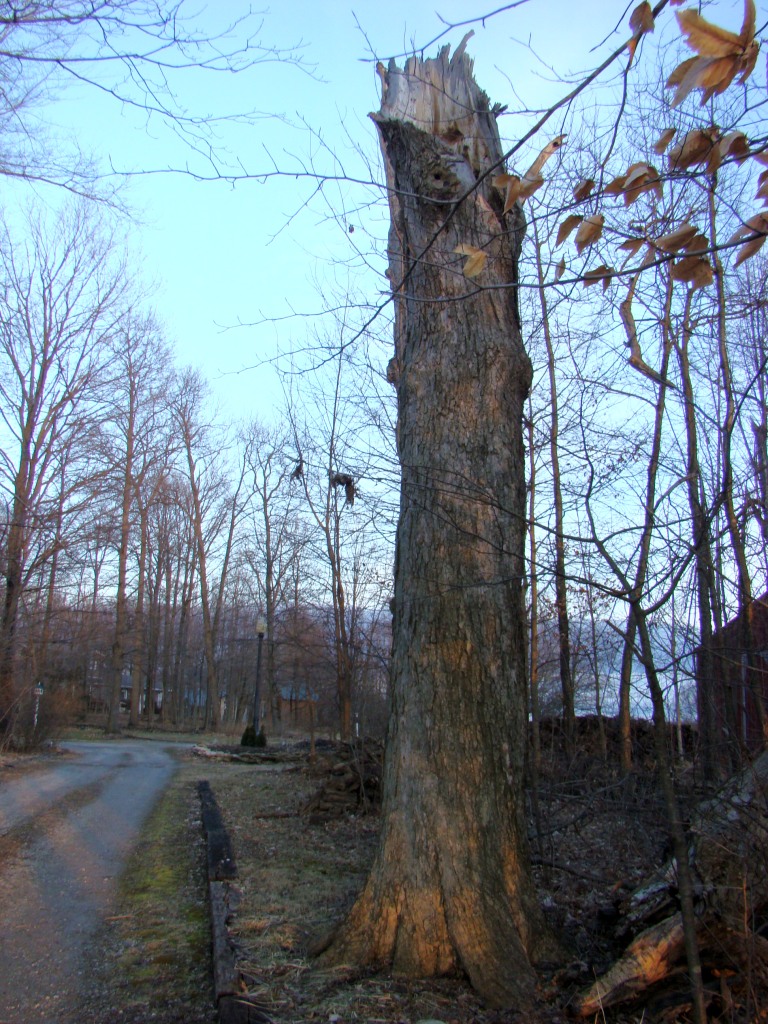
Once a thriving Sugar Maple in my woods, this towering relic is still a vector for a multitude of life forms both small and large.  Most go unseen. Fungus, slime-molds, tiny spiders and ants populate and colonize the decaying tissues. Wood boring insects, centipedes and beetle grubs enliven the bark layers, creating an irresistible attraction for birds.

 The Sugar Maple:  still a proud harbinger of life, well into decline and decay.

 One favored bird, the White-breasted Nuthatch  runs wildly head-first down the tree.  Caching food for future use and generally adding to the woodland ambiance with his ank-ank-ank or ip-ip-ip calls.  Nuthatches are the only birds able to descend trees in the face-forward postion.  It is all in the toes. Unlike the others woodpeckers' two toes in front, two toes in back arrangement, the nuthatch toes are configured one in back, three forward. The back one is long- and decurved- which allows for the "hanging downward" position.

This towering trunk could also provide a home for the local Screech Owls.  Several broods have been raised in our woodlot and this standing trunk has all the promise of a new condominium.  I'll be watching for the evidence of owl pellets. 

Just as a whale-fall in the ocean provides a unique habitat for a league of species, the "tree-fall" in my yard is worthy of much more study.

To learn more about habitats found in your own back yard, join us on March 3rd at Muskingham Valley Gardeners'  "Spring Fever" Home Gardening Symposium.  You can find all the details HERE.

Sunday, February 19, 2012

Dabbling in Duck Stamps

Once considered the proprietary domain of hunters, duck stamps have come out the of conservation closet and into the mainstream. And let's face it- the main stream is a great place for a duck.

 This year's winner for the Duck Stamp Art was a brilliantly hued Wood Duck by Joseph Hautman of Plymouth, MN.  This stamp will be available in July of 2012 and is an excellent purchase of art for conservation.  Ducks bring in bucks.  It is as simple as that, and without the conservationists - like Ducks Unlimited-  we would be much the sadder for wetlands. 

 Many important wetlands have been purchased largely by the monies collected for Duck Stamps. While visiting Maryland and Delaware recently, we stopped by a National Wildlife Refuge named Blackwater.

We were able to drive right in, because my savvy driver Paul Baicich had purchased Duck Stamps.  Paul is well known in conservation circles and his articles are found in Bird Watcher's Digest and a plethora of other print media. 

I hope you will join Paul and many others (including me) as we support the excellent refuges system across America.  It not just for ducks either; plants, butterflies and songbird love these places as well!

Friday, February 17, 2012

Rice is Nice

A whirlwind trip to Washington DC and other parts east has provided some new insights for this blog.  Paul Baicich of Great Birding Projects invited me to join him at a reception for California Rice's meet and greet with growers, environmental types and other notables from DC.  This may be the first time being from Ohio felt nearly- exotic.  ie: "You are from Ohio?  How did you get to DC?"  

But the important news is the great work being done.  Rice is bird friendly.  Looky at their logo- they can't help themselves for bragging! 


And after spending an evening sharing stories about great birds and fabulous wetland habitat, we were all in agreement.  Birds really like rice fields.  And those soggy fields are filled with ducks and geese,  as well as an array of other species making a living of the insects that live in wetlands.   We were regaled with tales of a Tufted Duck and a leucistic (white) Burrowing Owl- both found on rice farms.  Go here for more info.


California Rice is white rice.  That big fluffy stuff from Japan that is exclusively used in the rolling of sushi.  We had an colorful assortment of sushi for our gastronomic delight; being the botany type, I insisted on a "vegan" roll.  Besides, that will also keep me from being chastised by my daughter the aquatic biologist.  

 Shall I mention that sushi also pairs well with California wines?  Seems to me California should be elevated to the top of my "Places to Bird" list!