Monday, April 12, 2010

FOWL Friends in Wetlands

Now appearing in most wetlands near you: Marsh-marigold, Caltha palustris!

While many spring ephemerals have poked through the ground and are putting on their best April attire, the wetlands are simply golden. Fowler Woods in Richland County has one of the most spectacular displays of Marsh-marigolds to be found. And while pre-scouting for the Managing Wetlands for Biodiversity conference, we just had to take it in.


A member of the buttercup family (Ranunculaceae), this wetland gem creates a sea of color. Marsh-marigold can be grown in the landscape too, if you give it enough water.
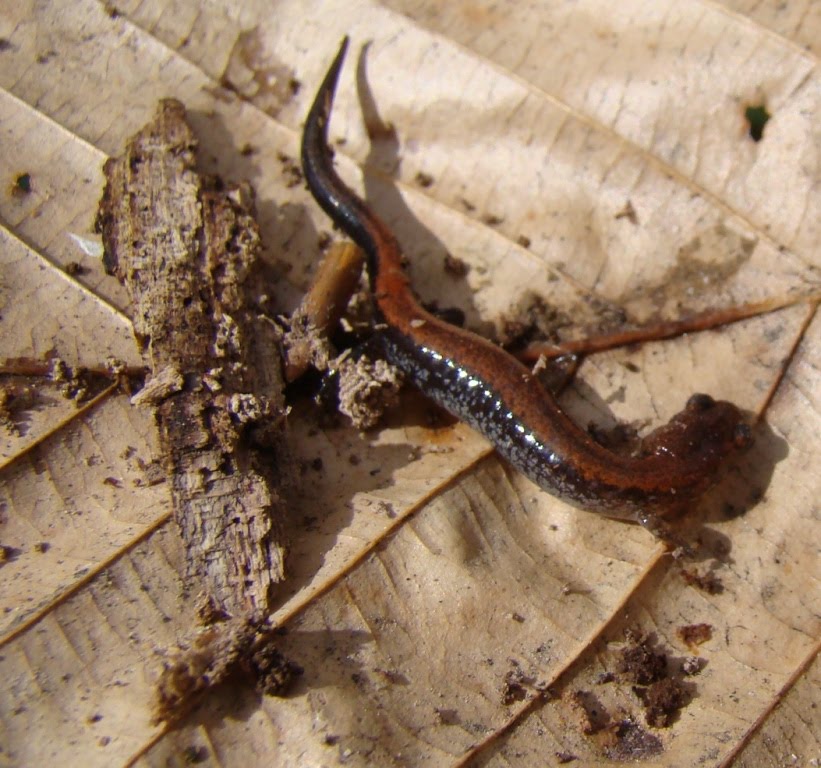

If you are looking for biodiversity, healthy wetlands are chocked full of it! Wetlands support a host of interesting species, including this Redback Salamander. Abundant and some-what common, the dark red line on its back makes this one easy to remember. However they are occasionally found unstriped, and called "lead phase." While they do not breed in vernal pools, they certainly have a predilection for these damp forested habitats.

Greg Lipps was our amphibian and salamander expert, a source of infinite knowledge of all things slimy, including gelatinous eggs. Wading deep into dark waters, he found salamander and frog egg masses in several vernal pools in Ashland county.
His program, "Small, Messy, and Diverse: Why Vernal Pools are Full of Life" got the folks reved up to investigate wetlands on our afternoon field trips.


Nothing got past this crew. The Black Forks Wetlands provided good looks at fairy shrimp and a mayfly in this small pool. Jan Kennedy, Lori Totman, Patty Saunders and Tim Mason were scanning the ditches for interesting life forms usually left unnoticed.


Not a staged photo! Hard to believe, but this candid shows how much fun naturalists can have on a sunny day, with a few friends and a water-hole.
...
Thanks to all our speakers: Greg Lipps, John Mack and Jim Bissell for opening our eyes to the fauna and flora of wetlands. Also, to the Ashland Park District volunteers and Ray Stewart of "FOWL" (Friends of Wetlands)- we couldn't have done it without you.

Wednesday, April 7, 2010

Of Ravens and Unraveling

About a week ago, I led a fact finding group on a mission to Fernwood State Forest. The others, Greg Miller and Su Snyder, were along to help locate Ohio's only known nesting ravens. Common Ravens, most under appreciated birds, are extremely intelligent and have interesting historical implications as well. Something about these Corvids really excite me, and you'll find an interesting treaties on ravens here. And yeah, I would be lying if I didn't admit, we wanted to add it to our Ohio's birds list too.


Ravens can easily be mistaken for a American Crow, but for the wedged shape tail, "big honking" bill and somewhat larger size in general. The American Crows are common in Ohio. The Common Ravens... not so.


It is all about habitat, and the high walls the ravens love to nest on are more commonly found in Pennsylvania and the Virginias. It is not a regular feature of Ohio's geology, unless... the area has been mined for coal. Strip mining laid bare portions of the Ohio landscape and older sites were never "restored" to current Government standards. So, it is those high walls at Fernwood that lured in our first ravens.


We conducted a pretty thorough survey, including the local landfill. Greg Miller brought along a super-sensitive listening devise, but nada. No "Rawk" of the raven was heard.


And what does this all have to do with unraveling? It is symptomatic of an unraveling ecosystem.
...
In the immediate area of the Common Raven's uncommon nest was an on-going logging operation. We probably shouldn't be surprised that the ravens felt threatened and vacated the area, especially since it happened during their nesting season.
...
The analogy that best describes this type of forest fragmentation can be found in David Quammen' s Song of the Dodo. You'll want to read the book, but here is the quick version:
Start with an expensive oriental rug. Now, take a carpet knife and cut that rug into 16 equal squares. It should be worth the same amount, right? Wrong. You have a dismembered whole, which no longer retains the same value. Each square has ragged edges prone to unraveling, or in forest terms, invasive species eating away at the edges of our natural areas.
...
Every gas line right-of -way, every roadway, every timber operation fragments the whole and reduces biodiversity a forest or natural area can support. You see fewer and fewer native species as invasive species force them out. Common Ravens will just fly away, to a more suitable habitat. Unfortunately when the garlic mustard takes over, West Virginia Whites, small butterflies with weak and short flights, just disappear.
...
And meanwhile, our edges keep unraveling....


Saturday, April 3, 2010

Fernwood: a forest out of balance

The previous post featured the West Virginia White butterfly, a charming and altogether unexpected find at Fernwood State Forest. Unfortunately, an isolated rock dome named Little Round Top may be a last outpost in this "forest". Unlike the Ravens we sought, West Virginia Whites are weak fliers, doomed by habitat disturbance. Forest fragmentation and invasive plants are the primary causes for their decline.


Marginal Woodfern, Dryopteris marginalis was one of the few native species hanging on for dear life. If this was once a "Fernwood," the name has long outlived the reputation.


Many non-native species have taken hold, like Coltsfoot, Tussilago farfara, shown here eking out a living along a creek.

The creek color, tinged with Yellow Boy, tells the whole story: coal mining was here. If you are ever told the tale of "clean coal" you need look no further. Much of southern Ohio bleeds the orange of acid mine runoff. While student teaching in Athens' elementary schools, my daughter noted the children color the creeks orange in their artwork; the only color of water they have ever known.


Fernwood was strip-mined before the days of Federal standards for reclamation (i.e. The Wilds). Left to recover by its own devices, invasive species rule. The Armageddon of nature, Ailantus altissima or Tree-of-heaven, must come straight from hell, as it can endure anything. Honeysuckle, buckthorn, garlic mustard- looking for a noxious weed? Look no further. Once stripped of native soil, the non-natives move in.


And if it wasn't bad enough, the Forestry service helped them along with Russian Olive, another noxious and invasive weed. Too often these invasive plants provide attractive but non-nurturing fruit to birds but do not provide host material for our native insects, including lepidoptera. Caterpillars, the bio-mass most preferred by nesting birds, are a vitally important link in the food chain.
....
So, we Weedpickers go on-and-on about invasive species and non-natives... it is not just a preference for our natural world. It is actually the life-line that holds our natural world together. Botany drives the wildlife, and geology drives botany. And strip-mined areas, become biological deserts filled with invasives. Coal has a long-term cost we haven't begun to measure.

Friday, April 2, 2010

Lost and Found at Fernwood

Recent travels took me to Fernwood State Forest, near Wintersville, right on the eastern edge of the state of Ohio. It has been the only known nesting sight of an Ohio raven, one of the largest and most wary members of the Corvid family of birds. Unfortunately, no ravens were found on the trip, but we still had some interesting sightings.


Four West Virginia White butterflies were spotted that day, but taking a photo of these ghostly little creatures is not so easy. Fast-fluttering and high-flying, it was a fortunate shot indeed that captured this specter's image. A bit smaller than the common Cabbage White butterfly, W.V.W.s lack the distictive black spots found on Cabbage White's wings.


West Virginia Whites, Pieris virginiensis are considered, rare to occasional and quite localized in Ohio. Don't even try for them in Toledo or parts west, you won't find them there! Some of our earliest fliers, W.V. Whites are mighty particular about their chow as well. Here is the host plant you'll be looking for:


Cut-leaved Toothwort, Cardamine concatenata (used to be called Dentaria lanciniata) is a member of the mustard family. Now I did not note any toothworts at this location, but I did see several of its close mustard family relatives.
....
WV Whites are interesting flutter-bys and one you should note. In fact, the Cleveland Museum of Nature's LEAP program has been charting their occurrence. The invasive alien, Garlic Mustard may be impacting these little beauties in a very bad way. Forest fragmentation and loss of habitat are just a couple more reasons they are in decline. So, if you find some West Virgina Whites fluttering through your neighborhood, you might do a good deed and report them to the authorities!

Thursday, April 1, 2010

Rare Species Found at Shawnee State Park

Just in from Shawnee State Park and Forest, in beautiful southern Ohio: Local man finds rare "purple morph" Zabulon Skipper. This stunner is a real eye opener and the crowds are starting to gather. Lepidopterist from across the country are headed to Scioto County to see this charming butterfly of violet hue.


You won't find this in your Butterflies of Ohio! This documentary photo, arrived in my e-mail just last night, shows the creature at rest. Zabulon skippers, Poanes zabulon are known to use several host plants in the grass family, including Purpletop Grass, Tridens flavus. Are we seeing a color morph due to long-term pigment retention from its host plant? This normally brown and golden butterfly is listed as uncommon to occasional, and most likely to be found in open woodlands and forest margins from April through September.

Local butterfly enthusiasts have suggested a sub-species name of Poanes zabulon april-foolsii!