Friday, July 4, 2014

Aquatic Adventures

A hot summer day in July is perfect for a little kayak trip and some aquatic adventures. So let's proceed to the findings of the North East Ohio Naturalist's bio-bitz on a private pond near Kent, Ohio.  

Judy Semroc gathers plant samples.
Much of my time was spent with Cleveland Museum of Natural History's Judy Semroc and Larry Rosche.  If you like dragonflies, you'll immediately recognize them as the primary authors of the Dragonflies and Damselflies of Northeast Ohio.  Buying it might be the best $24.00 you'll ever spend.


Water Lilies floating like mini islands. 

The water lilies created mini islands for micro habitats.  There was a myriad of beetles, bugs, damsel and dragonflies all worth investigating more closely.  Today's post is mostly "bugs", so I'll spend some time with aquatic plants on a later post.


A water born moth.
 This moth, which became a specimen, had already expired by the time I found it.  But let's take a closer look at it in the photo below.


Unknown moth species.
Judy had alerted me to watching  for water-born moths.  I did not know about the moth species which have larva that live and feed underwater.  The adult moths lay their eggs in or near the water, and the first half of their offspring's life cycle is aquatic.  Fascinating!  If you are able to click on the photo you might take an even closer look at the barbs on the legs.  Some moths have remainders of breathing tubes from their aquatic life.  It makes me curious to learn more about these lepidoptera.

A dragonfly exuvia.
 It is not unusual to find dragonfly exuvia on aquatic vegetaion, like water lilies.  The exuvia is the cast off exoskeleton left behind when a damsel or dragonfly shed to become their adult form. You can often find them in cat-tail stands.Those white stripes are the left-over, underwater breathing tubes!

State endangered:   Lilypad Forktails (I. kellicotti)  (male above, female below)
We were most fortunate to have Larry Rosche along, as he quickly noted this State Endangered- and extremely rare forktail.  In fact, this damselfly is not even in his book, as there were no known populations in Ohio when it went to press.
Dragon-master, Larry Rosche.
Dragonfly watching is always good entertainment and being eye-level and a just paddle's-length-away is one of the best ways to observe them.

The  lilypad's "heart"!
We had many wonderful discoveries, and I love to photograph the aquatic plant life.  I will be trying to sort the plants out in the next blog.  For now I am content to have this happy take-home message: Do what you like and like what you do!

On the goods days you'll have some great discoveries, too. 

Tuesday, June 17, 2014

Survival 101: Hiding in plain sight.

 On a recent foray into the field, the Weedpicker made two discoveries.  Or rather, nature illuminated a couple of camouflage secrets.  Nature has loads of tricks and mimicry is just one of them.  Let's start with a flower and a butterfly.

Meadow Salsify, Tragopogan pratensis
 Salsify can refer to several different flowers.  Some have edible roots, usually they are yellow, but occasionally they are lavender or purple.  You may have noticed their gigantic seed-head which resembles a dandelion on steroids.

Tiger Swallowtail
 Behold, this is the large and beautiful Tiger Swallowtail.  It might be hard to believe one would ever confuse this striking butterfly for a flower.


Unless that flower was in the middle of a dew-moistened field.  The photo on the left was a single flower of Salsify, which I would have sworn was a Tiger Swallowtail drying her wings.  The spaces between the petals looked like dark lines from a distance. Suddenly it struck me! Those vivid black stripes on a Tiger Swallowtail really act as camouflage.

So the second photo is a real Tiger Swallowtail in the sun "basking" position.  I have seen butterflies poised on flowers hundreds of times, but it was not until seeing this lone flower in the field I realized how similar both could look to a predator. "Nothing to eat here, just another flower..."


Last year's milkweed pods.
How else can fauna "hide" as flora?   Just study the photo below and it should become obvious.


Which is the sparrow and which is last year's milkweed pod?  When one actively seeks sparrows in a field full of spent milkweed pods, you soon learn how effective this camouflage can be!  (The milkweed is on the left; sparrow is teed-up in the shrub.)


Henslow's Sparrow   Photo by Dylan Leedom

The sparrow we were seeking: the Henslow's Sparrow.  It is a known skulker and denizen of the grasses.  It is usually a challenge to get a good look at this bird! His insect-like call, "tss-up" may be your only clue to his where-abouts.

Henslow's Sparrow in full glory.   Photo by Kim Leedom
This handsome fellow was not afraid to show himself. In fact, he was actively advertising for a mate.

This was exactly the reason we had traveled north to Sharonville Wildlife Management Area in Michigan. Our southern Ohio Henslow's Sparrows were already actively on nests or tending young by late May. We were able to travel north to see the Michigan birds on territory.

As we were leaving the area, I had the good fortune to meet Kim Leedom, who has kindly shared her personal photos as well as one taken by her son.  Birding is a wonderful way to meet fellow nature enthusiasts and an opportunity to witness nature's secret hiding places in the field.

Wednesday, June 11, 2014

Our Man in the (Kirtland's) Field

 One last post on the Kirtland's Warbler, as I have an update from our friend, Greg Miller.

Greg Miller puts his blessing on the Kirtland's Warbler. Photo by Michael Godfrey.*

 Greg is headed up to Grayling, Michigan to be the keynote speaker on Thursday June 12th at the Ramada Inn located in Grayling, Michigan.  The program will be from 6:30-8:30 p.m., so it is not too late to make it!!!

Kirtland's Warbler in Jack Pine. photo by Kim Leedom.*
 Greg tells me the Kirtland's Warbler is about to be removed from the Endangered Species list. It is wonderful news that their population has increased to such a level.  However, there are concerns, without continued management of the habitat and control of predators the Kirtland's Warbler will have a tough time of it.  Here is a Michigan news article to tell you all about it.

Greg is supporting the efforts of Huron Pines group, and you should go to his blog  to get the story first hand.

Kirtland's Warbler feed in early spring oaks.
Photo by Kim Leedom.*

Better yet, go support this group's efforts and enjoy a tour of the Jack Pines and the gorgeous Kirtland's Warblers which inhabit them!  Once again, tourism dollars speak volumes when it comes to political action.  Make your plans to visit Michigan, soon.


* A footnote on these photographers.  One meets the nicest people while birding!  Both of the photographers featured in this blog were people I first met in the field while birding. If you like the people aspect of birding, you might consider joining the Birding Ohio Facebook group or visit Ohio Ornithological Society's web page.  The birding community is just waiting to meet you!

Monday, June 9, 2014

Conserving the Kirtland's Warbler

It is human nature to equate something rare with something desirable. Meet America's premier "wish-list warbler," the Kirtland's.  It also has an interesting connection to Ohio, as the first one described to science was found in Cleveland and named in honor of Dr. Jared Kirtland, a well known naturalist.


Kirtland's Warbler
Kirtland's pass through Ohio twice a year, during spring and fall migration.  Their breeding grounds are the Jack pines forests of Michigan.  Jack pines need a fire ecology to complete their life cycle, as the pine cones require heat to release the seeds hidden within. 

We don't know why Kirtland's use Jack pines, but it is their only nesting habitat. Before there was an understanding of this fire-dependent ecology,  the warblers' population had dipped down to less than 200 calling males (only calling males can be consistently counted.)

He  has to be good looking , 'cause he's so hard to see.
 Michigan began managing pine forests to provide habitat for the Kirtland's Warblers.  Recent counts have the calling males now numbering close to 2,000.  Although it is a huge improvement from the 1970's, this work is not done.  Michigan state continues to open up more land and plant landscapes of evenly-aged Jack pines that Kirkland's need for nesting.  Their breeding territory is being enlarged in Michigan, and in recent years the warbler has also been found nesting in the state of Wisconsin and Ontario, Canada.

 
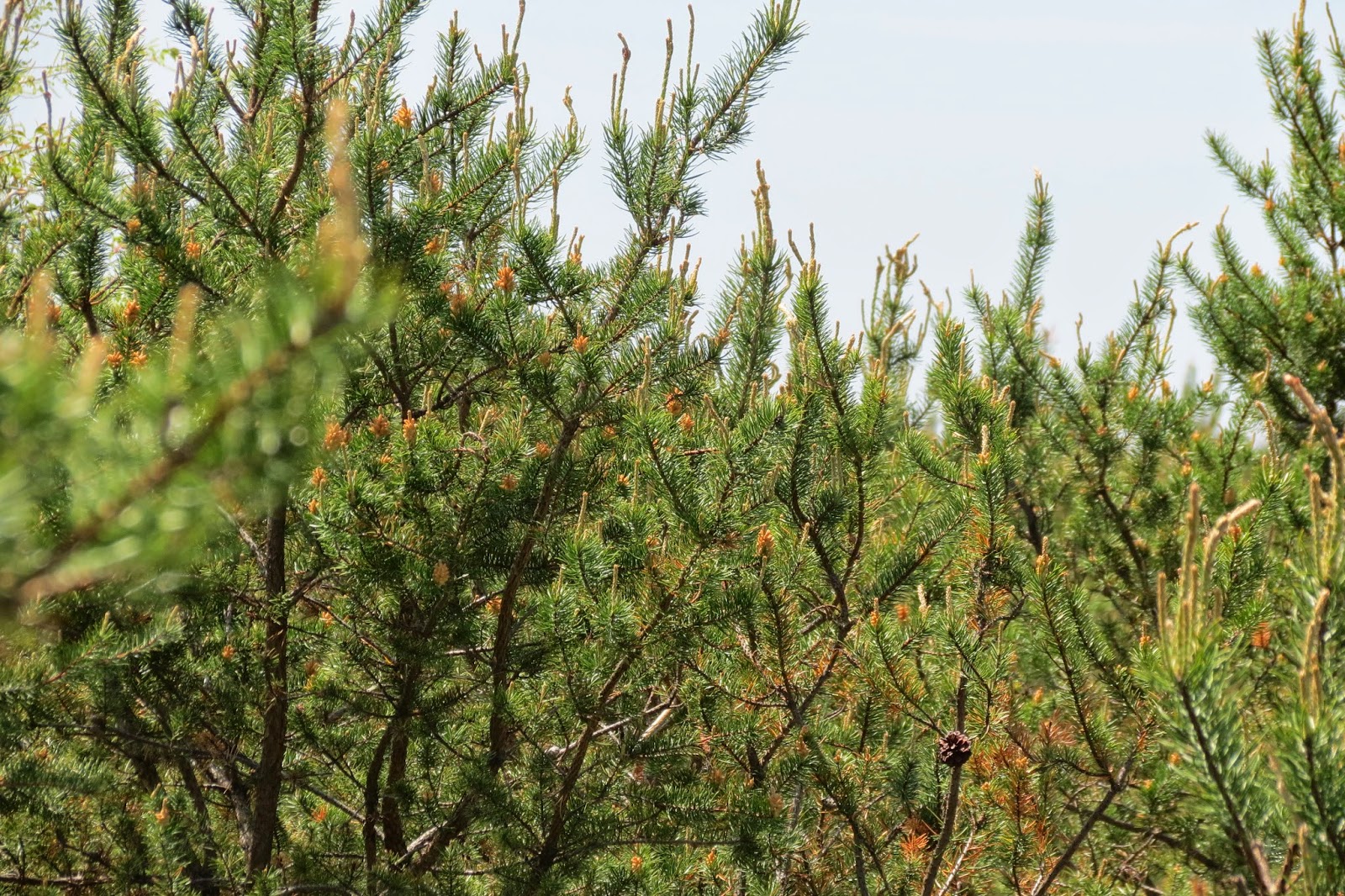
Jack pines, Pinus banksiana provide the perfect camouflage for Kirtland's Warblers.  The fresh growth, or candles, have a distinctive yellow color- very similar to the Kirtland's belly.  Conifers are wind pollinated and many of our trees were also loaded with pollen ready to start the new generations of cones. (photo left)

The cones (center of photo on right) are blueish-gray and I noted them to be an uncanny match for the textured blue-gray plumage on the Kirtland's back.  They were devilishly hard to spot with all these distractions built into the landscape.


 Imagine peering into this wall of green, while warblers pop about, often calling from mid-bush or from the ground.  We arrived when it was unseasonably hot and windy, and the birds were not making it easy to get satisfying looks.  Eventually we got our film and photos.


Occasionally a Kirtland's Warbler would land in the larger oak trees, to glean larvae and bugs from the unfurling leaves.  One of the park naturalists believed she saw the birds eating black-flies.  If that is the case, I can attest, they have tapped into a potentially endless supply of food!  Later in the summer, Kirtland's will also feed upon the blueberries which grow throughout these acidic pine forests. 

Cheryl Harner models her birding burka.
Each of the pine forests seemed to have its own version of biodiversity. One had small, annoying insects that hummed and buzzed about our ears and eyes. Once I looked though my camera screen only to note a swarm of insects. They were annoying but bearable.

Hartwick Forest featured mosquitoes, while another had black-flies in blood sucking swarms.  It didn't take long for me to adapt a scarf into what I dubbed my birding burka.  Sure I looked crazy with my head all wrapped up, but it gave the back of my neck and face an amazing amount of protection from insects. At one point all that remained visible was my binoculars. That's when I realized...


I probably looked like an Ewok. You know, the critters from Star Wars? These fellows would have been well-suited to life in the Jack Pine.  I bet they would like the blueberries!

Live trap and detention center for Cowbirds.
Back to conservation:
Reducing the population of the parasitic Cowbirds is another step the Michigan Department of Natural Resources and the U.S. Fish and Wildlife has taken to conserve these warblers.  Unfortunately, since there are no more herds of bison to follow across the Great Plains, the Cowbirds have become a bit of a pest. When all of Michigan was deeply forested, with no fragmentation (caused by roads, farms, logging operations and urbanization), the warblers stood a chance.  In order maximize the warblers' recruitment,  now the Cowbirds must be managed.

Kirtland's Warblers are much more than another "pretty bird." Their life history and populations' struggle are intertwined with numerous species of plants, insects and other birds. To conserve a species we must first understand its total ecology before we can bring an order of balance back to nature.

Congratulations Michigan and thank you for the successful programs which conserve Kirtland's Warblers!

Sunday, June 8, 2014

On the Special K-bird Trail

Kirtland's Warbler. Sure everybody wants to see this gorgeous blue and yellow bird of the Michigan pines!  I have been fortunate to see a few in my days, but a recent trip to Michigan multiplied that number substantially. So here are the pro-tips for finding America's rarest warbler.

1.  Fly.  If it is an option I suggest flying to Michigan, as it saves a six hour car ride!  My favorite means of transportation is Annie Mae. We were there in a few short hours.


 2. Head N-W, as the Crow flies, or any bird for that matter, it is fairly short trip from Port Clinton, Ohio to Grayling, Michigan.  Grayling and Mio are ground-zero for the breeding grounds of Kirtland's Warblers.


Good-bye Port Clinton and Catawba Island!  This is the most scenic portion of the journey, as the next leg takes us on a course between Toledo, Ohio and Detroit. Michigan.  I wish I could have seen those areas pre-settlement.


3. Pines, now this is more like it.  We have now entered Michigan's land of the Kirtland's Warbler.  Even aged Jack Pine, Pinus banksiana forests are the only breeding sites for the ground nesting Kirtland's.  The preferred pine is young, between 6-12 years, for a prime canopy dense enough to hide the much-sought warbler.


4. Sand botany is a huge part of this Kirtland's equation.  The diminutive Jack Pine, often stunted in growth, grows in sandy regions. It rarely reaches 50 ft in height. It was once thought to poison the ground on which it grows, as few plants are found in conjunction with the pine.  However, we noted thick mats of Sand Cherry and Blueberries growing in abundance. Another plant species requires a disturbance to set-up shop in this dense eco-system. Bird-foot Violet, Viola pedata is only found growing in the middle of the sandy roads we traveled through the forests.

The leaves of Bird-foot Violet, Viola pedata.
 Aptly named, this unusual violet has leaves that resemble tiny bird's feet!


Bird-foot Violet is a favorite of Ohio's botanists, as we only find it in a few counties, predominately the sand barrens of the Oak Openings and in Scioto and Adams County.  

It is only fitting that a rare plant should point the way to one of American ornithologist's favorite birds- the Kirtland's Warbler!